


















Lesson 3 of 48 · Getting Started
How hard is your language? Hours, distance and honest estimates
What the FSI hour estimates really say, why language distance and writing systems change the time needed, and how to turn rough numbers into a realistic study plan.
Before you commit months of your life to a language, you should know roughly what you are signing up for. Two learners who study the same number of hours can end up far apart, because one chose Spanish and the other chose Korean, or because one practiced the right things. Researchers cannot give you a precise number of hours for your case, but they can give you a defensible range and tell you what moves it up or down.
The best-known source is a set of estimates from the Foreign Service Institute (FSI), the training school for United States diplomats. They are widely quoted, often wrongly. This lesson shows what they actually say, what makes a language "far" from yours, and how to build a plan on rough numbers without fooling yourself.
What you will learn
- What the FSI categories claim, for whom, and what they do not claim
- Which features make a language easier or harder for you in particular
- Why writing systems and cognates change your time budget
- How to convert hour estimates into a weekly schedule
Key terms
FSI categories: a grouping of languages by estimated learning time for native English speakers, from Category I (closest) to Category IV (most distant).
Language distance: how different a target language is from the languages you already know in sound, grammar, vocabulary and writing.
Cognate: a word in two languages with a shared origin and similar form and meaning, such as English animal and Spanish animal.
False friend: a word that looks like a word in your language but means something different, such as Spanish embarazada ("pregnant"), not "embarrassed."
Logographic script: a writing system where characters stand for words or meaningful parts, as in Chinese.
What the FSI estimates say
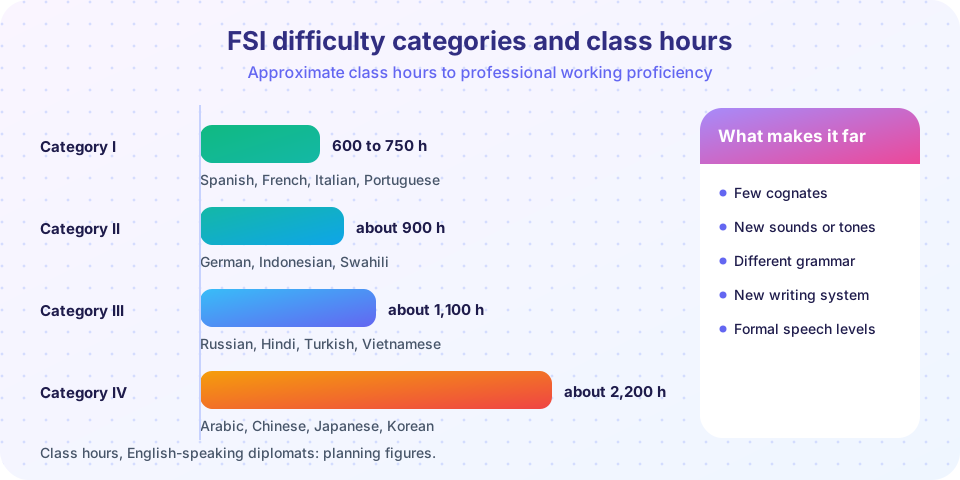
The FSI places languages in four categories for native English-speaking diplomats who study full time with trained instructors, in small classes, plus homework. The target is "professional working proficiency" in speaking and reading, a level roughly between B2 and C1 on the CEFR. The approximate figures commonly cited are:
| Category | Typical languages (examples) | Class hours (approx.) | Weeks (approx.) |
|---|---|---|---|
| I | Spanish, French, Italian, Portuguese, Dutch, Swedish | 600 to 750 | 24 to 30 |
| II | German, Indonesian, Swahili | about 900 | 36 |
| III | Many languages, e.g. Russian, Hindi, Turkish, Vietnamese | about 1,100 | 44 |
| IV | Arabic, Chinese, Japanese, Korean | about 2,200 | 88 |
The exact membership of the categories has changed over the years, so treat the examples as indicative. What stays stable is the shape: Category IV takes roughly three to four times as long as Category I.
Now the caveats, which are essential.
- The hours are class hours, not total hours. FSI students also do substantial self-study. Total time is often stated as about twice the class hours.
- The population is narrow. The students are adult, motivated, professionally selected, studying full time, with a clear job-related target. A part-time hobbyist will differ.
- The estimates are institutional, not experimental. They come from the school's long experience, not from a controlled study. They are useful planning figures, not scientific laws.
- They are about English speakers. A native Arabic speaker learning Hebrew faces a different distance from an English speaker.
- The target level matters. Reaching B1 takes much less than reaching B2/C1.
So use the numbers as order-of-magnitude guidance: hundreds of hours for the easiest targets, thousands for the hardest.
What makes a language "far" from yours
Language distance has several components, and your personal distance depends on every language you already know.
Vocabulary overlap. Cognates are a gift. An English speaker learning Spanish or French meets thousands of recognizable words, many from Latin. Learning German or Dutch gives fewer, but the common Germanic base still helps with everyday words. For Japanese or Korean the overlap is smaller, although modern loanwords from English (terebi, koohii) are numerous. Beware false friends: shared form with different meaning exists in every pair of languages.
Sound system. Sounds your own language lacks are hard to hear and produce. A speaker of Japanese struggles with the English r and l contrast; an English speaker struggles with Mandarin tones or Arabic pharyngeal sounds. Tonal languages add a whole dimension that non-tonal speakers must learn to hear. Chapter 4 covers this.
Grammar. Word order, case endings, gender, verb conjugation, honorifics and particles all take time. A language with many noun cases, like Russian or Finnish, loads memory with endings. A language with little inflection, like Mandarin or Indonesian, has simple grammar but moves complexity elsewhere (tones, measure words, context).
Writing system. A writing system that uses an alphabet you already read costs little. A new alphabet (Greek, Cyrillic, Hangul) takes days to weeks of focused practice. A logographic system takes years. Studies of reading in Chinese and Japanese describe thousands of characters needed for comfortable reading of ordinary text, which is a large part of why those languages sit in Category IV. Note that speaking Mandarin does not require characters at all, and many learners separate the two tracks.
Register and culture. Languages with formal and informal speech levels, such as Japanese and Korean, require you to choose forms in a way English does not.
Researchers have tried to put a number on this. Barry Chiswick and Paul Miller (2005) built a measure of linguistic distance from how English speakers scored on language tests after learning other languages, and found that distance explained a lot of the variation in difficulty. You do not need their formula; you need to understand which of the five components costs you most.
Same hours, different results
Language distance is not the whole story. The following also change the hours you need, and some of them you control.
- Prior language learning. People who have learned a second language tend to learn a third faster, partly because they already know how to study.
- Quality of practice. Ten hours of listening with comprehension are worth more than ten hours of music playing in the background. The next chapters are about quality.
- Exposure outside study time. Living in the language community adds many hours of input per day, which is why immersion helps, but it helps only if you engage rather than retreat into your own language.
- Consistency. Regular short sessions beat rare marathons for memory (Chapter 3).
"The FSI says Spanish takes 24 weeks." It says about 24 to 30 weeks of full-time instruction for professionals, in a classroom with teachers. If you study 30 minutes a day, the same hours stretch over years.
"Hard languages are impossible." They are longer, not impossible. Millions of adults learn Japanese, Arabic and Mandarin every year. The only question is whether your goal fits your time.
From hours to a schedule
Suppose your target is B1-level conversation in a Category I language. You might budget around 400 to 500 hours of total learning time. If you can spend 7 hours a week, that is roughly 60 to 70 weeks. If you can spend 14 hours, half that. For a Category IV language, the same target is perhaps two to three times as many hours.
These figures are guesses with wide error bars. The right use of an estimate is to catch impossible plans ("fluent in Japanese in three months, 20 minutes a day") and to choose a pace you can keep. You will check your progress against tasks (lesson 2), not against the calendar.
Try it
The first demonstration turns hours into calendar time, plotting how long each FSI category takes at different weekly study loads. The hours are rough planning numbers.
Press Run (or Ctrl + Enter) to see the result here.
Program input · what you'd type while the program runs
Type the answers before you press Run, one per line. Each time the program reads a line (with input()), it gets the next line from this box.
The second demonstration measures visible similarity between word pairs, using a simple edit distance. It is a toy that shows why cognates are easier to learn, not a measure of true relatedness. Words are written in the Latin alphabet; the Japanese ones are transliterations.
Press Run (or Ctrl + Enter) to see the console output here.
No output.
Check your understanding
Quick check · 4 questions
of 4 answered You scored / 4 · perfect!
-
1. The FSI hour estimates are best described as
They come from the school's experience with a narrow, motivated group, so they are order-of-magnitude guidance. -
2. Which factor does NOT directly change the time a language takes you?
Vocabulary overlap, writing system and similar factors affect difficulty; the textbook colour does not. -
3. A 'false friend' is
False friends share form but not meaning, such as Spanish embarazada and English embarrassed. -
4. If the FSI says about 600 to 750 class hours for Spanish, a hobbyist studying 3 hours a week should expect
Hours divided by weekly time gives the calendar: hundreds of hours at 3 per week stretch over years.
Summary
- The FSI groups languages into four categories for English speakers; the extremes differ by roughly a factor of three to four.
- The figures are class hours for full-time professional students, so they are rough guides, not laws.
- Distance has five parts: vocabulary, sounds, grammar, writing system and register.
- Prior learning, quality of practice, exposure and consistency change your actual time.
- Use estimates to catch unrealistic plans, then judge progress against tasks.
Track your progress
Create a free account to tick off lessons and pick up where you left off on any device.
of How to Learn a Language lessons completed