


















Lesson 41 of 48 · Plans, Tools and Projects
Chapter review: Plans, tools and motivation
A recap of CEFR goals, hour estimates, tool evaluation and habit research, a one-page plan template and a ten-question quiz.
This chapter turned research into a plan. You learned what CEFR levels and hour estimates can and cannot tell you, how to judge tools by the job they do, and how motivation and habits work. The aim of the chapter is simple: a plan you can keep for months.
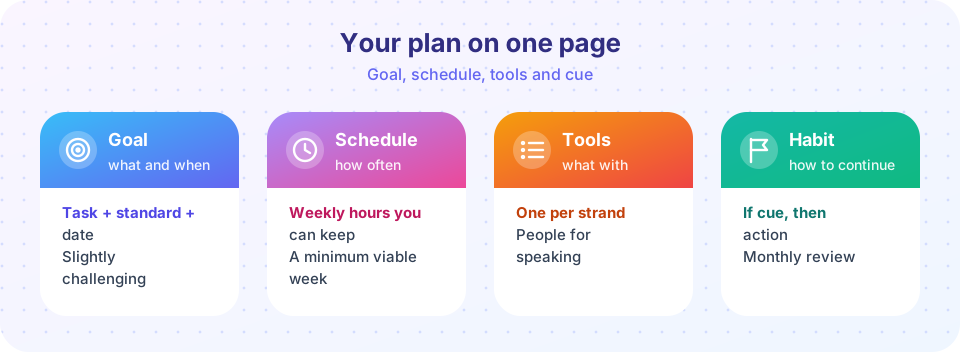
What you will learn
- The chapter's key points in one table.
- How to fill in a one-page plan.
- A self-check quiz.
Recap
| Topic | Key point | Lesson |
|---|---|---|
| Levels | CEFR describes what you can do at A1 to C2 | Goals and time |
| Hours | Cambridge and FSI figures are class-hour ranges, not promises | Goals and time |
| Goals | Specific: a task, a standard, a date; work backward | Goals and time |
| Tools | Judge by job, real use, adaptation, feedback, stickiness | Tools and apps |
| App evidence | Limited, often company-funded; strongest for vocabulary | Tools and apps |
| Motivation | Ideal L2 self, autonomy, competence, relatedness | Motivation and habits |
| Habits | Median about 66 days; one missed day matters little | Motivation and habits |
Build your one-page plan
Press Run (or Ctrl + Enter) to see the console output here.
No output.
Worked example: a filled-in plan
Here is a one-page plan for an imaginary learner, Tomás, who works full time and wants to hold simple conversations on vacation in six months.
- Goal: By 15 September, order a meal, ask for directions and chat for five minutes with a local about my family, understanding most replies.
- Schedule: 4 hours a week: four sessions of 30 minutes on weekdays (vocabulary, reading, listening, writing) and one 60-minute weekend session. Minimum viable week: three 15-minute sessions.
- Tools: a spaced repetition deck for words from lessons; one graded reader at a time; a weekly 30-minute tutor session (output and feedback); one podcast for the commute (input).
- Habit cues: If I finish breakfast, then I review ten cards. If I sit on the train, then I play the podcast. On Sunday at 10, tutor session.
- Reviews: Day 30, 60, 90: record a one-minute talk, rate four skills, adjust.
Check the plan against the chapter. Is the goal specific? Yes: task, standard and date. Is the weekly time realistic and protected by a minimum? Yes. Does the plan cover all four strands? Input (reader, podcast), output (tutor, writing), study (cards) and, since fluency is missing, he should add ten minutes of shadowing or retelling. That is exactly the sort of fix a review should find.
What to check at the end of month one
- Did you do at least two thirds of the planned sessions? If not, reduce the plan.
- Can you do one thing you could not do on day 0? Compare your recordings.
- Which strand has the fewest minutes? Move 10 percent of your time there.
- Are you enjoying at least some of it? If not, change the material or the format before you change the goal.
- What is one measure you will keep tracking for the next month?
The chapter's evidence in brief
The CEFR gives a language for goals, and the Cambridge and FSI figures give rough hour benchmarks that are classroom averages, not guarantees. Spacing practice improves retention (Cepeda and colleagues). App research is thin and sometimes company-funded, but spaced repetition itself has strong support. Same-language subtitles help adaptation to an accent more than first-language subtitles (Mitterer and McQueen). Motivation is supported by autonomy, competence and relatedness, and by a vivid ideal L2 self (Dörnyei). Habits typically take weeks to months, with a median near 66 days in one study, and a single missed day makes little difference (Lally and colleagues). If-then plans improve follow-through (Gollwitzer and Sheeran).
Check your understanding
Quick check · 10 questions
of 10 answered You scored / 10 · perfect!
-
1. What does the CEFR describe?
The CEFR is a framework of can-do descriptors. -
2. Which is a caveat for FSI hour estimates?
The estimates are rough and describe a demanding goal in an organized program. -
3. What are the three parts of a specific goal?
A task, a standard and a deadline make it specific. -
4. Why is spaced practice recommended over cramming?
Spacing generally gives better long-term retention. -
5. What is a limitation of the Duolingo effectiveness study by Vesselinov and Grego (2012)?
Funding source and attrition limit the conclusions. -
6. What did Mitterer and McQueen (2009) find about subtitles?
Same-language subtitles helped adaptation to an unfamiliar accent. -
7. What was the median time to habit plateau in Lally et al. (2010)?
The median was about 66 days, ranging from 18 to 254. -
8. Which is an if-then plan?
It links a cue to an action. -
9. What are the needs in self-determination theory?
These needs support motivation. -
10. A plan with only apps and flashcards is most likely missing which strand?
Apps and flashcards mostly cover study and some input; speaking and writing output often need people or deliberate tasks.
Summary
- Set a specific goal with a task, standard and date, and plan weekly hours.
- Choose a small set of tools that covers all four strands.
- Expect motivation to fluctuate and habits to take weeks to months.
- Use if-then cues, tiny minimums and monthly reviews.
Track your progress
Create a free account to tick off lessons and pick up where you left off on any device.
of How to Learn a Language lessons completed