


















Lesson 14 of 48 · Vocabulary and Spaced Repetition
Retrieval practice: the testing effect and better flashcards
Why testing yourself beats rereading, what Roediger and Karpicke found, how to build flashcards that work, and how to spot the illusion of knowing.
Most people study by looking: they reread a chapter, review a word list, watch a video again. It feels productive. The material looks familiar, and familiarity feels like knowledge. Research on memory says this feeling is misleading. The strongest way to build a lasting memory is not to look at the answer again but to try to produce it from memory, even if you fail.
This is called retrieval practice, and its effect on learning is called the testing effect. It is the second pillar, with spacing, of every good vocabulary method. This lesson explains the evidence, shows how to build flashcards that use it, and warns about the illusions that keep people studying the wrong way.
What you will learn
- What the testing effect is and the key experiments behind it
- Why retrieval works and why rereading feels better than it is
- How to make flashcards that follow the evidence
- How to check your own confidence against your actual recall
Key terms
Retrieval practice: bringing information to mind from memory, as in answering a question or recalling a word.
Testing effect: the finding that retrieving information produces better later memory than restudying it for the same time.
Desirable difficulties: Robert Bjork's term for conditions that make learning feel harder but improve long-term retention, such as spacing and retrieval.
Illusion of competence: feeling that you know something because it looks familiar, when you could not recall it unaided.
Feedback: showing the correct answer after an attempt.
The experiments
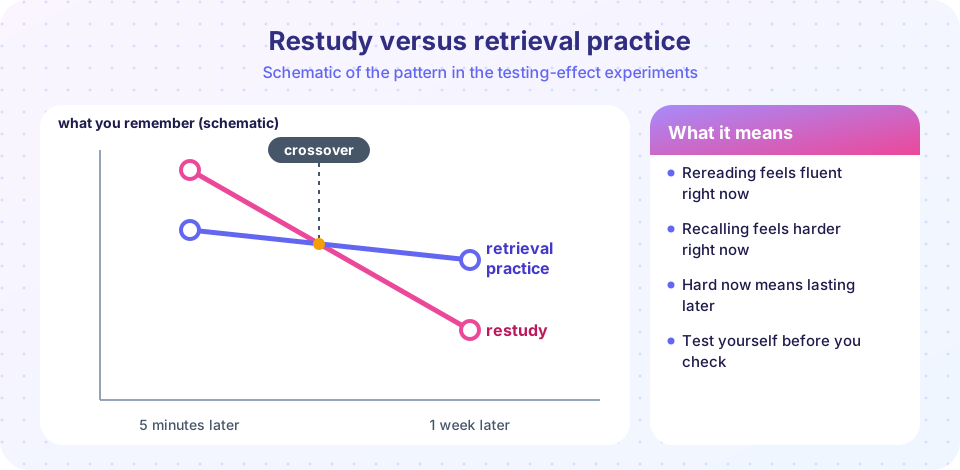
Roediger and Karpicke (2006). Students read short prose passages. Some studied them again (restudy), and some took a recall test on them, with no feedback. A few minutes later, the restudy group did better, which matches what most students expect. But when memory was tested a week later, the group that had been tested remembered more. The groups swapped places, with retrieval practice giving the long-term advantage even though it had felt harder and produced worse results in the short term. The same pattern appeared in many later studies.
Karpicke and Roediger (2008). In a study published in Science, students learned Swahili-English word pairs. After a pair was correctly recalled once, some students dropped it from further study, and others kept practicing it. The key finding was that continuing to retrieve the pairs mattered a great deal: students who kept retrieving recalled more than twice as many words a week later as students who dropped the pairs after one success. Repeated study after the first success added little. This is a major point for flashcard users: dropping a word as soon as you get it right once is too early.
Karpicke and Blunt (2011). Students studied science texts. Retrieval practice (writing what they remembered) beat a popular study method, concept mapping, on a later test, including on questions that required inference, not just facts.
Dunlosky and colleagues (2013). In a major review of ten study techniques, practice testing and distributed practice were the two rated as having high utility. Highlighting and rereading were rated low.
Why does retrieval work?
Several accounts exist and probably combine.
- Effortful retrieval strengthens the memory trace. Each successful recall makes the next one easier and builds more routes to the item.
- It reveals what you do not know. A failed attempt shows exactly where the gap is, and is followed by more attention to the answer.
- Recall practice matches the final task. You will need to retrieve words in conversation, so practice at retrieving transfers better than practice at recognizing.
- Even failures help. When people try and fail to recall an answer and then see it, they often remember it better than if they had only studied it (Kornell, Hays and Bjork, 2009). The condition is feedback right after the attempt.
Retrieval does not mean testing for a grade. It means any activity that makes you pull the answer from memory: flashcards, covering a vocabulary list and writing the words, retelling a story, or answering questions at the end of a chapter.
The illusion of knowing
If retrieval works so well, why do students prefer rereading? Because rereading makes material feel fluent. When you see a word again, you recognize it instantly and conclude that you know it. But recognition with the answer in front of you is easy. Recalling it without the answer is hard. Surveys by Karpicke, Butler and Roediger (2009) found that most students use rereading as their main strategy, and that few use self-testing.
This is the illusion of competence. A practical cure is calibration: before testing yourself, predict your score, then compare it with the actual score. Learners are typically too confident, and seeing the gap changes how they study.
"If I recognize it, I know it." Recognition is much easier than recall. A flashcard that shows both sides before you try tests recognition at best.
"Retrieval practice means constant exams." It means low-stakes recall attempts for learning. Make them frequent and private, and use mistakes as information.
"The testing effect has been proven for every kind of learning." It is strongly supported for facts and vocabulary and well supported for texts; for complex skills, practice must also be varied and realistic. Effects are smaller for very easy material.
Building flashcards that use the evidence
- Recall before you flip. Say or write the answer first. A card you only look at is a reread.
- Prefer production direction for words you need to use. Cue with the meaning or a picture and recall the word. Studies by Stuart Webb and others suggest that productive practice builds recognition too, while receptive-only practice builds production less, though results depend on how knowledge is tested.
- Keep cards small. Piotr Woźniak's "minimum information principle" says each card should test one fact. A card with five answers is hard to grade honestly.
- Use a sentence for context. A word in a short sentence preserves collocation and grammar. A cloze card ("Ella ___ a la tienda") teaches the form along with the meaning. There is no strong evidence that sentence cards beat word cards for speed, but they teach more.
- Add audio. Hearing the word links form to sound, which supports listening later.
- Consider a mnemonic for stubborn words. The keyword method links a new word to a similar-sounding word you know in a vivid image. Richard Atkinson and Michael Raugh (1975) found it helped learners of Russian vocabulary greatly in the short term. Later studies found the benefits less certain over long delays and for abstract words, so use it for the few words that resist normal review, not for everything.
- Review with feedback. After you answer, look at the correct card, whether you were right or wrong.
- Do not drop words after one success. Let the spacing schedule do its work.
The method is therefore: spaced and retrieval-based, with context and small cards.
Try it
The first demonstration is a typed-recall trainer. It asks you to produce the Spanish word from the English cue, then shows feedback. Accents are ignored in matching. Nothing is saved.
The second demonstration checks your calibration. Enter how many words you predicted you would recall and how many you actually did over several sessions. It reports whether you tend to be overconfident.
Press Run (or Ctrl + Enter) to see the console output here.
No output.
Check your understanding
Quick check · 5 questions
of 5 answered You scored / 5 · perfect!
-
1. In Roediger and Karpicke's (2006) experiments, what happened on the test a week later?
Restudy won at five minutes, but retrieval practice produced better memory after a week. -
2. Karpicke and Roediger (2008) found that students who dropped Swahili pairs after one correct recall
Continued retrieval produced far better delayed recall than dropping items early. -
3. What is the best first step on a flashcard?
The recall attempt is the active ingredient; flipping first turns the card into a reread. -
4. The illusion of competence is
Familiarity from rereading feels like knowledge but does not guarantee unaided recall. -
5. Which is a good flashcard principle?
Small cards are easier to grade honestly, and context preserves grammar and collocation.
Summary
- Retrieving information strengthens memory more than restudying it, especially after a delay.
- Keep retrieving items after your first success; dropping them early loses much of the benefit.
- Recognition feels like knowledge, so predict your score and test it to calibrate.
- Good cards are small, retrieved before flipping, given context and spaced out.
- Mnemonics such as the keyword method suit a few hard words, not the whole deck.
Next: Choosing words to learn
Track your progress
Create a free account to tick off lessons and pick up where you left off on any device.
of How to Learn a Language lessons completed