


















Lesson 42 of 48 · Projects and Practice
Chapter overview: Projects and practice
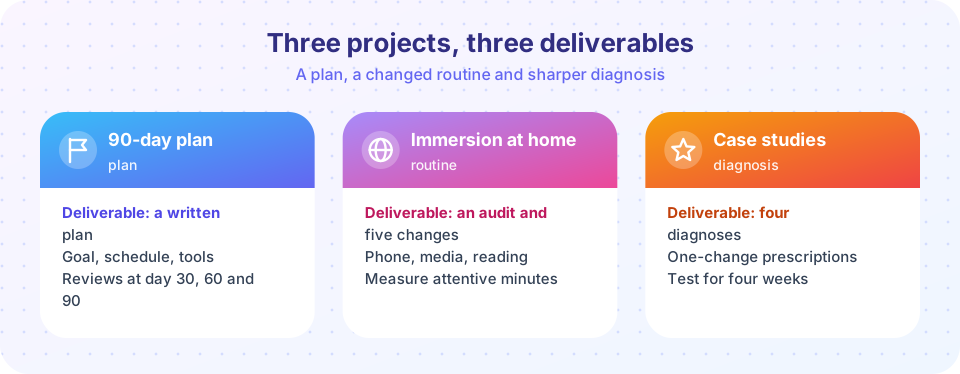
Put the research into action with a 90-day plan, an immersion-at-home project and case studies of learners with different problems, plus a glossary and cheat sheet.
Knowing how language learning works is not the same as learning. This chapter is where you do something with what you know. You will build a 90-day plan, redesign your daily life to include more of the language, and practice diagnosing the problems of imaginary learners, which is an excellent way to see your own problems more clearly.
The chapter ends with three reference lessons: a glossary of the terms used in this course, a one-page cheat sheet, and a guide to further study, including how this course connects to other parts of this site.
What you will learn
- What each project in this chapter asks you to produce.
- Which one to start with, depending on your situation.
- How the reference lessons help you review.
Key terms
Deliverable: a concrete thing you finish, such as a written plan.
Immersion at home: arranging your daily environment so that you meet and use the language regularly without traveling.
Case study: an example of a learner's situation used to practice diagnosis.
Retrospective: a short look back at what worked and what did not.
The projects
| Lesson | Deliverable | Time |
|---|---|---|
| 90-day plan | A written plan with goal, weekly schedule, tools and review dates | 1 to 2 hours to write |
| Immersion at home | An audit of your day and five changes | 1 hour, then daily |
| Case studies | Diagnoses and prescriptions for four learners | 1 hour |
| Glossary | A reference of terms | as needed |
| Cheat sheet | A one-page summary | 10 minutes |
| Further study | Where to go next | 15 minutes |
Where to start
Press Run (or Ctrl + Enter) to see the console output here.
No output.
Make a plan
Change your day
Diagnose
How to use these projects
Treat each project as a short experiment with a result you can look at, rather than a reading assignment.
Time-box them. The 90-day plan should take an hour or two to write. If you are still writing after a whole evening, you are perfecting, not planning. The immersion audit takes an hour; the rest is a daily habit.
Keep a learning journal. A single page per week is enough: what you did, how many minutes, one thing that worked, one thing that did not. A journal turns your own experience into data you can reflect on at the reviews. It also helps you notice progress, which tends to be invisible from day to day.
Share one project. Telling a friend, tutor or online group what your goal is makes it more real. Many learners find that a regular check-in with another person is the most dependable motivator available.
Revisit the research. When a project hits a snag, return to the relevant lesson. If your plan is not producing speaking, reread the chapter on speaking; if your reading is slow, reread the lesson on coverage. The projects are where the research meets your life, and each project is a chance to see which ideas matter most for you.
Common misconceptions
"Planning is procrastination." A plan is useful when it takes an hour and leads to action. A plan that takes a month is procrastination.
"I need a perfect plan." A good enough plan, reviewed monthly, beats a perfect one that never starts.
A note on honesty
Some of the projects will not go as planned. You may find that your day has almost no free minutes, that your first plan is too big, or that a case study seems to describe you uncomfortably well. That is useful information, not failure. The point of a project is to produce something you can test and improve. If a plan survives contact with real life for a month, even in a reduced form, you know more about how you learn than you did before, and that knowledge is what makes the next ninety days better than the first.
Check your understanding
Quick check · 3 questions
of 3 answered You scored / 3 · perfect!
-
1. What is immersion at home?
You change routines, media and tools to increase contact. -
2. Why practice with case studies?
Seeing patterns in others' situations helps you see your own. -
3. Which project fixes your goal and schedule?
The 90-day plan writes down goal, schedule, tools and reviews.
Summary
- The projects turn research into a plan, a changed routine and better diagnosis.
- Start with the 90-day plan unless you already have one.
- The glossary, cheat sheet and further-study guide support review and next steps.
Next: 90-day plan
Track your progress
Create a free account to tick off lessons and pick up where you left off on any device.
of How to Learn a Language lessons completed