


















Lesson 37 of 48 · Plans, Tools and Projects
Chapter overview: Plans, tools and motivation
How to turn what you know about learning into a realistic plan: goals and hours, choosing tools wisely, and keeping going when motivation dips.
You now know what the research says about vocabulary, listening, speaking, reading, writing and grammar. The remaining problem is practical: how do you fit all this into a life that already has work, family and a phone full of distractions? Most people do not fail at languages because they pick the wrong method. They fail because the plan does not survive the second month.
This chapter is about the plan. It covers realistic goals and the hours behind them, how to evaluate apps and tools without hype, and what motivation research says about habits that last.
What you will learn
- Why planning matters and what a good plan contains.
- The three topics of this chapter: goals and time, tools, motivation and habits.
- How to compute how long a goal takes at your weekly pace.
Key terms
CEFR: the Common European Framework of Reference for Languages, which describes six levels, A1 to C2.
Guided learning hours: teaching hours that exam providers use as rough estimates for reaching a level.
Implementation intention: a plan in the form "If situation X, then I will do Y".
Habit: an action triggered automatically by a cue.
A good plan has four parts
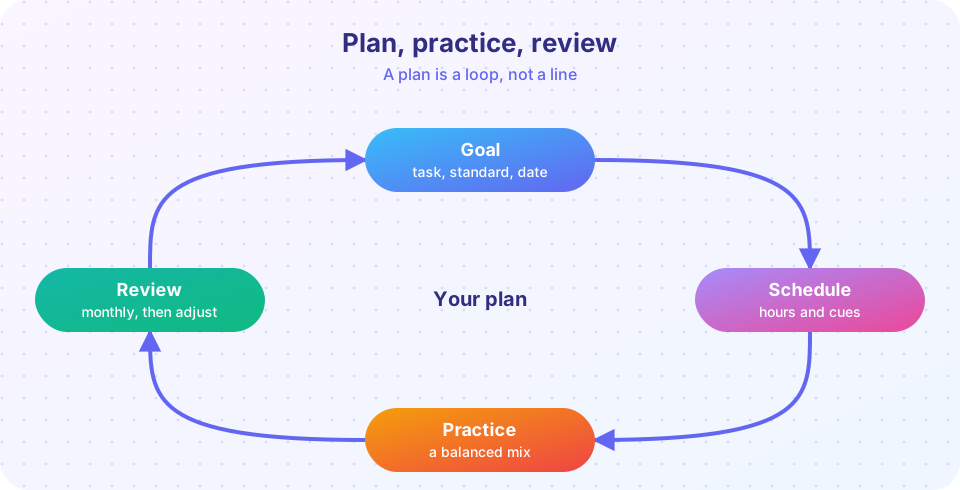
- A specific goal with a date, such as "hold a 10-minute conversation about my day by 1 June".
- A weekly time budget you can keep, such as 5 hours.
- A balanced mix of input, output, study and fluency work (the four strands from the fluency lesson).
- A review point every month, where you check progress and adjust.
You will find much more detail in the next lessons. For now, a quick calculation shows why the weekly pace is the number that matters.
Press Run (or Ctrl + Enter) to see the console output here.
No output.
What each lesson covers
| Lesson | Question |
|---|---|
| Goals and time | What level do I want, and how many hours does it take? |
| Tools and apps | How do I judge an app or resource? |
| Motivation and habits | How do I keep going? |
| Chapter review | Recap, a one-page plan and a quiz |
Plan the loop
Choose tools by job
Build habits
Why plans fail and how this chapter helps
Most abandoned plans fail for a small number of reasons, and each has a remedy in the lessons ahead.
| Why plans fail | What helps | Lesson |
|---|---|---|
| The goal is vague ("get better") | A task, a standard and a date | Goals and time |
| The schedule is too big for real life | A realistic weekly budget and a minimum viable week | Goals and time |
| The tools do one job and the plan needs four | Choose tools by job and check strand balance | Tools and apps |
| Motivation drops after the novelty wears off | Cues, tiny minimums, people and a vision of your future self | Motivation and habits |
| Nobody checks whether it is working | Monthly reviews with recordings and ratings | Chapter review |
The most important message of the chapter is that planning is a skill you improve by doing it. Your first plan will have mistakes. The goal is to make it small enough that you can see which parts work.
Common misconceptions
"A good method makes the hours unnecessary." Methods change efficiency, but time on task remains the main constraint.
"Motivation comes first, then action." Often action comes first. Starting small creates motivation.
"Apps alone are enough or useless." Evidence suggests they help with some jobs, such as vocabulary and listening basics, and not with others, such as interactive speaking.
Check your understanding
Quick check · 3 questions
of 3 answered You scored / 3 · perfect!
-
1. Which is a specific goal?
A specific goal has a clear behavior and a deadline. -
2. What is an implementation intention?
It links a cue to an action in advance. -
3. If a level needs 400 hours and you study 5 hours per week, about how many weeks does it take?
400 divided by 5 is 80 weeks.
Summary
- A plan has a specific goal, a weekly time budget, a balanced mix and a review point.
- Weekly pace is the key number for how long goals take.
- Tools and habits matter because plans fail through attrition, not method.
Next: Goals and time
Track your progress
Create a free account to tick off lessons and pick up where you left off on any device.
of How to Learn a Language lessons completed