


















Lesson 32 of 48 · Grammar Without Tears
Chapter overview: Grammar without tears
Why grammar is both necessary and overrated, what the explicit versus implicit debate is about, and a map of this chapter on patterns, chunks and learner errors.
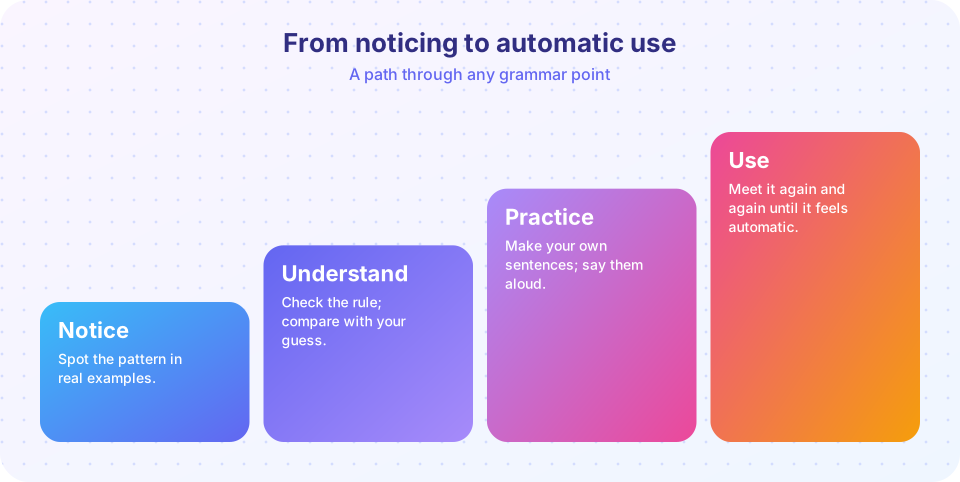
Grammar divides learners. Some love tables and rules and feel lost without them. Others have bad memories of conjugation drills and want to avoid grammar altogether. Research on second language acquisition does not support either extreme. It suggests that rules are useful for noticing and checking, but that using grammar fluently comes from meeting patterns again and again in meaningful contexts.
This chapter explains how to use grammar study without letting it take over your language time. It covers when explicit teaching helps, how chunks and patterns carry much of the grammar you use, and why learner errors follow a pattern that tells you something useful.
What you will learn
- What grammar study is good for and what it cannot do alone.
- The three big ideas of this chapter: explicit versus implicit learning, chunks, and interlanguage.
- A way to turn a rule into a pattern you can see.
Key terms
Explicit knowledge: knowledge you can state, such as a rule.
Implicit knowledge: knowledge that guides your language without your awareness of the rule.
Chunk: a group of words stored and used together, such as by the way.
Interlanguage: the learner's developing language system, which has its own rules.
What grammar is for
Grammar describes how words combine to carry meaning. Without it you can communicate with single words ("coffee, please") but struggle to say who did what to whom, when, and in what mood. It matters most for:
- Understanding. Word order, endings and small words can change meaning completely.
- Being understood. Systematic errors can confuse listeners and affect how you are perceived.
- Precision. The difference between "I have seen it" and "I saw it" in many languages is a grammar difference.
At the same time, many grammatical choices in everyday talk are prefabricated. You do not construct "How are you doing?" from rules each time. You retrieve it.
Three questions, three lessons
| Lesson | Question |
|---|---|
| Explicit and implicit learning | Does it help to learn rules, and how? |
| Patterns and chunks | How much of grammar is really stored phrases? |
| Errors and interlanguage | What do learner mistakes show, and how do you fix them? |
| Chapter review | Recap and a longer quiz |
Spot the pattern
Here is a quick discovery exercise. Read the output and work out the rule before reading the explanation.
Press Run (or Ctrl + Enter) to see the console output here.
No output.
Notice that you found the rule by seeing examples, and the rule then let you produce new forms. Both routes, from examples to rule and from rule to examples, are useful.
How to study this chapter
You can read the lessons in order, but it works well to treat them as three experiments. In the lesson on explicit and implicit learning, pick one grammar point and run the meet-notice-check-use routine on it for a week. In the lesson on chunks, collect ten frames with slots from something you read or heard. In the lesson on errors, start an error log from your own writing or speech and find your top two error types. By the end of the chapter you will have three small pieces of your own data. They are more convincing than any argument, including the ones in this course.
Common misconceptions
"Adults cannot learn grammar except by studying rules." Many adults pick up patterns from large amounts of input, though rules often speed things up.
"Knowing the rule means I can use it." Knowing a rule and applying it in speech are separate skills; the second needs practice.
"Grammar is the most important thing." It is one of several. Vocabulary often limits comprehension more than grammar does.
Check your understanding
Quick check · 3 questions
of 3 answered You scored / 3 · perfect!
-
1. What is a chunk?
Chunks such as 'by the way' are retrieved as wholes rather than built from rules. -
2. What is explicit knowledge?
Explicit knowledge is conscious and statable. -
3. What is interlanguage?
Learners' language is a system in its own right, not just a flawed copy of the target.
Summary
- Grammar helps understanding, being understood and precision, but it is not the whole language.
- Rules help you notice and check; fluent use comes from patterns met often.
- Much everyday language is made of chunks.
- Learner errors show a developing system worth studying.
Track your progress
Create a free account to tick off lessons and pick up where you left off on any device.
of How to Learn a Language lessons completed