


















Lesson 11 of 48 · How Languages Are Learned
Chapter 2 review: How languages are learned
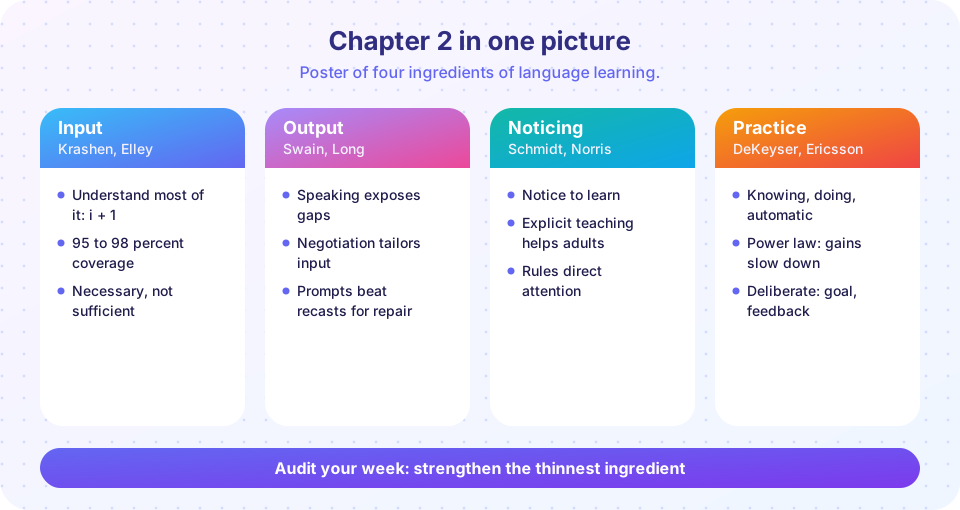
A one-picture recap of Chapter 2: comprehensible input, output and interaction, noticing, explicit knowledge and deliberate practice, with a table and a ten-question quiz.
Chapter 2 introduced four ingredients of language learning and the researchers who studied them. This review lines them up side by side, shows where the evidence is strong and where it is thin, and gives you a quiz. As always, try the questions before you read the table, then return in a few days to try again.
What you will learn
- A compact comparison of the four ingredients and their evidence
- Which ideas are strongly supported and which are contested
- How to turn the chapter into one habit for next week
Key terms
Comprehensible input: language you mostly understand, slightly above your level.
Pushed output: producing precise language rather than just getting by.
Noticing: consciously registering a form in the input.
Automaticity: fast, low-effort performance gained by practice.
Lexical coverage: the share of running words you know in a text.
The chapter in a table
| Ingredient | Key idea | Key names | Strength of evidence | Practical takeaway |
|---|---|---|---|---|
| Input | Understanding messages drives acquisition; 95 to 98 percent coverage is a useful range | Krashen; Elley and Mangubhai; Schmitt, Jiang and Grabe | Strong that input is necessary and helpful; weak that it is sufficient | Read and listen a lot at the right level |
| Output and interaction | Producing language forces grammar processing; negotiation gives tailored input and feedback | Swain; Long; Lyster and Ranta | Moderate to strong; the exact mechanism is debated | Speak and write, and get feedback |
| Noticing and explicit knowledge | Attention to forms matters; rules help through noticing | Schmidt; Norris and Ortega; Ellis; DeKeyser | Moderate to strong for explicit instruction, with testing caveats | Notice one feature at a time; use rules to direct attention |
| Practice | Skills become automatic through use; gains follow a power law | DeKeyser; Newell and Rosenbloom; Ericsson | Strong for the general shape; weak for exact hour counts | Deliberate, feedback-rich practice resembling real use |
Where the evidence is firm and where it is not
Firm: large amounts of meaningful input help; interaction beats no interaction; explicit teaching of specific forms helps adult learners; skills get faster with practice and gains slow as you improve.
Contested: how much of language is learned without any noticing; whether explicit knowledge becomes implicit; which type of corrective feedback is best; how far deliberate practice explains differences between learners; whether Krashen's acquisition-learning distinction is useful at all.
Missing or weak: controlled long-term studies of adult self-learners, which are hard to run. Many results come from classrooms and university students over weeks, so use them as guidance.
"The input hypothesis is dead." The strong version (input alone is enough) is not supported. The weaker version (comprehensible input is essential and underused) is widely accepted.
"Output is just for testing." Swain's work and the interaction research show that output can create learning by forcing you to process grammar and receive feedback.
"If one study says X, X is true." Many classic findings come from small samples. Look for meta-analyses and replications.
One habit for next week
Use the audit from the chapter overview. Pick the ingredient where you spent the fewest minutes last week and add 60 minutes to it. If input was thin, add a graded reader. If output was thin, book a conversation or write daily. If noticing was thin, keep a notebook. If practice was thin, set up a weekly recorded retelling.
Try it
The first demonstration turns the chapter into flashcards. Try to answer aloud before you flip.
The second demonstration generates a one-week practice plan for the ingredient you choose. The minutes are an example of the idea, not a prescription.
Press Run (or Ctrl + Enter) to see the console output here.
No output.
Check your understanding
Quick check · 10 questions
of 10 answered You scored / 10 · perfect!
-
1. At 98% lexical coverage, how many unknown words are in a 500-word text?
2% of 500 is 10. -
2. Which research finding motivated Swain's output hypothesis?
Large input did not secure accurate speech, so producing language seemed to add something. -
3. Negotiation of meaning refers to
Long argued that this repair work tailors input and provides feedback. -
4. Schmidt's diary study suggested that forms he used later were
Noticed forms appeared in his speech; many frequently heard but unnoticed forms did not. -
5. Which interface position says explicit knowledge helps indirectly by directing attention?
The weak interface view has the widest support. -
6. According to the power law of practice, to halve a response time you need
Time falls as a power of trial count, so equal improvements need ever more practice. -
7. Which is NOT a feature of deliberate practice?
Staying in the comfort zone is not deliberate practice. -
8. The 10,000-hour figure originally came from
Ericsson and colleagues' study of music students; it is an average in that sample, not a law. -
9. Which type of feedback often led to more self-correction in Lyster and Ranta's classrooms?
Prompts pushed learners to correct themselves more often than recasts. -
10. A learner only reads grammar books. Which ingredient is likely missing?
Books provide rules, but without input and output the loop cannot run.
Summary
- Four ingredients: input, output and interaction, noticing, and practice.
- Input is necessary but not sufficient; output, feedback and noticing add what input cannot.
- Explicit teaching helps adults; practice makes skills automatic with diminishing returns.
- Audit your week and strengthen the thinnest ingredient.
- Chapter 3 turns to the memory systems that hold vocabulary.
Track your progress
Create a free account to tick off lessons and pick up where you left off on any device.
of How to Learn a Language lessons completed