


















Lesson 46 of 48 · Projects and Practice
Glossary of language learning terms
A plain-English glossary of terms used in second language acquisition and in this course, from accuracy and chunks to spaced repetition and uptake.
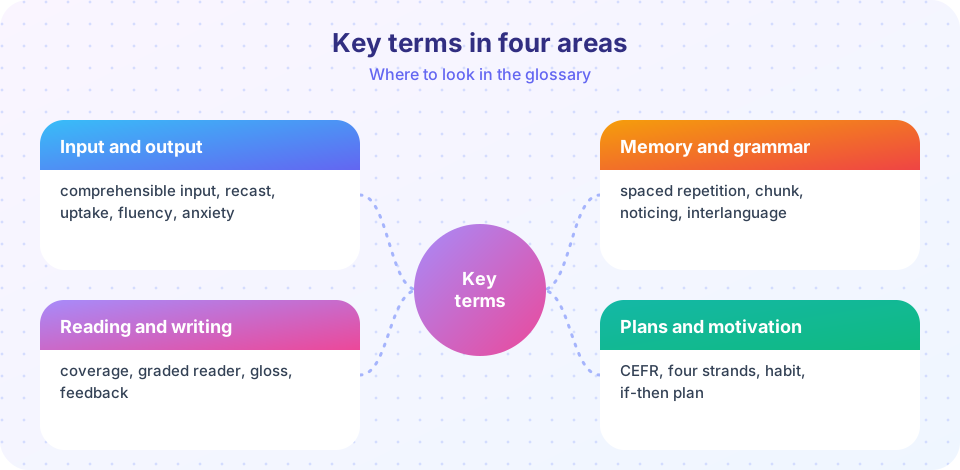
Language learning research has its own vocabulary, and the same word can mean different things in a classroom, a blog and a research paper. This glossary collects the terms used in this course, in plain English, with a pointer to where each idea appears. Use it as a reference while reading and when you meet unfamiliar words in articles and books about learning languages.
What you will learn
- The meaning of the main terms in this course.
- How terms relate to each other.
- How to look terms up quickly.
Input, output and interaction
| Term | Meaning |
|---|---|
| Comprehensible input | Language you mostly understand, with some new elements |
| Output | Language you produce, spoken or written |
| Pushed output | Production that demands more precision than you would use at ease |
| Interaction | Two-way communication in which speakers adjust to be understood |
| Negotiation of meaning | Repairing a breakdown by repeating, rephrasing or asking questions |
| Recast | A correct version of what a learner said, without explicit correction |
| Prompt | A cue that invites the learner to self-correct |
| Uptake | The learner's use of a corrected or new form after feedback |
| Circumlocution | Describing a missing word with words you know |
| Tandem learning | Two learners trading help in each other's languages |
Speaking, fluency and anxiety
| Term | Meaning |
|---|---|
| Fluency | Smooth, rapid speech with natural pauses |
| Accuracy | How closely speech matches standard forms |
| Complexity | Variety and elaboration of vocabulary and structures |
| Trade-off hypothesis | Limited attention means improving one aspect can cost another |
| Automatization | Practicing until use needs little conscious attention |
| 4/3/2 technique | Telling the same story three times with shrinking time |
| Foreign language anxiety | Worry specific to learning or using a language |
| Willingness to communicate | The readiness to start talking in a given situation |
Reading and writing
| Term | Meaning |
|---|---|
| Extensive reading | Reading a lot of easy text for volume and enjoyment |
| Intensive reading | Close study of a short text |
| Lexical coverage | Share of running words in a text that you know |
| Graded reader | A book written to a controlled vocabulary level |
| Word family | A base word with its inflected and derived forms |
| Gloss | A short meaning given beside a word in a text |
| Incidental learning | Learning words while doing something else |
| Written corrective feedback | Comments or corrections on writing |
| Direct feedback | The corrector writes the right form |
| Indirect feedback | The corrector marks the place or kind of error |
| Type-token ratio | Distinct words divided by total words |
Memory and practice
| Term | Meaning |
|---|---|
| Spaced repetition | Reviewing at increasing intervals |
| Retrieval practice | Recalling information rather than rereading |
| Forgetting curve | The pattern of memory loss over time, described by Ebbinghaus |
| Shadowing | Repeating audio a fraction of a second behind the speaker |
| Chunk (formulaic sequence) | A group of words stored and used as a unit |
| Collocation | Words that appear together more often than chance |
| Lexical bundle | A frequently recurring multi-word sequence |
Grammar and learner language
| Term | Meaning |
|---|---|
| Explicit knowledge | Knowledge you can state, such as a rule |
| Implicit knowledge | Knowledge that guides use without awareness |
| Noticing | Conscious attention to a feature of the input |
| Focus on form | Briefly drawing attention to form during meaning-based work |
| Interlanguage | The learner's evolving system with its own rules |
| Transfer | Carrying first-language patterns into the new language |
| Overgeneralization | Applying a rule too widely, as in goed |
| U-shaped development | Correct forms, then errors, then recovery |
| Fossilization | Persistence of an error despite exposure and correction |
| False friend | A word that looks like one in your language but means something else |
Plans, levels and motivation
| Term | Meaning |
|---|---|
| CEFR | The Common European Framework of Reference, with levels A1 to C2 |
| Can-do statement | A description of a task a learner can perform |
| Guided learning hours | Teaching hours used as rough estimates for reaching a level |
| FSI | The US Foreign Service Institute, source of widely quoted learning-time estimates |
| Four strands | Nation's balance of input, output, study and fluency |
| Ideal L2 self | The image of yourself as a successful language user |
| Implementation intention | An if-then plan linking a cue to an action |
| Habit | Behavior triggered by a cue with little thought |
| Minimum viable week | The smallest set of activities you will do in a bad week |
| Immersion | A setting where the language is used around you for real purposes |
Look up a term
Press Run (or Ctrl + Enter) to see the console output here.
No output.
You can extend the object with your own terms. Writing a definition in your own words is also good study.
How to use this glossary for study
A glossary is more useful as a tool than as a list to memorize. Here are three ways to use it.
Make your own definitions. Pick five terms you find confusing, and write a definition in your own words with an example from your own learning. Explaining an idea in your own words reveals whether you understand it, a version of the output hypothesis applied to ideas.
Compare neighbors. Many terms come in pairs or families: recast and prompt, explicit and implicit knowledge, extensive and intensive reading, fluency and accuracy. Write one sentence that says how each pair differs. If you cannot, reread the lesson.
Turn terms into questions. For each term ask, "What would I do differently if I took this seriously?" For example, "lexical coverage" suggests checking a text before reading; "implementation intention" suggests writing an if-then plan.
Remember that researchers sometimes use a term differently in different papers. When you read beyond this course, check each author's definition.
Common misconceptions
"Glossary terms are jargon with no use." Names help you search, compare and remember ideas. Use them when they help.
"One term has one meaning everywhere." Researchers sometimes define the same word differently. Check the definition in each source.
Check your understanding
Quick check · 5 questions
of 5 answered You scored / 5 · perfect!
-
1. What is a recast?
A recast reformulates the learner's utterance correctly. -
2. What does lexical coverage measure?
It is the percentage of words in a text you already know. -
3. What is implicit knowledge?
It shows up as a feeling that something sounds right. -
4. What is a false friend?
For example, Spanish embarazada means pregnant, not embarrassed. -
5. What is an implementation intention?
It links a specific cue to a specific action in advance.
Summary
- The glossary groups terms into input and output, speaking, reading and writing, memory, grammar and planning.
- Many terms have close neighbors; compare them, such as recast and prompt.
- Define terms in your own words to learn them.
Next: Cheat sheet
Track your progress
Create a free account to tick off lessons and pick up where you left off on any device.
of How to Learn a Language lessons completed