


















Lesson 27 of 48 · Reading and Writing
Chapter overview: Reading and writing
How reading builds vocabulary and writing builds precision, what research says about extensive reading and feedback, and a map of this chapter's lessons.
Reading and writing are the quietest ways to practice a language, and they are friendly to a busy schedule: no partner, no scheduling, no audience. They also work as a pair. Reading gives you the language; writing lets you test whether you can use it, at a speed that leaves time to think.
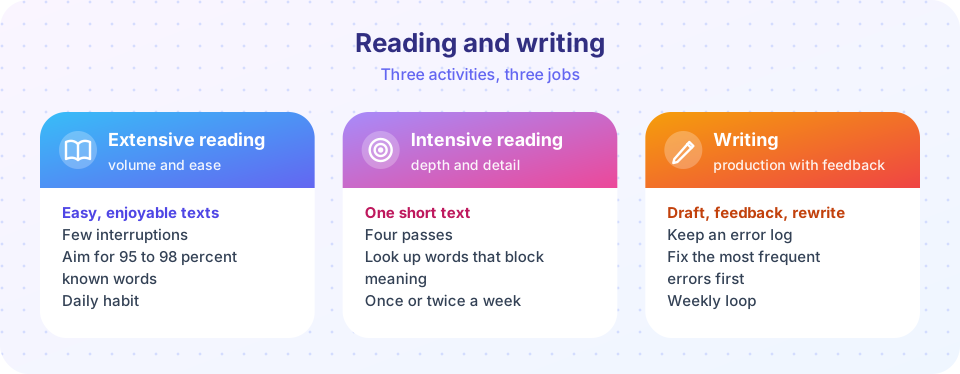
This chapter covers two kinds of reading, extensive (a lot of easy material for pleasure and volume) and intensive (slow, careful study of a text), and then writing, including the uncomfortable question of how much correction actually helps.
What you will learn
- Why reading is the most practical source of input for many learners.
- The difference between extensive and intensive reading, and when to use each.
- What writing adds that speaking cannot.
- How this chapter links to vocabulary and grammar.
Key terms
Extensive reading: reading a large amount of easy, enjoyable text with few interruptions.
Intensive reading: studying a short text closely, looking up words and analyzing structures.
Lexical coverage: the percentage of running words in a text that you know.
Written corrective feedback: comments or corrections on your writing.
Why reading is so useful
Reading is self-paced input. You can stop, reread, check a word and continue, which is impossible in live conversation. A well-chosen book can also expose you to far more words per hour than most conversations do, because written language uses a wider range of vocabulary.
Reading also feeds speaking and listening. Studies of vocabulary growth show that learners often meet most of their new words through reading, but only if they can already understand most of what they read. That condition is the key idea of the next lesson.
What writing adds
Writing slows production so that you can notice gaps and fix them. It leaves a record you can compare with a corrected version. And it lets you practice complexity, such as longer sentences and connectors, without time pressure. The cost is that feedback needs a reader.
A reading budget
Press Run (or Ctrl + Enter) to see the console output here.
No output.
Twenty minutes a day does add up, which is why habit matters more than session length.
What each lesson covers
| Lesson | What you will do |
|---|---|
| Extensive reading | Pick the right level and build reading volume |
| Intensive reading and tools | Study a text closely and use dictionaries wisely |
| Writing and feedback | Write regularly and use feedback well |
| Chapter review | Recap and quiz |
Reading gives you the language
Writing tests it
Mind the level
How to use this chapter
Start by checking your reading level with the page test described in the extensive reading lesson, because everything else depends on having texts you can understand. Then pick one reading habit and one writing habit to try for four weeks: for example, 15 minutes a day of easy reading and one 150-word text a week with feedback. As you read the lessons, adjust those habits using what you learn, and keep a short log of minutes, titles and words. A simple log is the best evidence you will have that your effort is paying off.
Common misconceptions
"Reading hard texts is the fastest way to learn." If you understand too little, you cannot guess new words from context and reading becomes decoding. Easier texts usually teach more.
"Writing without a teacher is pointless." You can learn from self-checking, rewriting after a break and comparing with model texts, though outside feedback adds value.
Check your understanding
Quick check · 3 questions
of 3 answered You scored / 3 · perfect!
-
1. What is extensive reading?
Extensive reading uses easy material, with few interruptions, to build volume and familiarity. -
2. Why does reading depend on how many words you already know?
Guessing from context needs high coverage of the surrounding words. -
3. What does writing give you that live speaking does not?
Writing slows production and leaves a record to review and correct.
Summary
- Reading provides self-paced input; writing provides self-paced output.
- Extensive and intensive reading do different jobs.
- Reading works best when you already know most of the words.
- Feedback makes writing more useful, but it is not the only source of learning.
Next: Extensive reading
Track your progress
Create a free account to tick off lessons and pick up where you left off on any device.
of How to Learn a Language lessons completed