


















Lesson 10 of 48 · How Languages Are Learned
Time and deliberate practice: how skills become automatic
How practice turns slow knowledge into fast skill: DeKeyser's stages, the power law of practice, deliberate practice, and why 10,000 hours is a myth for languages.
Understanding how a language works and being able to use it in real time are different achievements. You can know the rule for forming the past tense and still stumble over it in conversation, taking two seconds to retrieve each verb. Fluency is largely a matter of making knowledge fast, and the main tool for that is practice.
But "practice more" is poor advice. Some practice improves performance quickly, and some does almost nothing for years. This lesson explains how practice turns knowledge into skill, what the research on deliberate practice does and does not say, and how to design practice that is worth the hours.
What you will learn
- The three stages of skill acquisition and how they apply to language
- The power law of practice, and why progress feels slower over time
- What deliberate practice is, and what the 10,000-hour rule gets wrong
- How to turn the principles into a weekly practice routine
Key terms
Skill acquisition theory: the view that knowledge first stored as facts becomes procedural through use and automatic after extensive practice.
Automaticity: performing a task quickly, accurately and with little attention.
Power law of practice: the finding that performance improves with practice in a curve with rapid early gains and slower later gains.
Deliberate practice: effortful practice aimed at specific weaknesses, with feedback and repetition, as described by Anders Ericsson.
Transfer-appropriate practice: practice is most useful when it resembles the situation where you will use the skill.
Three stages from knowing to doing
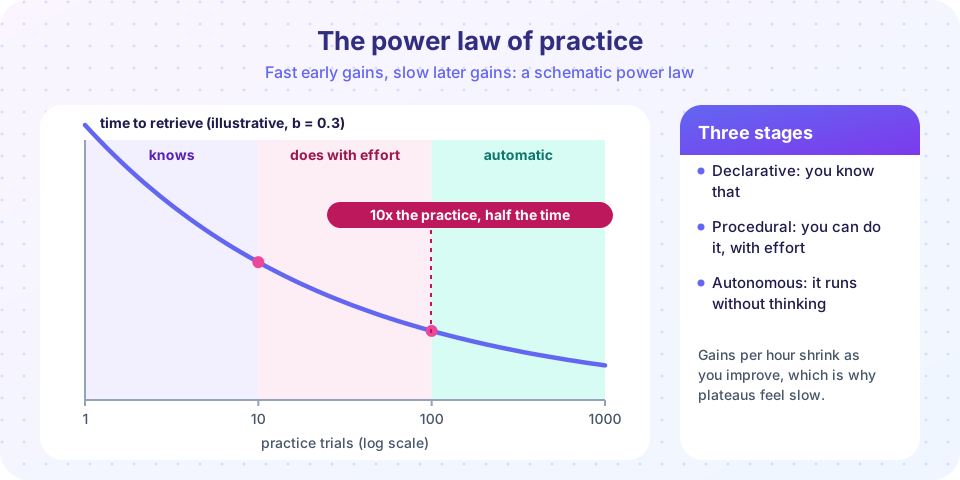
Paul Fitts and Michael Posner (1967) described three stages of learning motor and cognitive skills, and Robert DeKeyser (2007) adapted them to language.
- Declarative (cognitive) stage. You know that: the rule for the past tense, the word for "bread." Use is slow and effortful. You think each sentence through.
- Procedural (associative) stage. Through use, knowledge starts to run as procedures. Errors drop and speed increases, but you still have to attend to it.
- Autonomous stage. The skill runs with little conscious effort. You can chat and think about something else.
Different parts of language reach the third stage at different times. Common phrases do so early, rare constructions late. This also explains why advanced learners can sound fluent on familiar topics and halting on new ones.
The power law of practice
Allen Newell and Paul Rosenbloom (1981) analyzed learning curves across many tasks and found a consistent shape: the time to perform a task falls as a power law of the number of practice trials. In symbols, time = a x N^(-b), where N is the number of trials and b is a positive number, often between about 0.2 and 0.5 depending on the task.
Two consequences matter for learners.
- Early gains are fast. The first 20 hours bring a visible leap: you go from nothing to understanding simple sentences.
- Later gains are slow. To halve a response time, you must multiply the practice by a constant factor, not add a constant amount. If the exponent is 0.3, halving requires about ten times as many trials. This helps explain the intermediate plateau that many learners report: a long stretch where improvement is real but too slow to feel.
The power law is a statistical description of average curves for specific tasks, such as reaction times. Language learning as a whole is not one task, so use it as intuition, not as a forecast. The next demonstration lets you see the shape.
Practice should resemble use
DeKeyser's work stresses that skills are specific. Practice that builds the ability to recognize a verb form in reading does not automatically build the ability to produce it in speech. Studies of this kind of specificity suggest several points:
- Comprehension practice makes comprehension faster; speaking practice makes speaking faster. Each transfers only partly to the other.
- A learner who only does multiple-choice exercises gets good at multiple-choice exercises.
- The closer practice is to the real task (same speed, same pressure, same kind of material), the better it transfers.
So if your goal is conversation, much of your practice must be conversation-like, even though other activities support it.
Deliberate practice: what it is, and what it is not
Anders Ericsson, Ralf Krampe and Clemens Tesch-Römer (1993) studied violin students at a music academy in Berlin and found that the best players had accumulated more hours of solitary, goal-directed practice than less accomplished peers: on average about 10,000 hours by age 20 for the top group, in that sample. The popular "10,000-hour rule" grew from this, but it distorts the finding in three ways.
- The number is an average in one sample (violinists), not a threshold for any skill.
- The point was the kind of practice, not the total time. Ericsson's deliberate practice has four features: a clear goal, tasks that are challenging but achievable, immediate feedback, and repeated attempts with adjustments.
- Practice does not explain everything. A meta-analysis by Brooke Macnamara, David Hambrick and Frederick Oswald (2014) found that deliberate practice accounted for about a quarter of the variation in performance in games and about a fifth in music, but much less in education and almost nothing in some professional areas. Their analysis is itself debated, since definitions of deliberate practice vary, but it shows that practice is important and not the only factor.
How to apply this to languages:
| Feature | Example for a language learner |
|---|---|
| Clear goal | "Use the past perfect correctly in three sentences about my week" |
| Challenging but achievable | Slightly above your comfortable speed or vocabulary |
| Feedback | A tutor, a recording you check against a model, or a corrected text |
| Repetition with adjustment | Retell the same story three times, improving each time |
Language has an important complication: much of language use is meaningful communication, and exercise drills can feel artificial. The best language practice combines deliberate elements (target features, feedback) with meaningful tasks (real messages).
A practical technique: 4/3/2
Paul Nation and colleagues have long recommended fluency-building repetition. In the 4/3/2 technique (described by Maurice, 1983), a learner talks for four minutes on a topic to one partner, then repeats the same talk to a new partner in three minutes, then again in two. Because the content is fixed, attention goes to speed and ease of expression. Studies of the technique found that learners' speech became faster and smoother, with fewer hesitations, over the repetitions. You can imitate it alone with a timer and a recording.
"10,000 hours makes you fluent." The figure comes from violin practice, not languages, and describes an average in one sample. Language proficiency levels depend on target language, quality of practice and goals (see lesson 3 of Chapter 1).
"Any practice is good practice." Hours spent in the comfort zone, repeating what you already know, produce little. Mindless repetition without feedback can even fix errors in place.
"The plateau means I have stopped learning." Gains slow because of the power law. Measure progress against tasks over months, not days.
Designing a week
A simple template that follows the principles:
- One targeted feature per week (for example, past-tense forms or a set of 20 words in a topic).
- Three short deliberate sessions (20 to 30 minutes): produce the feature, get feedback, redo.
- Two fluency sessions: retell or speak at speed on familiar material, no stopping to correct.
- Plenty of input in between (Chapter 2, lesson 2).
- A weekly check: record yourself on the same task each Friday and compare.
Try it
The first demonstration plots the power law of practice with different exponents, so you can see why gains fade and what it takes to halve a response time. The values are illustrative, not measurements of any real learner.
Press Run (or Ctrl + Enter) to see the result here.
Program input · what you'd type while the program runs
Type the answers before you press Run, one per line. Each time the program reads a line (with input()), it gets the next line from this box.
The second demonstration reviews a practice log. Give each session a kind and see what share of your time is deliberate practice with feedback. The categories are a simple sorting tool, not a scientific measure.
Press Run (or Ctrl + Enter) to see the console output here.
No output.
Check your understanding
Quick check · 5 questions
of 5 answered You scored / 5 · perfect!
-
1. In skill acquisition theory, the autonomous stage means
At the autonomous stage the skill is automatic: it needs little attention. -
2. The power law of practice implies that, as practice grows,
Time falls as a power function of trials, giving large early gains and slower later ones. -
3. What is wrong with the claim '10,000 hours makes anyone fluent'?
The figure was an average for top violin students; Ericsson's point was the kind of practice, not a fixed number. -
4. Which is a feature of deliberate practice?
Clear goals, challenge, feedback and adjusted repetition define deliberate practice. -
5. In the 4/3/2 technique, why is the content kept the same across repetitions?
With content fixed, the learner can focus on fluency, producing the same message faster and with fewer pauses.
Summary
- Language skills move from declarative knowledge to procedural and then automatic use with practice.
- Improvement follows a power law: fast at first, then slowing, which explains plateaus.
- Practice transfers best when it resembles real use, so conversation practice builds conversation skills.
- Deliberate practice needs goals, challenge, feedback and repetition; 10,000 hours is a misreading.
- Combine one targeted feature per week with fluency repetition and plenty of input.
Next: Chapter 2 review
Track your progress
Create a free account to tick off lessons and pick up where you left off on any device.
of How to Learn a Language lessons completed