


















Lesson 30 of 48 · Reading and Writing
Writing practice and feedback: what actually helps
How to build a writing habit, why the correction debate (Truscott vs Ferris) is unsettled, and how to use feedback, error logs and rewriting to improve.
Writing is speaking in slow motion. You can reread what you wrote, replace a word and see the mistake you made two lines up. That is why it is a good place to test grammar you are not yet confident with, and why it is an excellent warm-up for conversation.
The central question for writers learning a language is feedback: does correcting a learner's errors help? The honest answer is that research found a surprising amount of disagreement, then gradually found that it usually does help, with plenty of conditions. This lesson explains the debate and then gives a practical writing routine that does not depend on perfect feedback.
What you will learn
- Why writing helps even without a teacher.
- The Truscott-Ferris debate and what later meta-analyses concluded.
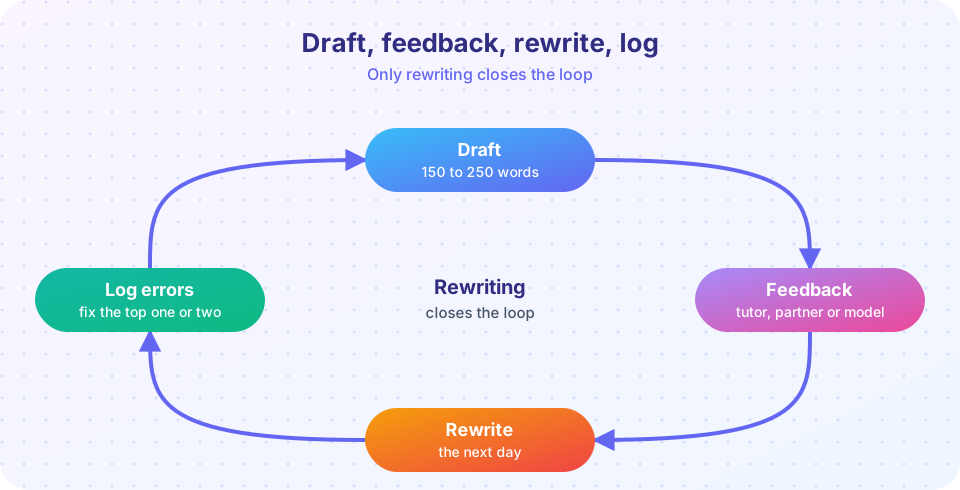
- How to make a draft, feedback, rewrite and log loop.
- How to track errors and choose what to fix first.
Key terms
Written corrective feedback (WCF): any response to a learner's writing that points out or fixes errors.
Direct feedback: the corrector writes the right form.
Indirect feedback: the corrector marks the place or the kind of error and the learner fixes it.
Focused feedback: correcting only one or a few error types.
Why write
Writing offers three benefits that speaking does not:
- Time. You can retrieve a word or a form slowly, which builds the connection.
- A record. You can compare drafts and see growth.
- Practice with complexity. Linking words, relative clauses and varied vocabulary are easier to try on paper.
It also trains skills for tests and real life: messages, emails and social posts. Many learners write more than they speak after the first year, so it deserves deliberate practice.
The great correction debate
In 1996, John Truscott published "The case against grammar correction in L2 writing classes", arguing that correction was ineffective and possibly harmful: it took time, it might raise anxiety, and learners could not apply corrections to new writing. Dana Ferris responded in 1999, pointing out that Truscott's claim was stronger than the evidence, because studies were few and learners generally wanted feedback.
Over the next two decades, researchers ran more careful studies. A meta-analysis by YouJin Kang and Zhaohong Han (2015) pooled many experiments and found that written corrective feedback had a positive effect on grammatical accuracy, with a medium-sized average. The effect was often larger for learners at higher proficiency, and for learners who wrote in a second-language setting. At the same time, benefits were typically measured on new writing close to the study and long-term evidence was thinner.
The current balanced position is:
- Correction can help, but it is not magic.
- It helps most when learners notice the correction and use it, for example by rewriting.
- Studies by John Bitchener and Ute Knoch used a single focused target such as English articles and found gains that lasted for weeks; broader corrections that tackle everything at once are harder to study and may overwhelm learners.
- Preferences differ: some learners value explicit corrections; others prefer hints.
Direct or indirect?
Direct feedback hands you the right form, which is fast and clear. Indirect feedback asks you to think, which takes effort and may build deeper learning. Research comparing them is mixed, and the best choice depends on the error type and your level: use indirect hints for slips you can fix, and direct feedback for forms you do not yet know.
A routine you can run alone
You do not need a teacher to use the principle behind feedback: notice, fix, repeat.
- Write 150 to 250 words on a simple topic, such as your day or a story, in 20 minutes. Do not use a dictionary during the first draft; mark gaps with a placeholder.
- Check gaps and doubts with a dictionary or grammar reference, then revise.
- Get feedback from a tutor, a language exchange partner or a learner community, or compare your text with a model text on the same topic.
- Rewrite the whole thing a day later. This is the step that closes the loop.
- Log your errors by category.
Press Run (or Ctrl + Enter) to see the result here.
Program input · what you'd type while the program runs
Type the answers before you press Run, one per line. Each time the program reads a line (with input()), it gets the next line from this box.
The data are invented. With real data you often find that two or three error types account for most mistakes, which makes them worthwhile targets. This follows the Pareto principle as a rule of thumb rather than a law.
Measuring your writing
Counting simple features can show growth, as long as you keep expectations modest. Average sentence length and vocabulary variety are two rough indicators.
Press Run (or Ctrl + Enter) to see the console output here.
No output.
These are rough measures. A longer sentence is not always better, and a high variety score can come from odd word choices. Use them to notice change, not to judge quality.
Other ways to practice writing
- Journaling. Write a few sentences each day, even if only three.
- Copying and shadow writing. Copy a short model text and then rewrite it from memory to learn how fluent writers connect ideas.
- Reformulation. Write a text, have it reformulated by a more proficient writer, and compare the two versions.
- Real audiences. Message a pen friend or post in a learner community. The pressure of real readers makes you care.
What good feedback looks like
Not all feedback is equally useful. Compare four responses to the same learner sentence, "Yesterday I go to the market and buy two apple."
| Type | Response | What the learner must do |
|---|---|---|
| Direct | "Yesterday I went to the market and bought two apples." | Compare and notice the differences |
| Indirect, marked | "Yesterday I go to the market and buy two apple." | Work out the correct forms |
| Indirect, coded | "Yesterday I go (tense) to the market and buy (tense) two apple (plural)." | Apply the rule behind each label |
| Reformulation | The writer's idea rewritten in natural English | Compare whole phrasing |
None of these is best everywhere. Direct feedback is fast and is useful for forms you cannot produce. Coded feedback asks for more thinking and often suits errors you know but forget. A reformulation shows how a fluent writer would say the whole idea, which can teach word choice and connectors that no error code covers.
Good feedback is also selective and explained. Ten corrections in one paragraph can feel like a wall. If you are working with a tutor, ask them to mark the two or three most important error types, and to give one sentence explaining each. If you are working alone, compare your text with a model on the same topic, and underline three phrases the model uses that you did not. Then use them in your rewrite.
Common misconceptions
"Corrections teach me by themselves." They help when you pay attention and use them, especially by rewriting.
"A perfect text means I have learned the grammar." You can write correctly with effort and still produce errors in speech.
"Longer sentences mean better writing." Clarity matters; build length only when it helps the message.
Check your understanding
Quick check · 5 questions
of 5 answered You scored / 5 · perfect!
-
1. What did Kang and Han's (2015) meta-analysis conclude about written corrective feedback?
They found a positive, medium-sized average effect, with conditions. -
2. What is indirect feedback?
Indirect feedback asks the learner to find and correct the problem. -
3. Which step of the routine closes the loop?
Rewriting makes you use the correction rather than merely read it. -
4. Why are Bitchener and Knoch's studies often cited?
Focused feedback on one structure produced measurable gains. -
5. What is a limit of the type-token ratio?
Longer texts repeat words more, so the ratio drops; compare texts of similar length.
Summary
- Writing offers time, a record and practice with complexity.
- Research moved from Truscott's skepticism to a positive but conditional view of corrective feedback.
- Feedback works best when you notice it and rewrite.
- Keep an error log and fix the most frequent errors first.
- Simple text measures can show growth but are not quality judgments.
Track your progress
Create a free account to tick off lessons and pick up where you left off on any device.
of How to Learn a Language lessons completed