


















Lesson 22 of 48 · Speaking and Conversation
Chapter overview: Speaking and conversation
Why speaking practice is the hardest skill to schedule, what research says about output, interaction and fluency, and a map of the four lessons in this chapter.
Speaking is the skill most learners want and the one they practice least. You can read for an hour on a train and listen to podcasts while you cook, but conversation needs another person, a free slot in both your calendars and the courage to sound clumsy out loud. This chapter is about solving that problem with evidence rather than slogans.
You will meet the research behind two questions. First, does producing language (not just hearing it) actually change what you learn? Second, what kind of speaking practice gives the most improvement per hour? The honest answers are "yes, in specific ways" and "it depends on how you practice, not only how much".
What you will learn
- Why speaking needs its own practice and does not appear automatically from listening and reading.
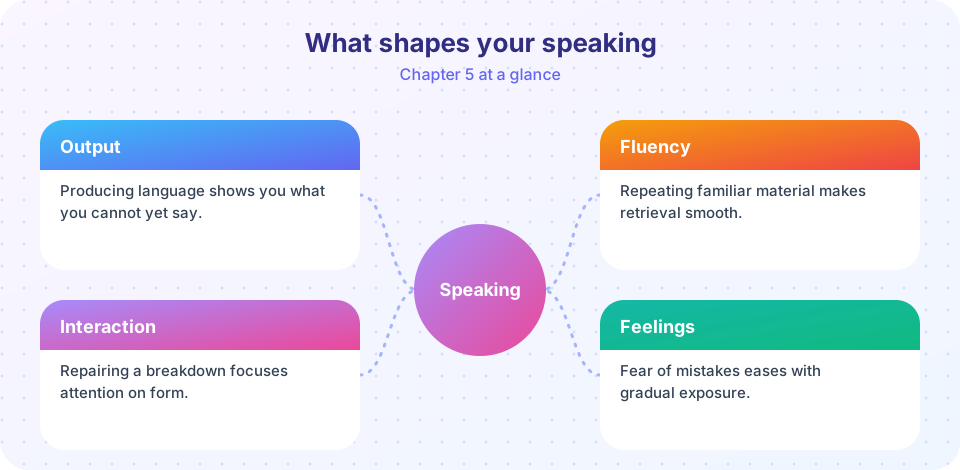
- The big ideas of the next three lessons: output, interaction, fluency and anxiety.
- How to estimate how many minutes you really speak in a week.
- How this chapter connects to vocabulary, listening and grammar.
Key terms
Output: language you produce yourself, spoken or written.
Interaction: two-way communication in which both people adjust to be understood.
Fluency: speaking smoothly and quickly enough for a listener to follow without long pauses.
Accuracy: how closely your sentences match the standard form of the language.
Why speaking needs its own practice
Understanding a sentence and producing it are different mental jobs. When you listen, context fills gaps: you can guess a word you have never learned from the topic, the speaker's face and the sentences around it. When you speak, nobody supplies the missing piece. You must choose a word, find its form, put it in order and say it, all within a second or two. Researchers call this retrieval under time pressure, and it improves mainly by being practiced under time pressure.
An early observation that shaped the field came from Canadian French immersion classrooms in the 1980s. Merrill Swain noticed that students who had spent years learning school subjects in French understood it very well yet spoke and wrote with persistent grammatical gaps. Years of input, she argued, were not enough: learners also needed to be pushed to produce language. Her idea became the output hypothesis, which you will study in the next lesson.
The speaking budget
Most learners overestimate their speaking time. Imagine a weekly one-hour group class with twelve students. If the teacher talks half the time and the rest is shared equally, each student speaks about two and a half minutes per class. Over a 30-week course that is roughly 75 minutes of speaking in total, which is about the length of a single movie.
Press Run (or Ctrl + Enter) to see the console output here.
No output.
The shares in the code are assumptions, not measurements. The point is the pattern: the format with the most "class time" is rarely the one with the most speaking time.
What each lesson covers
| Lesson | Question it answers |
|---|---|
| Output and interaction | Why does producing language matter, and what happens when a conversation breaks down? |
| Partners and tutors | How do you find speaking time, and how do you make each session productive? |
| Fluency and anxiety | How do you speak more smoothly, and what do you do about fear and mistakes? |
| Chapter review | A recap, a one-page picture and a longer quiz. |
Speaking is its own skill
Output pushes you
Interaction repairs
Practice smoothly
Common misconceptions
"I will start speaking when I know enough." Research on learner interaction suggests the opposite: speaking early reveals gaps that study alone hides, and anxiety usually shrinks with exposure rather than with extra preparation.
"Speaking practice means talking to natives." A patient fellow learner or tutor often gives you more useful speaking time than a busy native speaker who switches to your language.
Try it
Use the calculator above to find your current weekly speaking minutes. In the review lesson you will turn that number into a plan.
Check your understanding
Quick check · 4 questions
of 4 answered You scored / 4 · perfect!
-
1. Why can listening feel easier than speaking?
When you listen, topic, tone and surrounding words fill gaps. When you speak, you must supply every word and form yourself. -
2. Which idea came from Merrill Swain's work in French immersion classrooms?
Swain noticed that students with years of input still had gaps in production, which led to the output hypothesis. -
3. In a one-hour group class of twelve, about how long does each student speak if the teacher talks half the time and the rest is shared equally?
Thirty minutes shared among twelve students is about two and a half minutes each. -
4. Which statement about speaking practice is best supported by this chapter's approach?
Speaking time is usually lower than people think, so measuring it is the first step toward improving it.
Summary
- Speaking is retrieval under time pressure and needs its own practice.
- Output, interaction, fluency and feelings are the four forces in this chapter.
- Real speaking minutes are usually far lower than class hours suggest.
- Early, imperfect speaking reveals gaps and lowers anxiety over time.
Next: Output and interaction
Track your progress
Create a free account to tick off lessons and pick up where you left off on any device.
of How to Learn a Language lessons completed