


















Lesson 36 of 48 · Grammar Without Tears
Chapter review: Grammar without tears
A recap of explicit and implicit knowledge, noticing, chunks and interlanguage, a spaced plan for one grammar point and a ten-question quiz.
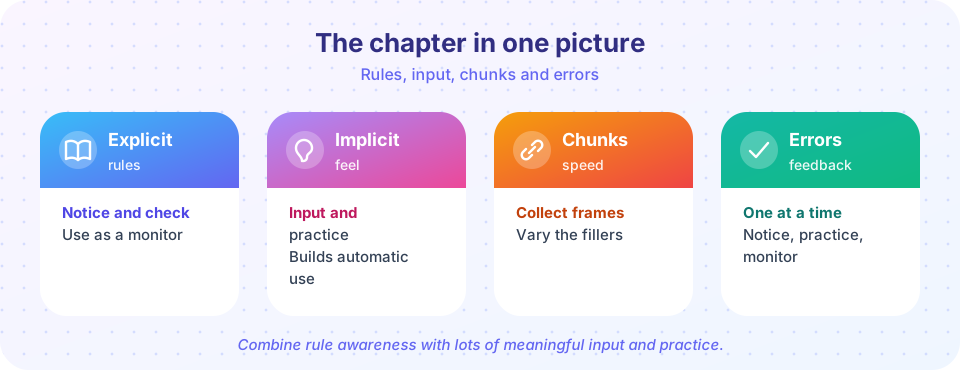
Grammar learning works best as a partnership. Rules help you notice and check. Input and practice make patterns automatic. Chunks carry much of everyday speech. Errors show what your developing system is doing. This review pulls the chapter together and gives you a schedule for working on any grammar point.
What you will learn
- A table of the chapter's key ideas and the evidence behind them.
- A spaced plan for learning one grammar point.
- A self-check quiz.
Recap
| Idea | Key point | Lesson |
|---|---|---|
| Explicit knowledge | Statable rules; help noticing and monitoring | Explicit and implicit |
| Noticing | Schmidt (1990): input must be noticed to be learned | Explicit and implicit |
| Instruction | Norris and Ortega (2000): focused, explicit instruction helps on average; test type matters | Explicit and implicit |
| Chunks | Pawley and Syder (1983), Sinclair (1991): much language is retrieved, not built | Patterns and chunks |
| Interlanguage | Corder (1967), Selinker (1972): errors reflect a developing system | Errors and interlanguage |
| Fixing errors | One at a time: notice, understand, practice, monitor | Errors and interlanguage |
A spaced plan for one grammar point
Press Run (or Ctrl + Enter) to see the console output here.
No output.
The intervals are a common pattern, not a proven optimum; the point is to come back to the topic several times.
Key studies revisited
- Corder (1967) and Selinker (1972). Learner errors are evidence of an evolving system, called interlanguage. Limits: the notion of fossilization is debated.
- Dulay and Burt (1974), Brown (1973). Learners of English acquire certain morphemes in a fairly consistent order. Limits: orders are tendencies, and effects of instruction and first language are also visible.
- Schmidt (1990). Noticing is needed for input to become intake. Limits: how much awareness is needed remains debated.
- Norris and Ortega (2000). Focused instruction helps, with an average advantage for explicit approaches. Limits: tests often favor explicit knowledge and treatments are short.
- Pawley and Syder (1983), Sinclair (1991). Fluent speech relies on stored chunks and semi-fixed phrases. Limits: percentages of formulaic language depend on definition.
Worked example: a persistent error
A learner keeps writing "I am agree" in emails. Apply the chapter's tools. Source: transfer from a first language that says "I am in agreement". Notice: collect five correct examples ("I agree", "She agrees", "They don't agree") and the learner's own five wrong ones. Understand: "agree" is a verb, so no "am". Practice: make ten sentences with the chunk "I agree with ___" and vary the filler. Monitor: for a week, search drafts for "am agree" before sending. Feedback: ask a partner to flag it. Two or three weeks later, the learner checks the error log. If it has dropped from several times a week to rarely, the cycle has worked. If not, the learner looks for a different cause, such as a related chunk that was never learned.
What to do next
Choose one item from each of the three experiments in the overview: a grammar point to run through the meet-notice-check-use routine, ten frames with slots to collect and practice, and your top error to fix. Give each four weeks. At the end, compare what you can do with your starting point: a recording, a paragraph or a count of how often the error appears. If a change helped, keep it; if not, change one thing and test again. Grammar learning stops feeling like tears when it becomes a series of small experiments whose results you can see.
Check your understanding
Quick check · 10 questions
of 10 answered You scored / 10 · perfect!
-
1. Who proposed that input must be noticed to be learned?
Schmidt (1990) proposed the noticing hypothesis. -
2. What is implicit knowledge?
It is the feeling that something sounds right without being able to explain why. -
3. Which finding is part of Norris and Ortega (2000)?
They found large average gains and an explicit advantage, with caveats about tests. -
4. What does Sinclair's idiom principle describe?
Speakers often draw from prefabricated phrases. -
5. Which is a frame with a slot?
The fixed words plus a gap let you produce many sentences. -
6. Who coined the term interlanguage?
Larry Selinker introduced it in 1972. -
7. What does a U-shaped curve show?
Memorized correct forms can give way to overgeneralization before recovery. -
8. How many persistent errors should you work on at once?
Focusing on one error at a time makes practice manageable. -
9. Why is the a/an example useful as a monitor demonstration?
Rules about sounds with exceptions are easier to apply when you have time. -
10. What is the best-supported view on the relation of explicit and implicit knowledge?
Interface positions differ, but all support combining rules with input and practice.
Summary
- Rules help with noticing and checking; input and practice build automatic use.
- Chunks with slots are a fast route to natural speech.
- Errors show what your interlanguage is doing; fix them one at a time.
- Use a spaced schedule for each grammar point.
Track your progress
Create a free account to tick off lessons and pick up where you left off on any device.
of How to Learn a Language lessons completed