


















Lesson 28 of 48 · Reading and Writing
Extensive reading: volume at the right level
Why reading many easy texts builds vocabulary and fluency, how lexical coverage sets the right level, and what the Book Flood and meta-analyses found.
Most people who read fluently in a second language did not get there by studying word lists alone. They read, a lot, and at a level where the story kept moving. Extensive reading is the practice of making that happen on purpose: choosing easy, interesting texts and reading for meaning rather than for study.
The idea is simple, but two details decide whether it works. The first is level: too hard and you stop understanding. The second is volume: a few pages a month will not give you enough repeated encounters with words. This lesson explains both with numbers, and tells you what the research can and cannot claim.
What you will learn
- What lexical coverage is and what coverage levels research suggests for reading.
- What studies, including the Fiji Book Flood and later meta-analyses, found.
- How to choose books and graded readers at the right level.
- How to estimate how many encounters you need to learn a word from reading.
Key terms
Lexical coverage: the percentage of the words in a text that you already know.
Graded reader: a book written or adapted with a controlled vocabulary at a stated level.
Incidental learning: learning words while doing something else, such as reading for the story.
Word family: a base word with its common inflected and derived forms, such as help, helps, helped, helpful.
Why reading volume matters
Stephen Krashen argued for free voluntary reading, reading that you choose and enjoy, as a major source of language acquisition. His broader claims were contested, but several studies support the core point that reading a lot helps.
In the best-known experiment, W. B. Elley and Francis Mangubhai (1981, 1983) introduced a "Book Flood" in Fijian primary schools: classrooms received many books in English, and children read them for pleasure rather than studying English reading lessons. After one and two years, the Book Flood groups improved more in reading comprehension and other English measures than groups using a conventional audio-lingual program. The study had limits (primary school pupils, a specific setting, teachers who were enthusiastic), but it helped inspire later work.
Later syntheses support a moderate positive effect. Meta-analyses of extensive reading programs, such as those by Nakanishi (2015) and Jeon and Day (2016), report benefits for reading skill and for other outcomes like vocabulary and fluency, with larger effects in longer programs. They also note differences in how studies were run, so you should treat the size of the effect as approximate.
Why level matters: lexical coverage
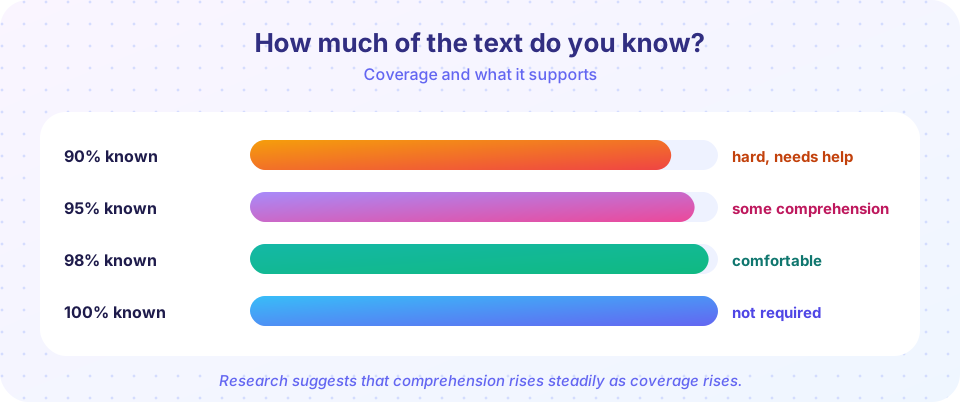
For a text to be understandable without constant help, you need to know most of its words. Research on this threshold:
- Batia Laufer (1989) suggested that about 95 percent coverage gives some reasonable comprehension.
- Hu and Nation (2000) found that learners needed about 98 percent coverage for adequate unassisted comprehension, and that comprehension rose steadily as coverage rose.
- Schmitt, Jiang and Grabe (2011) found a roughly linear relationship between coverage and comprehension, without a sharp cut-off, which suggests that "more is better" rather than a magic number.
Nation (2006) estimated what these levels mean in English: a vocabulary of roughly 8,000 to 9,000 word families to reach 98 percent in many novels and newspapers, and about 6,000 to 7,000 for informal spoken language. Exact figures depend on language, genre and how "words" are counted, so use them as orders of magnitude, not as a test.
A practical check: take a page, count unknown words in the first 100 words. About 2 unknown words per 100 is the 98 percent zone; 5 per 100 is 95 percent. One or two unknown words every line is too hard for extensive reading.
Press Run (or Ctrl + Enter) to see the result here.
Program input · what you'd type while the program runs
Type the answers before you press Run, one per line. Each time the program reads a line (with input()), it gets the next line from this box.
The shape is the lesson: coverage climbs fast with the first few thousand words, then slowly. That is why easier texts, with common words repeated many times, are the best place to start.
Choosing books
Richard Day and Julian Bamford's widely used principles of extensive reading include: the material is easy, there is a variety of topics, learners choose what to read, reading is its own reward, and reading speed is usually faster rather than slower. In practice:
- Graded readers are written for exactly this purpose. Publishers label levels by headword count, for example 400, 800 or 1,500 words.
- Children's books and comics are easy and have pictures that support meaning.
- Simplified news sites and blogs work if the coverage is high.
- Reread what you enjoy. Repetition builds fluency and is allowed.
Use the page test above: if you meet unknown words more often than every couple of lines, move down a level. Drop books you do not enjoy. Choice and interest keep you reading.
How many encounters does a word need?
One meeting with a word rarely teaches it. Studies of reading and vocabulary (for example by Waring and Takaki, 2003; Webb, 2007) suggest that learners often need around ten or more encounters before a word is reliably retained, and that knowledge starts shallow and deepens slowly. This is another argument for volume.
Press Run (or Ctrl + Enter) to see the result here.
Program input · what you'd type while the program runs
Type the answers before you press Run, one per line. Each time the program reads a line (with input()), it gets the next line from this box.
Treat the output as a model, not a prediction for your language. The pattern holds in real texts: rare words are rare, so only large volume brings them back often enough.
Making it a habit
- Read at the same time each day, even for 10 minutes.
- Keep a simple log: title, date, pages.
- Do not look up every unknown word; look up only words that block understanding or appear again and again.
- Move up a level after finishing a few books at ease.
A starter plan for the first month
If you have never read extensively in your target language, a simple plan will help you start without choosing too ambitiously.
- Week 1: find your level. Borrow or download three graded readers at adjacent levels. Read the first page of each and count unknown words in the first 100 words. Choose the level where you meet about two unknown words per 100, or fewer.
- Week 2: build the habit. Read 15 to 20 minutes a day at a fixed time. Do not look up words unless you cannot follow the story. Keep a simple log of titles and dates.
- Week 3: add variety. Finish one book, and pick a second from a different genre. If you are bored, you chose the wrong book; stop and pick another without guilt.
- Week 4: check your progress. Notice whether you read faster than in week 1. Many learners find that the same pages feel easier after repeated exposure to common words. Move up half a level only if you are reading comfortably.
Reading speed is worth watching. In your first language you may read around 200 to 300 words per minute; in a second language you may start far below that. A common suggestion in the reading fluency literature is to work toward a speed of roughly 150 to 250 words per minute on easy text, but the right target depends on your language and level.
Common misconceptions
"I must understand every word." Extensive reading works with high, not perfect, coverage. Skipping a word you do not need is a skill.
"Reading alone replaces study." Reading builds vocabulary and fluency, but explicit study of vocabulary and grammar also helps; the best programs combine them.
"Harder books are more prestigious and therefore better." Level should match what you can understand with ease, and ease builds speed.
Check your understanding
Quick check · 5 questions
of 5 answered You scored / 5 · perfect!
-
1. What is lexical coverage?
Coverage measures how much of a text's vocabulary you already know. -
2. What coverage level did Hu and Nation (2000) find supported adequate unassisted comprehension?
Their study suggested around 98 percent, with comprehension rising as coverage rose. -
3. What was notable about the Fiji Book Flood study?
Elley and Mangubhai found gains for children who read many books in English. -
4. If you meet about 5 unknown words in every 100, what coverage is that?
Five unknown words per 100 leaves 95 percent known. -
5. Which is a principle of extensive reading?
Easy, enjoyable material supports fluent reading and sustained volume.
Summary
- Extensive reading means a lot of easy, enjoyable reading.
- Research suggests 95 to 98 percent coverage for comfortable reading, with 98 percent better for unassisted comprehension.
- The Fiji Book Flood and meta-analyses support moderate benefits, with caveats about study design.
- Words usually need many encounters, so volume matters more than any single book.
- Pick graded readers or easy texts you enjoy and read a little every day.
Track your progress
Create a free account to tick off lessons and pick up where you left off on any device.
of How to Learn a Language lessons completed