


















Lesson 12 of 48 · Vocabulary and Spaced Repetition
Chapter 3 overview: Vocabulary and spaced repetition
What it means to know a word, how many words you need, receptive versus productive vocabulary, and a map of the memory-science lessons in this chapter.
Grammar gets the blame, but when learners are asked what holds them back, the most common answer is simply "I do not know enough words." They are right to worry. Vocabulary size is one of the best single predictors of reading and listening comprehension, and a missing word cannot be repaired by cleverness the way a missing grammar rule sometimes can.
Vocabulary also has the clearest science of any part of language learning, because it is mostly a memory problem and memory has been studied in laboratories for more than a century. This chapter shows how that science translates into methods, and this overview sets the frame.
What you will learn
- The aspects of "knowing a word" according to Paul Nation
- The difference between receptive and productive vocabulary
- Rough vocabulary sizes needed for different goals, and their limits
- What the lessons in this chapter cover
Key terms
Word family: a base word with its inflected and derived forms, such as help, helps, helped, helpful.
Lemma: the dictionary form of a word, such as run for ran and running.
Receptive vocabulary: words you recognize when you hear or read them.
Productive vocabulary: words you can actually use in speech or writing.
Collocation: words that tend to occur together, like heavy rain or make a mistake.
What does it mean to know a word?
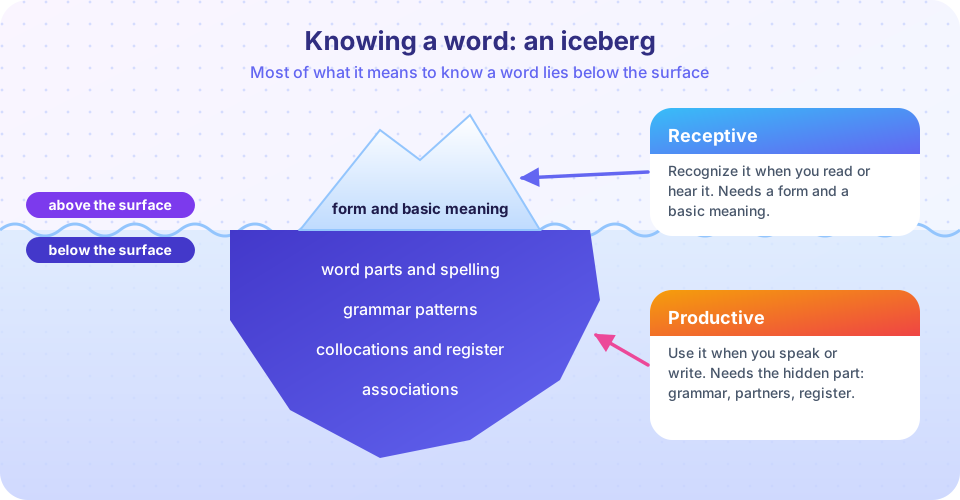
A common mistake is to treat words as pairs: perro equals dog. Paul Nation (2001) listed what it can mean to know a word, grouped into three kinds of knowledge.
Form
Meaning
Use
Take the English word drive. Knowing the form means recognizing /draɪv/ and spelling it, and knowing that driven, driver and drove are related. Knowing the meaning includes the main sense (operate a vehicle) and others (drive a point home, a hard drive). Knowing the use includes that it takes an object (drive a car), that you drive someone crazy but do not drive a bike, and that drive in a business meeting can mean "motivation." No dictionary entry carries all of that. Native speakers acquire it from thousands of encounters.
The practical consequence is that vocabulary learning has depth as well as breadth. A first meeting gives you a shallow link between form and meaning. Later encounters add collocations, senses and nuance. A good method makes sure the later encounters happen.
Receptive and productive
You recognize far more words than you use. Receptive vocabulary (recognizing words while reading or listening) is almost always larger than productive vocabulary (using words in speaking or writing). Studies find the gap is large at lower levels and narrows somewhat with proficiency. Producing a word demands more: you must recall the form from a meaning, with no cue to help you.
This matters for study. If your goal is reading, receptive learning (see the word, recall the meaning) is efficient. If your goal is speaking, you need practice in the productive direction (see the meaning or situation, recall the word), and, as lesson 3 explains, retrieval in that direction is more demanding but builds stronger memory.
How many words do you need?
There is no single answer, but research provides orientation.
- Native speakers. Estimates differ by counting method. Older estimates for educated adults were around 20,000 word families (Goulden, Nation and Read, 1990), and a large online study by Marc Brysbaert and colleagues (2016) estimated that a typical young adult native speaker of English knows about 42,000 lemmas, with the typical range shifting as vocabulary grows through adulthood. Whatever the counting method, the number is large.
- For reading and listening. Paul Nation (2006) estimated that about 8,000 to 9,000 word families are needed to read novels and newspapers at 98% coverage, and about 6,000 to 7,000 for spoken English. Smaller sizes get you partial understanding with more guessing.
- For everyday conversation. A few thousand words go a long way, because frequent words recur so often (lesson 4 shows why).
Three cautions: these figures come mostly from English; other languages differ with morphology and script; and a word-family count is not the same as the number of items you will actually learn, because related forms are not free.
"A translation equals knowing the word." A translation is the first step. Collocations, grammar and register come later.
"Knowing 1,000 words means understanding 1,000 words' worth of speech." Frequent words make up a large share of running text, so a small vocabulary gives surprising coverage but still leaves gaps that block comprehension.
"I understand it, so I can say it." The receptive-productive gap is real. Plan separate practice for production.
Two routes to words
Researchers distinguish incidental learning (picking up words while reading or listening for meaning) from intentional learning (studying words deliberately, for example with flashcards). Incidental learning gives depth and context but is slow: a single encounter often adds little, and many encounters are needed. Intentional learning is fast and efficient for building a base, but alone it can give shallow knowledge. The best-supported plan uses both: intentional study to build the first few thousand words and reading and listening to deepen them.
The lessons in this chapter
| Lesson | What it covers |
|---|---|
| Forgetting and spacing | Ebbinghaus, the forgetting curve, why spacing works, review schedules |
| Retrieval practice | The testing effect, flashcards done right, illusions of knowing |
| Choosing words to learn | Word frequency, Zipf's law, coverage, what to learn first |
| Chapter 3 review | One picture and a ten-question quiz |
Try it
The first demonstration profiles how well you know one word across Nation's nine aspects. Rate a word you recently learned and see which aspects are missing. The scoring is a reflection tool, not a test.
The second demonstration plots an illustrative gap between receptive and productive vocabulary as a learner grows. The curves are invented to show the typical pattern of a gap that narrows slowly, not data from a study.
Press Run (or Ctrl + Enter) to see the result here.
Program input · what you'd type while the program runs
Type the answers before you press Run, one per line. Each time the program reads a line (with input()), it gets the next line from this box.
Check your understanding
Quick check · 4 questions
of 4 answered You scored / 4 · perfect!
-
1. Which is part of knowing a word, according to Nation?
Nation lists form, meaning and use, each with several aspects. -
2. Receptive vocabulary refers to words you
Receptive knowledge is recognition; productive knowledge is use. -
3. About how many word families does Nation (2006) estimate are needed to read novels at 98 percent coverage?
His estimate for written text was 8,000 to 9,000 word families. -
4. Why combine intentional and incidental learning?
The two routes complement each other: speed and breadth versus depth and context.
Summary
- Knowing a word means form, meaning and use, not just a translation.
- Receptive vocabulary is larger than productive vocabulary; train both directions as needed.
- Reading needs thousands of word families; the figures are guides, mostly from English.
- Intentional study plus incidental learning from input is the best-supported mix.
- The next lessons explain how to make the words stay.
Next: Forgetting and spacing
Track your progress
Create a free account to tick off lessons and pick up where you left off on any device.
of How to Learn a Language lessons completed