


















Lesson 13 of 48 · Vocabulary and Spaced Repetition
Forgetting and spacing: why reviews should be spread out
Ebbinghaus's forgetting curve, why spacing reviews beats cramming, what Cepeda and Bahrick found, and how Leitner boxes and spaced-repetition software schedule your words.
You learn twenty words on Sunday evening and feel good. By Wednesday you can recall perhaps half. By next Sunday, fewer. This is not a personal failing. It is how human memory works, and it was measured with remarkable care in 1885 by a German psychologist who used himself as the only subject.
The same research gave language learners their most powerful practical tool: if you review at the right moments, the same material sticks for far longer with far less total effort. This lesson explains forgetting, then spacing, then the scheduling methods, from paper boxes to software, built on them.
What you will learn
- What Ebbinghaus measured and what the forgetting curve shows
- What the spacing effect is, and what large reviews found about it
- How Leitner boxes and spaced-repetition software choose review dates
- The practical rules for building a sustainable review habit
Key terms
Forgetting curve: the pattern in which memory declines fast soon after learning and then more slowly.
Spacing effect: material reviewed over several sessions separated by gaps is remembered better than the same time spent in one block.
Retention interval: the time between learning (or last review) and when you need to remember.
Spaced repetition: a method that schedules reviews at increasing intervals.
Leitner system: a box-based method devised by Sebastian Leitner in the 1970s where correctly answered cards move to boxes reviewed less often.
Ebbinghaus and the forgetting curve
Hermann Ebbinghaus published Über das Gedächtnis (On Memory) in 1885. To study memory without the influence of meaning, he invented lists of nonsense syllables such as ZOF or BEK. He memorized lists until he could recite them perfectly, left them for various times, and then measured how much effort it took to relearn them. The measure, savings, is the proportion of the original learning effort that was saved by the earlier learning.
His reported savings were roughly: about 58% after 20 minutes, about 44% after an hour, about 34% after a day, about 25% after six days and about 21% after a month. The numbers vary slightly between sources, but the shape is robust: a steep early fall and a long tail. In 2015, Jaap Murre and Joeri Dros repeated the experiment with a single participant over a similar schedule and found a curve of the same general shape, including a small bump at about 24 hours that may relate to sleep.
Three cautions apply before you read this as a law for vocabulary.
- Nonsense syllables are the hardest case. They have no meaning, no associations and nothing to attach to. Meaningful material is forgotten more slowly.
- The curve depends on the memory's strength. Material you have used many times fades much slower than something you saw once.
- Savings is not recall. A savings score of 34% does not mean you can still recall 34% of the items.
The message is not "you will lose 66% in a day." It is that memory decays in a predictable shape, and that this decay can be changed.
The spacing effect
If you have 60 minutes to spend on a set of words, is it better to study them for 60 minutes straight (massed practice) or for 20 minutes on each of three days (spaced practice)? In dozens of laboratory studies, spacing wins for retention after a delay. The effect is among the oldest and most reliable in cognitive psychology.
Cepeda and colleagues (2006) reviewed 839 comparisons from 317 experiments and found that spaced practice generally beat massed practice, with larger benefits as the delay before the test grew. Cepeda and colleagues (2008) tested more than 1,300 participants who learned facts and were tested after delays from a week to nearly a year. They varied the gap between study sessions and found that the best gap depended on how long you wanted to remember: for a test a week away, a gap of a day or so was best; for a test a year away, a gap of a few weeks was best. In general, the best gap was a modest fraction of the retention interval, and that fraction got smaller as the interval got longer. Too short a gap hurt more than too long a gap, so when in doubt, space more widely.
In language learning specifically, Harry Bahrick and colleagues (1993) had four adults (the researchers themselves) learn hundreds of foreign-language vocabulary items over many sessions with gaps of 14, 28 or 56 days and tested them up to five years later. Longer gaps required more effort in the sessions but produced better memory years later. The sample was tiny, but it is an unusually long follow-up of real vocabulary.
Why does spacing work? Several explanations exist, and they are not mutually exclusive. After a gap, retrieving the item takes some effort, and effortful retrieval strengthens memory more than easy re-reading (lesson 3 explores this). Spaced encounters also occur in different mental contexts, which gives the memory more routes of access.
"Cramming works well enough." Cramming can raise performance on a test tomorrow, but the memory fades fast. Studies show learners often judge massed practice as more effective than spacing even when spacing produced better scores (Kornell and Bjork, 2008), because massed practice feels fluent.
"Spacing means I should wait until I forget everything." The goal is to review when recall is possible but effortful, not when it has already gone. If you cannot recall at all, you have waited too long.
From theory to schedule
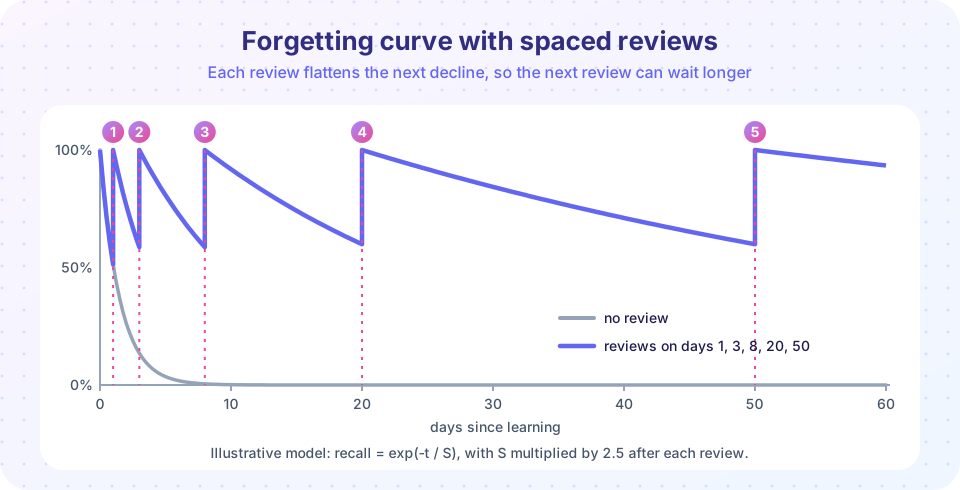
Ebbinghaus's curve and the spacing effect suggest a plan: review when the memory is starting to fade, and each time you succeed, wait longer. Several systems implement this.
Pimsleur's graduated-interval recall (1967). Paul Pimsleur suggested reviewing at expanding intervals, commonly cited as about 5 seconds, 25 seconds, 2 minutes, 10 minutes, an hour, 5 hours, a day, 5 days, 25 days and later, each interval about five times the previous.
The Leitner system (1972). Sebastian Leitner proposed a paper method using boxes. All new cards start in box 1. A correct answer moves the card to the next box; a wrong answer sends it back to box 1. Box 1 is reviewed daily, box 2 every two days, box 3 every four days, and so on. The system needs only paper and a shoebox.
Software: SuperMemo and Anki. Piotr Woźniak developed the SM-2 algorithm for SuperMemo in 1987. After each review you rate how easy it was, and the program computes the next interval by multiplying the last one by an "ease factor." Anki uses a modified version. Newer schedulers, such as the FSRS algorithm, fit a memory model to review histories to predict when you are about to forget; they are promising but are newer and less studied than the classic methods.
Do expanding gaps matter? Landauer and Bjork (1978) suggested expanding gaps help, but later work, for example Karpicke and Roediger (2007), found that equal gaps worked as well or better for long-term retention in their experiments. The important features seem to be spacing and successful retrieval, not the exact pattern. Expanding schedules remain popular because they are efficient: easy items drop out of daily review.
Making it a habit
- Review daily, briefly. Ten to twenty minutes every day beats an hour once a week. Reviews are cheap when the cards are easy.
- Control new cards. Reviews pile up. Ten new cards a day generate more than a hundred reviews a day within a month. Choose a number you can sustain.
- Never skip the reviews to add new cards. A backlog is the main reason people abandon spaced repetition.
- Be honest when grading. If you hesitated, you did not know it well.
- Retire what you know. Words you meet constantly in reading do not need cards.
- Combine with use. Reading and conversation are reviews with meaning.
Try it
The first demonstration models memory strength with a simple formula. The chance of recall falls as exp(-t / S), where S is the memory's "stability." After each successful review, S is multiplied by a factor (here 2.5, an assumption). It shows how four well-timed reviews stretch the interval from a day to months. This is a model for intuition, not a measured law.
Press Run (or Ctrl + Enter) to see the result here.
Program input · what you'd type while the program runs
Type the answers before you press Run, one per line. Each time the program reads a line (with input()), it gets the next line from this box.
The second demonstration is a working Leitner box you can operate. Cards due today are shown one at a time. Mark whether you knew the word, then advance the day to see which cards return. Intervals are 1, 2, 4, 8 and 16 days.
Check your understanding
Quick check · 5 questions
of 5 answered You scored / 5 · perfect!
-
1. What did Ebbinghaus's savings measure show?
The forgetting curve has a steep early fall and a long tail. -
2. The spacing effect states that
For the same total study time, spaced practice is better for retention after a delay. -
3. In the Leitner system, what happens when you answer a card correctly?
Correct cards advance to boxes with longer intervals; wrong ones return to box 1. -
4. Which conclusion about expanding versus equal gaps is best supported?
Karpicke and Roediger (2007) found equal gaps worked as well or better for long-term retention in their experiments. -
5. Why do learners often prefer cramming?
Kornell and Bjork (2008) found people judged massing as more effective even when spacing gave better results.
Summary
- Memory decays quickly at first and then more slowly (Ebbinghaus, replicated by Murre and Dros).
- Spreading reviews over time beats cramming for long-term memory; larger gaps suit longer goals.
- Leitner boxes, Pimsleur intervals and software schedulers all lengthen the gap after each success.
- Do short daily reviews, limit new cards, and never skip reviews to add new ones.
- Spaced repetition works because reviewing at the edge of forgetting strengthens memory.
Next: Retrieval practice
Track your progress
Create a free account to tick off lessons and pick up where you left off on any device.
of How to Learn a Language lessons completed