


















Lesson 17 of 48 · Listening and Pronunciation
Chapter 4 overview: Listening and pronunciation
Why understanding speech is harder than reading, how listeners find word boundaries, and a map of the chapter on sound perception, listening practice and pronunciation.
Many learners can read a newspaper in their target language and still fail to understand a taxi driver. The words are the same, but the signal is different. Writing comes with spaces, punctuation and time to think. Speech comes as a continuous stream that fades the moment it is produced, at a speed chosen by someone else, with sounds blurred together and half of them missing.
This chapter treats listening and pronunciation together because they are two sides of the same skill: the sound system. You cannot reliably say what you cannot hear, and you cannot hear well what you have never learned to attend to. This overview explains why listening is hard and maps the lessons.
What you will learn
- Why spoken language is harder than written language for learners
- How listeners find words in a continuous stream
- The difference between bottom-up decoding and top-down prediction
- What the lessons in this chapter cover
Key terms
Speech segmentation: dividing a continuous stream of sound into words.
Bottom-up processing: building meaning from the sounds upward: sounds, words, phrases.
Top-down processing: using knowledge, context and expectations to interpret what you hear.
Reduced forms: shortened or blended pronunciations in connected speech, such as "gonna" for "going to."
Phoneme: the smallest sound unit that can change a word's meaning, such as /p/ versus /b/ in pat and bat.
Why listening is hard
Several features of speech make it difficult for learners, and each can be trained.
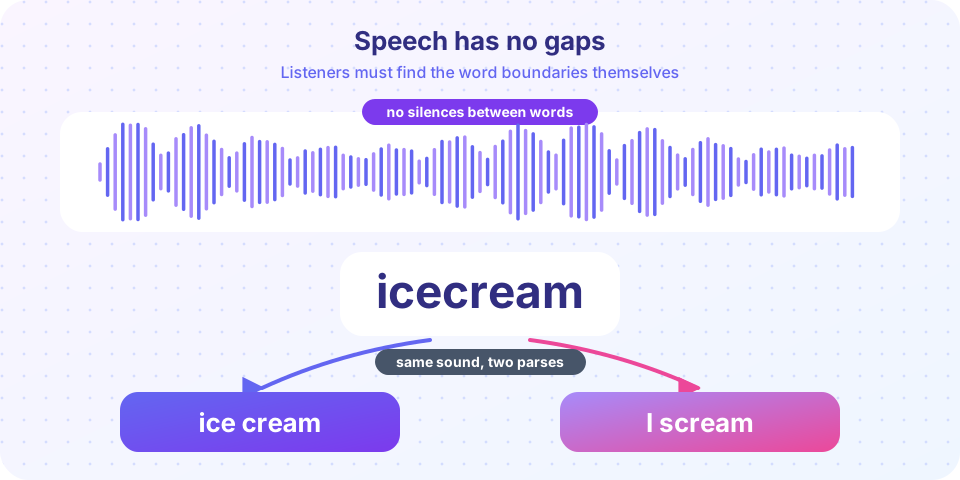
There are no reliable gaps. In a written sentence, spaces mark words. In speech, there are pauses at some phrase boundaries but usually not between words. Listeners must find the boundaries by knowing which sound sequences are possible words. Familiar examples are English phrases like ice cream and I scream, which can sound almost the same. Native listeners use context to choose; learners with a small vocabulary have fewer candidates to work with.
Sounds change in connected speech. Words shorten, blend and drop sounds: want to becomes wanna, did you becomes didja, and and shrinks to a tiny schwa. Learners trained on slow, careful, textbook pronunciation may fail to recognize words they know well.
Speech is fast and temporary. A reader can slow down and reread. A listener cannot. Typical conversational speech in English runs at around 150 to 200 words per minute, and it varies with speaker and language. If processing one word is slow, the next several pass by unnoticed.
Processing is shared. Native listeners process sounds automatically and spend their attention on meaning. Learners often spend most of their attention on decoding, leaving little for understanding. John Field, a researcher in listening, argues that much listening difficulty at lower levels is a decoding problem: recognizing the words in the first place.
Accents and speakers vary. Each speaker pronounces words differently, and training on one voice does not guarantee understanding another.
Bottom-up and top-down
Listening is not just decoding. Skilled listeners combine two kinds of processing.
- Bottom-up: sounds are matched to words, and words are combined into phrases.
- Top-down: context, topic knowledge and expectation guide interpretation. If you hear a weather report, you expect words like rain and tomorrow, so a blurred syllable is easy to resolve.
Learners with limited vocabulary rely too much on top-down guessing, which makes them vulnerable when the guess is wrong, and learners who focus too much on every word lose the thread. Good listening practice trains both: attention to the sounds and use of the context.
Evidence on how listeners cope with the stream comes from experiments such as those of Anne Cutler and Dennis Norris (1988), who proposed that English listeners tend to treat strong stressed syllables as likely word beginnings, a strategy that works well for English but not for other languages. Listeners from different languages use different cues, which is one reason learning to listen in a new language involves more than learning the words.
"I know the words, so I should understand the speech." Knowing a written word is not the same as recognizing its spoken form, especially in connected speech.
"I just need to listen more." Volume helps, but only when you understand most of what you hear. Practice must be at the right level and include attention to form (lesson 3).
"Understanding speed is about hearing speed." Mostly it is about how fast you recognize words. That improves with vocabulary and listening practice.
The lessons in this chapter
| Lesson | What it covers |
|---|---|
| Sound perception | How infants and adults tune their ears, categorical perception, why some sounds are hard |
| Listening practice | Extensive and intensive listening, dictation, shadowing, speech rate |
| Pronunciation training | Intelligibility versus accent, minimal pairs, high-variability training, feedback |
| Chapter 4 review | One picture and a ten-question quiz |
Try it
The first demonstration shows the segmentation problem. It finds every way to split an unbroken string into words from a small dictionary. Real listeners also use meaning, but the sound alone can fit several parses.
Press Run (or Ctrl + Enter) to see the console output here.
No output.
The second demonstration lets you turn word spacing on and off for a sentence, to feel what a listener faces. It is a visual analogy, not audio.
Check your understanding
Quick check · 4 questions
of 4 answered You scored / 4 · perfect!
-
1. Why is spoken language harder than written language for learners?
The speech stream has no reliable gaps, vanishes quickly and changes sounds in connected speech. -
2. Speech segmentation means
Listeners must find the word boundaries themselves. -
3. Top-down processing uses
Top-down processing draws on topic knowledge and expectations. -
4. John Field argues that much listening difficulty at lower levels is a
Learners often cannot recognize the words in the stream, so understanding suffers.
Summary
- Speech is continuous, fast and temporary; written text is none of these.
- Listeners find word boundaries using knowledge of the language, and connected speech reduces and blends sounds.
- Skilled listening combines bottom-up decoding with top-down prediction.
- Listening and pronunciation are two sides of the sound system.
- The next lessons cover how ears are tuned, how to practice listening and how to train pronunciation.
Next: Sound perception
Track your progress
Create a free account to tick off lessons and pick up where you left off on any device.
of How to Learn a Language lessons completed