


















Lesson 48 of 48 · Projects and Practice
Further study: where to go next
A timeline of key ideas in second language acquisition, approachable books and reports to read next, and related tracks on this site for linguistics, memory and study skills.
You now have a working model of how languages are learned and a plan to apply it. This lesson shows how to keep going in two directions: toward the research itself, for the curious, and toward more practice, for everyone. It also points to related tracks on this site.
What you will learn
- How the ideas in this course fit into a timeline of research.
- How to read a research paper on language learning with a critical eye.
- Books and reports to explore, and tracks on this site that connect.
Key terms
Meta-analysis: a study that combines the results of many studies to estimate an overall effect.
Effect size: a number describing how large a difference or relationship is.
Replication: repeating a study to see whether the result holds.
Peer review: evaluation of research by other experts before publication.
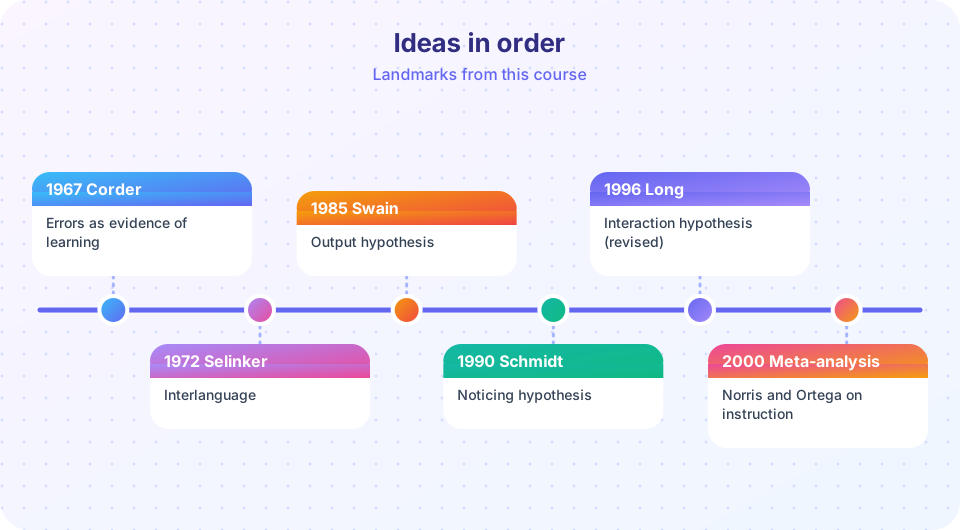
The ideas in order
The milestones below connect names you met in this course. They are not the whole field, only landmarks.
Press Run (or Ctrl + Enter) to see the result here.
Program input · what you'd type while the program runs
Type the answers before you press Run, one per line. Each time the program reads a line (with input()), it gets the next line from this box.
How to read a research paper
When you meet a claim such as "studies show that...", ask:
- Who were the participants? Children or adults, classroom or lab, one language or many?
- What was measured? A test right after the study, or months later? Writing, speaking or judgments?
- What was the comparison? No treatment, a different method or the same learners before and after?
- How big was the effect? Look for effect sizes, not just "significant".
- Has it been replicated? One study rarely settles a question.
- Who paid? Company-funded studies are not automatically wrong, but they deserve extra caution.
A meta-analysis helps because it pools many studies, but it can inherit the problems of the studies it combines. When two meta-analyses disagree, look at which studies and outcome measures each included.
Where to read next
These books and reports are widely used by teachers and researchers. They are named here as pointers, not reproduced.
- How Languages Are Learned by Patsy Lightbown and Nina Spada, a clear introduction to the field.
- Understanding Second Language Acquisition by Lourdes Ortega, a thorough overview of theories and evidence.
- Learning Vocabulary in Another Language by I. S. P. Nation, the standard reference on vocabulary.
- Extensive Reading in the Second Language Classroom by Richard Day and Julian Bamford, on reading programs.
- Motivation, Language Identity and the L2 Self, edited by Zoltán Dörnyei and Ema Ushioda, on motivation research.
- The Common European Framework of Reference for Languages and its companion volume, the source of the CEFR descriptors.
Reading the introductions and conclusions first, then returning to details, is a practical way to approach research papers.
Related tracks on this site
Pick what fits your interest.
- Linguistics for the structure of language: sounds, words, grammar and meaning.
- Psychology of learning and Cognitive psychology for memory, attention and the science behind spaced practice.
- Study skills and exam technique for general habits that also support language study.
- Statistics and probability if you want to read effect sizes and meta-analyses with confidence.
- Language tracks for practice, such as Spanish for beginners, French for beginners, German for beginners and Japanese for beginners.
- English grammar and English writing and composition for learners of English and for anyone sharpening writing.
A last exercise
Press Run (or Ctrl + Enter) to see the console output here.
No output.
Common misconceptions
"Reading research means I must accept the latest study." One study is evidence, not proof. Look for replication and consistent patterns.
"The research gives a single best method." It supports principles, such as meaningful input, output and spaced practice, that you can combine in many ways.
Check your understanding
Quick check · 4 questions
of 4 answered You scored / 4 · perfect!
-
1. What is a meta-analysis?
It pools results to estimate an overall effect. -
2. Which question helps you judge a research claim?
Outcome measures and timing affect what a result means. -
3. Which milestone came first?
Corder published in 1967. -
4. Why does replication matter?
Repeated findings increase confidence.
Summary
- The ideas in this course form a timeline from learner errors to large-scale meta-analyses.
- Read research with questions about participants, measures, comparisons, effect size, replication and funding.
- Use books and related tracks to go deeper or to practice.
- Keep testing changes for four weeks and review what works for you.
Back to the course: How to Learn a Language
Track your progress
Create a free account to tick off lessons and pick up where you left off on any device.
of How to Learn a Language lessons completed