


















Lesson 21 of 48 · Listening and Pronunciation
Chapter 4 review: Listening and pronunciation
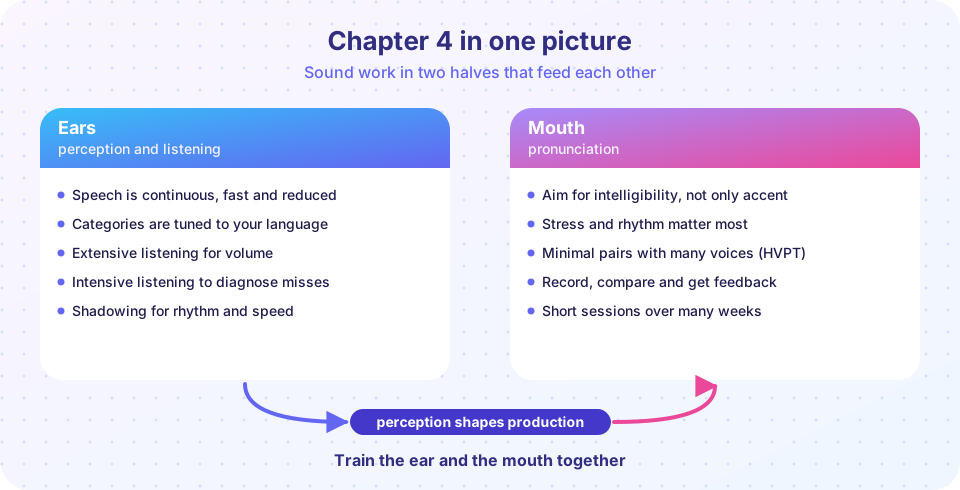
A one-picture recap of Chapter 4: why listening is hard, how sound perception is tuned, listening methods, and pronunciation training, with a table and a ten-question quiz.
Chapter 4 followed the sound system from both ends. You saw why the speech stream is hard to decode, how ears are tuned to one language in infancy, which listening practice builds decoding, and how pronunciation training works best. This review brings the pieces together, shows what is well supported, and gives you a ten-question quiz. Try the questions before reading the table.
What you will learn
- A compact comparison of the chapter's findings
- Which methods are well supported and which are promising but limited
- A weekly routine for sound work
Key terms
Speech segmentation: finding word boundaries in a continuous stream.
Categorical perception: hearing sounds as belonging to categories with sharp boundaries.
Perceptual narrowing: tuning of infant perception to native contrasts in the first year.
Intelligibility: how much of a message listeners understand.
HVPT: high-variability phonetic training with many talkers, words and feedback.
The chapter in a table
| Topic | Main finding | Key names | Strength of evidence |
|---|---|---|---|
| Why listening is hard | Speech is continuous, fast, temporary and reduced; decoding often fails first | Field; Cutler and Norris | Strong as a description; training studies are smaller |
| Sound perception | Categories are language-specific; infants narrow in the first year; hard contrasts fall inside native categories | Werker and Tees; Kuhl; Best; Flege | Strong for infants and for category effects; models are debated |
| Listening practice | Combine extensive volume, intensive diagnosis, captions and shadowing | Renandya and Farrell; Montero Perez et al.; Hamada | Moderate; many small classroom studies |
| Pronunciation | Accent differs from intelligibility; stress and meaning-changing contrasts matter; HVPT works | Munro and Derwing; Lively; Bradlow; Thomson and Derwing | Moderate to strong for HVPT; transfer to speech is smaller than lab gains |
A weekly routine for sound work
- Daily, 10 minutes: minimal-pair training with several voices, on one contrast at a time.
- Three times a week, 20 minutes: intensive listening on a short clip, with diagnosis of misses, then shadowing the same clip.
- Several hours spread across the week: extensive listening with material you mostly understand.
- Weekly, 10 minutes: record the same short passage and compare it with a native recording or ask a tutor for two points of feedback.
"Listening ability grows just from time spent." Time helps when it is attentive and at the right level; diagnosis speeds it up.
"My accent will fix itself." Fossilization is real; early attention to sounds and rhythm helps.
"One trick, such as shadowing, solves everything." The best-tested approaches are combinations, and the research base for each single technique is modest.
Try it
The first demonstration reviews the chapter with flashcards. Try to answer aloud before you flip.
The second demonstration builds a one-week sound plan from the time you have. The split follows the routine above and is a starting point, not a prescription.
Press Run (or Ctrl + Enter) to see the console output here.
No output.
Check your understanding
Quick check · 10 questions
of 10 answered You scored / 10 · perfect!
-
1. Why does reading ability not guarantee listening ability?
Decoding sounds into words is a separate skill from recognizing written words. -
2. Perceptual narrowing refers to
Sensitivity to non-native contrasts declines while native sensitivity improves. -
3. The Perceptual Assimilation Model predicts difficulty when
Learners treat the two sounds as one, so the contrast is hard to hear. -
4. In Kuhl, Tsao and Liu (2003), live Mandarin interaction
Social interaction seemed to support the learning of a non-native contrast. -
5. Intensive listening's diagnosis step determines
Different causes need different fixes. -
6. Which tends to hurt comprehensibility more?
Features that change word identity or disrupt rhythm reduce understanding most. -
7. What did high-variability training use?
Variability produces categories that generalize. -
8. A fair summary of the shadowing evidence is that it
Hamada (2016) and others found gains, but samples are small. -
9. A strong accent means speech is
Munro and Derwing found accent and intelligibility are separate. -
10. Which captions are better supported for building listening and vocabulary?
Reviews found benefits for same-language captions, while first-language subtitles divert attention from the sounds.
Summary
- Decode first: listening difficulty is often about recognizing words in a fast, reduced stream.
- Ears are tuned to native categories, so hard contrasts need new categories built with variable, feedback-rich training.
- Extensive plus intensive listening, captions faded over time and shadowing form a balanced routine.
- Aim for intelligibility; train stress, rhythm and meaning-changing contrasts first.
- Chapters 5 and 6 turn to speaking, reading and writing.
Track your progress
Create a free account to tick off lessons and pick up where you left off on any device.
of How to Learn a Language lessons completed