


















Lesson 25 of 48 · Speaking and Conversation
Fluency, accuracy and speaking anxiety
What fluency really is, how the 4/3/2 technique builds speed, why accuracy competes with it, and what research says about foreign language anxiety.
Two things stop learners from speaking smoothly: slow retrieval and nerves. They interact. When retrieval is slow, you pause, you feel exposed, and the discomfort makes retrieval slower. Breaking that cycle needs two different tools, repetition to make language automatic and exposure to make speaking feel safe.
This lesson defines fluency in a way that can be practiced, explains why accuracy and fluency compete for attention, introduces a classic fluency exercise, and looks at what research on foreign language anxiety does and does not show.
What you will learn
- What fluency, complexity and accuracy mean and why they trade off.
- How automatization works and how Nation's fluency strand builds it.
- How to run the 4/3/2 technique.
- What research shows about anxiety, and practical ways to lower it.
Key terms
Fluency: the speed and smoothness of speech, usually measured by speech rate, length of runs between pauses and the number and length of pauses.
Complexity: how varied and elaborate your vocabulary and sentence structures are.
Automatization: practicing something until it needs little conscious attention.
Foreign language anxiety: worry or tension specific to learning and using a language.
Fluency is not speed alone
In everyday use, "fluent" can mean "speaks the language well" or even "fully proficient". Researchers use a narrower definition: how smoothly and rapidly speech flows. A study by Judit Kormos and Mariann Dénes (2004) of Hungarian learners found that listeners' fluency ratings were best predicted by speech rate, the average length of uninterrupted stretches, and the amount of time spent on actual speech rather than silence. Interestingly, the number of pauses mattered less than where they fell: pauses between clauses sound natural, while pauses in the middle of phrases sound hesitant.
A useful practical definition: you are more fluent when you can say the message you intended without stopping to build each phrase from parts.
Complexity, accuracy and the attention budget
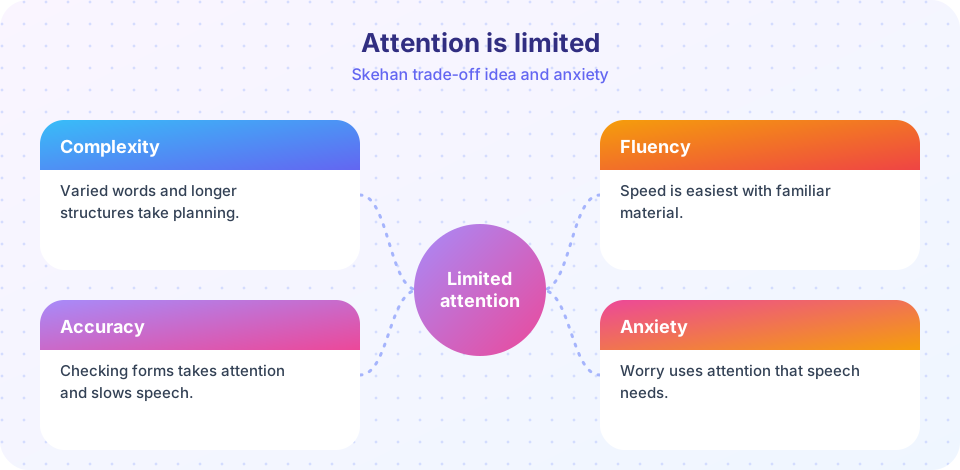
Peter Skehan and colleagues described speech performance in terms of complexity, accuracy and fluency (often abbreviated CAF) and proposed a trade-off hypothesis: because attention is limited, pushing hard on one aspect leaves less for the others. Say a difficult idea in a tricky tense and you may slow down. Say a familiar story at speed and you may use simpler structures.
The practical conclusion is to practice them at different times:
- For accuracy, slow down, write or plan, and ask for corrections.
- For complexity, attempt harder messages and accept some errors.
- For fluency, repeat familiar material at speed.
You do not need to choose one forever. The skill is to know which goal today's practice serves.
Automatization: making it effortless
Robert DeKeyser's skill acquisition account describes language learning as moving from declarative knowledge (facts you can state, such as a rule) to procedural knowledge (using it in action) to automatic use after much practice. In this view, fluency practice is the long middle and final stage, and it needs repetition of the same material, which is exactly what vocabulary lists and grammar drills do not give you.
Paul Nation, a leading researcher in vocabulary and course design, proposed that a balanced course has four strands in roughly equal time: meaning-focused input (reading and listening), meaning-focused output (speaking and writing), language-focused learning (study) and fluency development, where learners work with material they already know. The fourth strand is where many self-study plans are weakest.
The 4/3/2 technique
The 4/3/2 exercise was described by Maurice (1983) and tested by Nation (1989): you speak on the same topic to three different partners, for four minutes, then three, then two. Because the content is familiar, your attention is free to improve how you say it, and the shrinking time pushes speed. Studies find gains in speech rate and in the length of fluent stretches, while accuracy often stays similar or changes less.
Choose a story you can tell in a few sentences, such as your last trip. If you have no partner, speak to a recording device or a mirror; you lose the social pressure but keep the repetition.
Anxiety: what the research shows
Elaine Horwitz, Michael Horwitz and Joann Cope (1986) described foreign language classroom anxiety as a specific kind of anxiety involving communication apprehension, fear of negative evaluation and test anxiety, and built a 33-item scale to measure it. Since then many studies, and meta-analyses combining them, find a moderate negative correlation between language anxiety and achievement, typically around -0.3 to -0.4.
Three cautions:
- Correlation is not causation. Anxiety may lower performance, but poor performance also causes anxiety. Most evidence suggests both directions.
- Some tension may help. Mild nervousness can sharpen attention; the harmful form is when worry crowds out thinking.
- It is not a diagnosis. Typical classroom anxiety is not the same as a clinical anxiety disorder. If fear interferes strongly with your life, talk to a qualified professional.
MacIntyre and colleagues' willingness to communicate model describes speaking as the result of layers: personality, attitudes, confidence, and the situation. This is a helpful reminder that you can change the situation even if you cannot change your personality.
Ways to lower anxiety that have support from teaching studies:
- Graduated exposure: start with scripted or low-stakes talk (shadowing, voice messages), then move to live conversation.
- Predictable formats: known topics and partners reduce uncertainty.
- Reframing mistakes: treat errors as information. Keep a list of mistakes and celebrate each one you fix.
- Talking to supportive partners who give feedback you asked for.
Press Run (or Ctrl + Enter) to see the result here.
Program input · what you'd type while the program runs
Type the answers before you press Run, one per line. Each time the program reads a line (with input()), it gets the next line from this box.
The curve is a model that shows the idea behind exposure approaches. Real people vary, and some learners improve in steps rather than smoothly.
A week of fluency practice
Fluency work is easy to postpone because it feels repetitive, so it helps to make it concrete. Here is one way to run it for a week.
- Monday. Choose a story you can tell in about a minute: a recent trip, how you met a friend, a work problem. Tell it once to a recording app and write down every place where you stopped to search for a word.
- Tuesday. Look up the missing words, then tell the story again, aiming to fill the gaps.
- Wednesday to Friday. Do the 4/3/2 exercise with a partner or a mirror. Each time, shorten the time.
- Saturday. Record the story a final time and compare it with Monday's recording.
You can measure change roughly: transcribe or count the words in each recording and divide by the length in minutes to get words per minute. Speech rate is only one aspect of fluency, so also listen for fewer mid-phrase pauses. Because the story is familiar, you are not testing new vocabulary, you are testing how smoothly you can retrieve what you already have, which is the point of the exercise.
Common misconceptions
"Fluent speakers never make mistakes." Native speakers hesitate, repeat and self-correct constantly. Fluency is smoothness, not perfection.
"If I am nervous, I am bad at languages." Anxiety is common and is not a measure of ability.
"Practicing fluency means rushing." Fluency work uses familiar content so that speed comes from ease, not from skipping grammar.
Check your understanding
Quick check · 5 questions
of 5 answered You scored / 5 · perfect!
-
1. In Kormos and Dénes (2004), what best predicted listeners' fluency ratings?
Speech rate, mean length of run and phonation time ratio predicted ratings; where pauses fall also matters. -
2. What does Skehan's trade-off hypothesis claim?
Because attention is limited, learners often cannot maximize complexity, accuracy and fluency at once. -
3. In the 4/3/2 technique, what stays the same across the rounds?
You repeat the same content with new partners and shorter time to build speed. -
4. Which conclusion is best supported about language anxiety and achievement?
Meta-analyses find moderate negative correlations; poor performance can also raise anxiety. -
5. Which approach is an example of graduated exposure?
Gradual steps from low-stakes to higher-stakes speaking are a standard way to reduce tension.
Summary
- Fluency means smooth, rapid speech with natural pauses; it is practiced with familiar material.
- Complexity, accuracy and fluency compete for limited attention, so train them at different times.
- The 4/3/2 technique and Nation's fluency strand build automatization.
- Language anxiety correlates moderately and negatively with achievement; causation runs in both directions.
- Lower tension with gradual exposure, predictable formats and a positive view of errors.
Next: Chapter review: Speaking
Track your progress
Create a free account to tick off lessons and pick up where you left off on any device.
of How to Learn a Language lessons completed