


















Lesson 31 of 48 · Reading and Writing
Chapter review: Reading and writing
A recap of extensive and intensive reading, lexical coverage and corrective feedback, a sample weekly routine and a ten-question quiz.
This chapter described two quiet skills with large payoffs. Reading supplies volume and vocabulary; writing tests and shapes what you have absorbed. Research gives several concrete anchors: coverage targets for comfortable reading, the value of reading volume, the usefulness of selective lookup, and a conditional yes for corrective feedback.
What you will learn
- The chapter's main findings in one table.
- How to put reading and writing into a weekly routine.
- Which topics to revisit.
Recap
| Topic | Key finding | Lesson |
|---|---|---|
| Extensive reading | Easy, abundant reading helps; 95 to 98 percent coverage supports comprehension | Extensive reading |
| Book Flood | Children given many books improved more than a control program (Elley and Mangubhai) | Extensive reading |
| Intensive reading | Four passes; selective lookups; glosses help vocabulary learning | Intensive reading and tools |
| Writing feedback | Positive, conditional effect; rewriting closes the loop | Writing and feedback |
| Error logs | A few categories usually cause most errors | Writing and feedback |
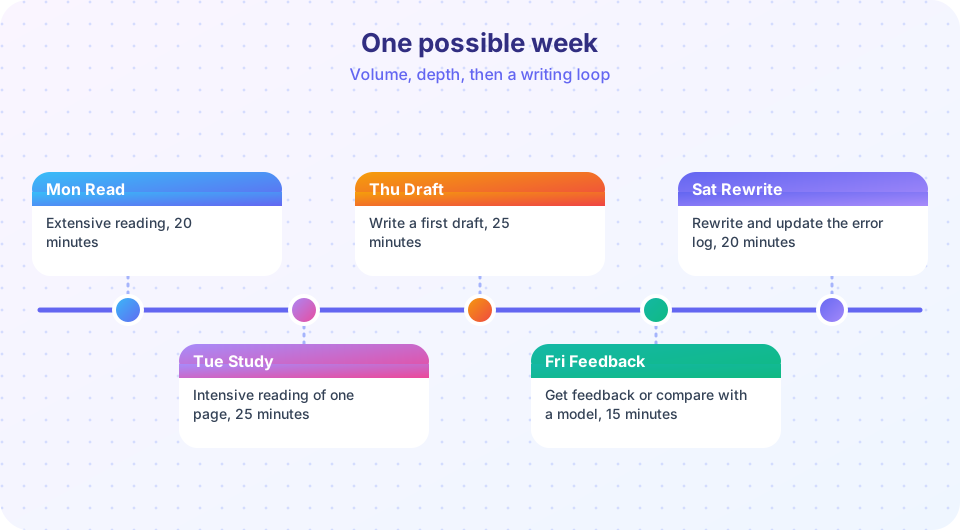
A weekly routine
Press Run (or Ctrl + Enter) to see the console output here.
No output.
Key studies revisited
It helps to remember not only what each study found but also its limits.
- Elley and Mangubhai (1981, 1983), the Fiji Book Flood. Primary school children who received many books and read for pleasure improved more than children on a conventional program. Limits: a specific setting, young learners and a program with enthusiastic teachers.
- Hu and Nation (2000). Adult learners needed about 98 percent coverage for adequate unassisted comprehension of fiction, and comprehension rose steadily as coverage rose. Limits: one text type and a small set of participants; later work found a gradual rather than a sharp threshold.
- Nakanishi (2015) and Jeon and Day (2016). Meta-analyses found moderate positive effects of extensive reading programs. Limits: studies differ widely in length, level and measures.
- Hulstijn, Hollander and Greidanus (1996). Glosses and dictionaries helped vocabulary learning, especially for words actually looked up. Limits: short-term tests and specific texts.
- Truscott (1996), Ferris (1999) and Kang and Han (2015). Skepticism about correction gave way to a positive, conditional view: corrective feedback helps, most when learners notice and use it. Limits: long-term effects on free writing are less well studied.
Worked example: judging a book
Imagine you pick up a novel and open to a random page of about 200 words. You find 14 words you do not know. That is 7 unknown words per 100, so your coverage is about 93 percent. Below the 95 percent line, this book will be frustrating for extensive reading without a lot of help. You have three options: choose an easier book, use the novel for a short intensive session only, or wait until your vocabulary grows. Compare a graded reader on the same topic where you find 3 unknown words in 200 words: 1.5 per 100, so coverage is about 98.5 percent, perfect for volume. The check takes a minute and can save weeks of frustration.
What to do next
Spend one week measuring before changing anything: log your reading minutes, the level of your books by the page test and the number of words you write. Then pick one change, such as moving to easier books or adding a rewrite step to your writing, and keep it for four weeks. At the end, read the same test page again and compare your speed and the number of words you needed to look up. The most reliable evidence about what works is the evidence you collect yourself, and reading and writing are the skills where such a simple measurement is easiest.
Check your understanding
Quick check · 10 questions
of 10 answered You scored / 10 · perfect!
-
1. Roughly what coverage did Hu and Nation (2000) associate with adequate unassisted comprehension?
They found comprehension rose with coverage and about 98 percent supported adequate unassisted reading. -
2. Which describes extensive reading?
Extensive reading values volume, ease and enjoyment. -
3. What was the key comparison in the Fiji Book Flood?
Elley and Mangubhai compared a reading-rich program with a traditional one. -
4. In the four-pass routine, what is the first pass?
Skimming activates what you know and sets a purpose. -
5. What did Hulstijn, Hollander and Greidanus (1996) report?
Learners with help learned more words, especially those they looked up. -
6. What is the current balanced view of written corrective feedback?
Meta-analyses find positive average effects with many conditions. -
7. Which step makes feedback more effective?
Rewriting makes you apply the correction. -
8. Why use an error log?
A Pareto-style log shows where to focus. -
9. A page has 5 unknown words per 100. The coverage is about:
Five unknown words per 100 means 95 percent known. -
10. Why might the type-token ratio mislead?
Longer texts repeat words, lowering the ratio.
Summary
- Match text difficulty to your level: 95 to 98 percent coverage for comfortable reading.
- Mix volume (extensive) with depth (intensive).
- Look up selectively and guess from word parts and context.
- Treat feedback as a loop: draft, feedback, rewrite, log.
- A steady weekly routine matters more than any single long session.
Track your progress
Create a free account to tick off lessons and pick up where you left off on any device.
of How to Learn a Language lessons completed