


















Lesson 33 of 48 · Grammar Without Tears
Explicit and implicit grammar learning: what the research says
What explicit and implicit knowledge are, what Schmidt's noticing hypothesis and the Norris and Ortega meta-analysis found, and a practical rule-to-pattern routine.
Few questions in language teaching have been argued over as long as this one: should you learn grammar by studying rules, or by absorbing patterns from lots of input? Each side has had its champions. Research gradually produced a middle view in which both help, with rules mostly speeding up learning and helping you check your own language, and input and practice building the automatic knowledge you use while talking.
This lesson explains the vocabulary of the debate, summarizes the best-known evidence and its limits, and ends with a practical routine you can use on any grammar point.
What you will learn
- The difference between explicit and implicit knowledge, and three views of how they relate.
- What the noticing hypothesis says.
- What meta-analyses found about explicit instruction, and why the result needs care.
- A practical routine for studying a grammar point.
Key terms
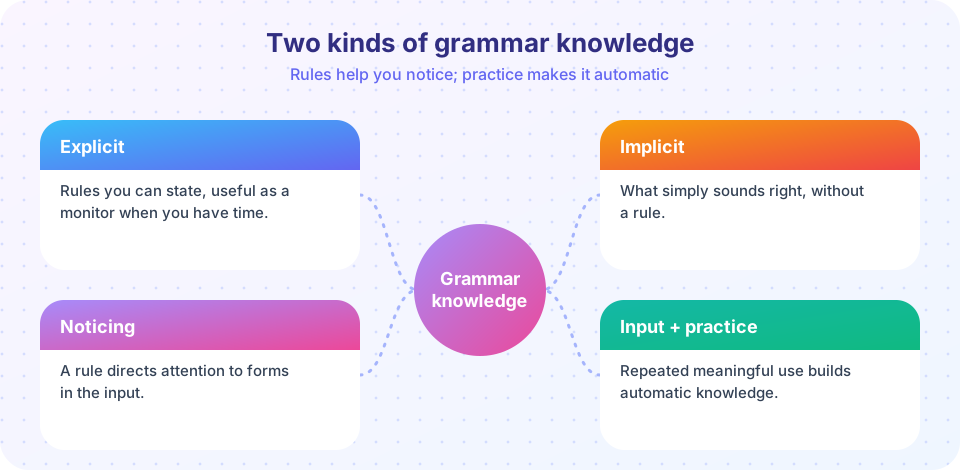
Explicit knowledge: conscious knowledge you can talk about, such as "adjectives agree with nouns".
Implicit knowledge: knowledge you use without being aware of the rule; it feels like "sounds right".
Noticing: paying conscious attention to a feature in the input.
Focus on form: briefly drawing attention to a form while the main focus is on meaning.
Two kinds of knowledge
Think of your first language. You can say that "I goed there" sounds wrong without being able to state the rule. That is implicit knowledge. A student of English as a second language might be able to state the rule for the past simple but still forget it while talking. That is explicit knowledge without automatic use.
Researchers describe three positions on how they relate:
- Non-interface. Explicit knowledge cannot turn into implicit knowledge. Stephen Krashen's early view held that learned rules only act as an editor (the "monitor") for your output, while acquisition happens through comprehensible input.
- Strong interface. Explicit knowledge can become implicit with enough practice. Robert DeKeyser's skill acquisition theory follows this path: declarative knowledge becomes procedural and then automatic.
- Weak interface. Explicit knowledge helps indirectly, by helping you notice forms in the input, which then feeds implicit learning. Rod Ellis and others have favored versions of this view.
Evidence does not make a single position the clear winner, which is partly why advice varies. The good news is that all three give similar practical advice: combine rule awareness with lots of meaningful input and practice.
The noticing hypothesis
Richard Schmidt (1990) argued that nothing is learned from input unless it is noticed. He drew on his own experience learning Portuguese, in which he kept a diary and found that forms he consciously noticed in speech later appeared in his own talk. The hypothesis is influential, though what counts as "noticing" and how much awareness is required remain debated.
The practical lesson is that grammar rules help most when they direct your attention to something real in the input. Learning a rule about the Spanish subjunctive makes you suddenly see it in songs and news; before, it was background noise.
Does explicit instruction work?
A landmark meta-analysis by John Norris and Lourdes Ortega (2000) combined dozens of studies of second language instruction. Two conclusions stood out:
- Instruction that focuses on specific forms produced large average gains compared with no focused instruction.
- Explicit approaches did better than implicit ones on average.
Later work refined the picture. Spada and Tomita (2010) found that both explicit and implicit instruction were effective, and that explicit instruction led to larger gains for several grammatical features. A meta-analysis by Goo and colleagues (2015) found that explicit instruction had advantages and that part of the explicit advantage came from tests that rely on explicit knowledge, such as grammar judgment items in which you have time to think.
So the careful conclusion is:
- Explicit instruction helps, at least in the short term and on tests that reward conscious knowledge.
- Whether it builds automatic knowledge for fluent conversation is less clear.
- Study designs often use short treatments, and results for long-term, free-speaking performance are harder to measure.
These findings come from classroom and laboratory studies. Your needs (a trip next month, an exam, a job) affect how much explicit study makes sense.
A routine: meet, notice, check, use
You can combine the best of both approaches in a short routine.
- Meet it in input. Read or listen to material with many examples of the pattern. Teachers call this input flood.
- Notice it. Highlight each example. Ask what changes and what stays the same.
- Check it. Read the rule in a grammar reference or ask a teacher. Compare it with your own guess.
- Use it. Write five sentences about your own life, then say them aloud. Do this again in a week.
Press Run (or Ctrl + Enter) to see the result here.
Program input · what you'd type while the program runs
Type the answers before you press Run, one per line. Each time the program reads a line (with input()), it gets the next line from this box.
The regular expression is rough and will miss some forms. Its job is to turn a rule into something visible in real text, which is the first step of noticing.
Using rules as a monitor
Explicit rules are especially useful when you have time: writing, careful speech and reviewing your own errors. A small checker shows the idea.
Press Run (or Ctrl + Enter) to see the result here.
Program input · what you'd type while the program runs
Type the answers before you press Run, one per line. Each time the program reads a line (with input()), it gets the next line from this box.
The rule is about sounds, not letters, which is a nice example of why a rule plus exceptions is hard to apply while speaking. A monitor works when you have time to run it.
When explicit study pays off most
Research suggests that explicit rules help some features more than others. Two ideas from the literature explain why.
First, salience. Some forms are easy to notice, such as a new word order or a clear ending like English -ing. Others are hard to notice because they are short, unstressed or add little meaning, like the English third-person -s ("she works"). Because they are easy to miss in input, a rule that points them out can help noticing.
Second, communicative value. A feature that changes meaning, such as a past tense ending, gets feedback from conversation when you get it wrong. A feature with little communicative value, such as an article in many contexts, can be wrong for years without misunderstanding, so nobody corrects it. Rules, and deliberate checks of your own writing, supply the feedback that conversation does not.
Rules also pay off when you have an exam to pass, when you are an advanced learner trying to refine accuracy, or when a pattern has a clear form that is easy to state. They pay off less for patterns with many exceptions, such as gender in many languages, where large amounts of examples and chunks work better. A sensible principle is to match the tool to the feature: rules for tidy patterns, examples and chunks for messy ones.
Common misconceptions
"Explicit grammar study is useless for speaking." It can help noticing and self-correction; it is not enough on its own for automatic use.
"Implicit learning means never studying a rule." Learning from input is powerful, but studies suggest that guidance often speeds up the process.
"More rules means better grammar." Many rules are best learned as patterns met in context. Learn the ones that explain frequent errors.
Check your understanding
Quick check · 5 questions
of 5 answered You scored / 5 · perfect!
-
1. What does the noticing hypothesis (Schmidt, 1990) claim?
Schmidt argued that noticing is necessary for input to become intake. -
2. In the weak interface position, explicit knowledge:
Explicit knowledge directs attention, and noticing feeds implicit learning. -
3. What did Norris and Ortega (2000) find on average?
Their meta-analysis found large average gains for focused instruction, with an advantage for explicit approaches. -
4. Why should explicit instruction results be read with care?
Test type and short treatments may favor explicit approaches. -
5. What is the last step in the meet-notice-check-use routine?
Using the pattern in your own sentences helps move it toward automatic use.
Summary
- Explicit knowledge is statable; implicit knowledge guides use without awareness.
- Interface positions differ, but all support combining rules with input and practice.
- Noticing is the bridge: rules help you see patterns in the input.
- Meta-analyses favor explicit instruction on average, with caveats about test types and short treatments.
- Use a meet, notice, check, use routine and a rule as a monitor when you have time.
Next: Patterns and chunks
Track your progress
Create a free account to tick off lessons and pick up where you left off on any device.
of How to Learn a Language lessons completed