


















Lesson 43 of 48 · Projects and Practice
Project: Write your 90-day language plan
Write a 90-day plan with a specific goal, weekly schedule, tools and review points, using a worked example, a plan generator and rules for adjusting at day 30 and 60.
Ninety days is long enough to see real change and short enough to keep in view. In this project you will write a plan that uses what you have learned in this course: a specific goal, a balanced weekly schedule, a small set of tools and scheduled reviews that tell you whether to continue or adjust.
The plan is a template based on principles from the research covered earlier, not a method proven in a trial. Treat the first version as a draft you will correct.
What you will learn
- How to write a 90-day plan in six steps.
- How to split weekly hours across the four strands.
- How to decide at day 30 and day 60 what to change.
- How to use a script to generate a week-by-week outline.
Key terms
Milestone: a checkpoint with a visible result, such as a recording or a finished book.
Baseline: your starting performance, recorded so you can compare later.
Minimum viable week: the smallest set of activities you will do even in a bad week.
Retrospective: a short review of what to keep, stop and start.
Step 1: Record your baseline
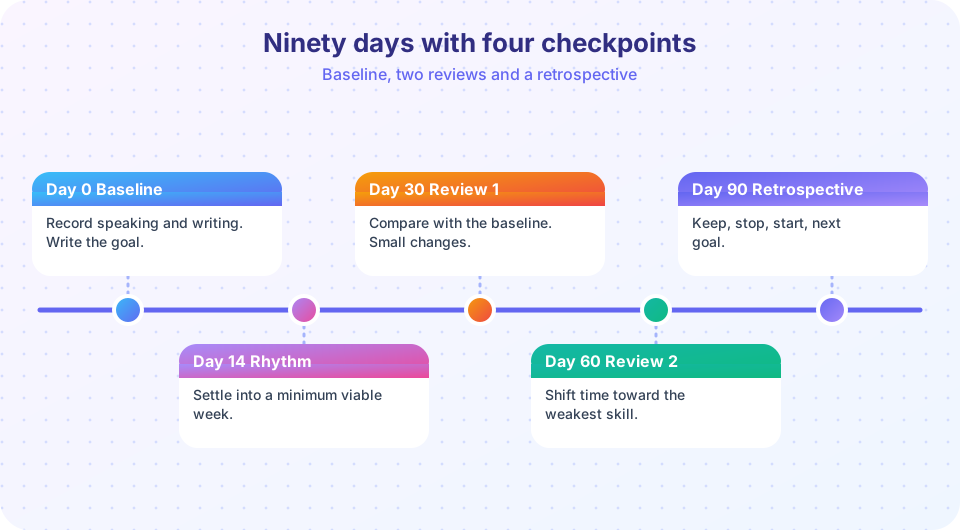
On day 0, make two recordings: one minute of speaking on a simple topic and one short piece of writing. Save them. Also write down three can-do statements you cannot yet do and want to, such as "order a meal and ask about ingredients".
A baseline matters because progress in language learning is slow day to day and invisible, so a comparison with day 0 is the best evidence you have.
Step 2: Write a goal
Use the format from the goals lesson: a task, a standard and a date.
"By day 90, I will talk with a tutor for 10 minutes about my week, understanding at least 80 percent of what they say, and ask three follow-up questions."
Make the goal slightly challenging but within reach in 90 days. If your language is far from your first language, shrink the target.
Step 3: Set your weekly time
Choose a number you can keep. Be honest: add up the real time between work and family. A minimum viable week, such as three 20-minute sessions, protects the habit when life gets busy.
Step 4: Split the hours
Use Nation's four strands. A starter split for the first month:
| Strand | Share | Examples |
|---|---|---|
| Meaning-focused input | 35% | graded readers, podcasts, videos with subtitles |
| Meaning-focused output | 25% | speaking with a tutor or partner, writing |
| Language-focused study | 20% | vocabulary review, a grammar point |
| Fluency | 20% | shadowing, repeating familiar stories |
If you have no speaking partner yet, put output time into self-talk and writing, and start finding a partner in week 2.
Step 5: Choose tools and cues
Choose one tool for each strand, not five. Link each to a cue, such as "after coffee, vocabulary review" or "on the train, podcast". Write them as if-then plans.
Step 6: Schedule reviews
Put three dates on the calendar: day 30, day 60 and day 90. Each review answers: what can I do now, what is hardest, and what will I change?
Press Run (or Ctrl + Enter) to see the result here.
Program input · what you'd type while the program runs
Type the answers before you press Run, one per line. Each time the program reads a line (with input()), it gets the next line from this box.
The shares are a starting point. Shift them according to your weak spots, for example more output if your speaking lags.
The day 30 and day 60 reviews
At each review, compare with your baseline recordings and rate your four skills from 1 to 5. Then use simple adjustment rules.
Press Run (or Ctrl + Enter) to see the console output here.
No output.
Review decisions should be modest. Changing the whole plan every month prevents you from seeing whether anything works.
The day 90 retrospective
Write four lines:
- Keep: what clearly worked.
- Stop: what you did out of habit and did not help.
- Start: one new practice.
- Next goal: the task, standard and date for the next 90 days.
Compare your day 90 recordings with day 0. Hearing the difference is a powerful motivator.
A worked example
Imagine Ana, who works full time and wants to speak with her partner's family in Portuguese. She has five hours a week at most, studied a little years ago and knows Spanish. Her goal: "By day 90, I will talk for 10 minutes with my partner's mother about daily life and understand most replies." Her plan uses 20 minutes of daily vocabulary on her phone, 40 minutes of graded readers on weekends, a one-hour tutor session once a week, and 30 minutes of shadowing. She records herself at day 0, 30, 60 and 90. At day 30, her speaking rating is lowest, so she adds a second weekly exchange. This is an invented example to show the process.
Troubleshooting your plan
Even a good plan meets problems in the first weeks. Here are the most common ones and what to do about them.
| Symptom | Likely cause | Adjustment |
|---|---|---|
| I miss most sessions | The plan is bigger than your real free time | Halve the weekly hours; keep the minimum viable week |
| I do the easy parts and skip speaking | Speaking feels risky | Book a tutor session in advance and pay for it; add a voice message partner |
| I feel bored | Materials do not match your interests | Switch to content about a hobby or topic you like |
| I do not feel progress | Progress is slow and invisible | Compare recordings and log can-do statements |
| I keep changing tools | Looking for a perfect method | Commit to one tool per strand for four weeks |
Your week 1 checklist
- Baseline speaking and writing recorded and saved.
- Goal written with a task, a standard and a date.
- Weekly time chosen, with a minimum viable week.
- One tool per strand picked.
- Cues written as if-then plans.
- Day 30, 60 and 90 reviews on the calendar.
- One person told about the goal.
If you can tick all seven boxes, you have a plan that is better than most learners start with. The rest is repetition and honesty about what works.
Common misconceptions
"Ninety days will make me fluent." It will not for most languages. It can make a clear, visible difference at a level you choose.
"If I miss a week, I must restart." Return to the minimum viable week and continue. One missed week does not erase learning.
"More hours always beat a better balance." Time matters, but a plan with no speaking is unlikely to produce speaking skill.
After day 90
At the end of the retrospective you will probably want to raise your goal. That is fine, but resist the urge to double everything. A common pattern is that learners who finish a first plan feel confident and take on twice as much, then burn out in the second month. A better approach is to keep the parts that worked, raise the difficulty of one element, such as harder texts or longer conversations, and repeat the cycle. Over several cycles, the plan becomes a habit that you adjust rather than a project you restart.
Check your understanding
Quick check · 5 questions
of 5 answered You scored / 5 · perfect!
-
1. Why record a baseline on day 0?
Language progress is slow and hard to notice, so a baseline gives evidence. -
2. What is a minimum viable week?
It protects your habit when time is short. -
3. At a review, if you did only 40 percent of planned sessions, what should you consider?
A plan you cannot follow needs to be made smaller. -
4. Which is part of the retrospective?
These four lines turn the review into a plan for the next period. -
5. In the starter split, which strand gets the largest share in the first month?
Input gets about 35 percent, the largest share.
Summary
- A 90-day plan has a baseline, a specific goal, a realistic weekly time, a four-strand split, tools with cues and reviews at day 30, 60 and 90.
- Keep a minimum viable week for busy periods.
- Make modest adjustments at reviews and finish with a retrospective.
- The plan is a template to test and revise, not a guaranteed method.
Next: Immersion at home
Track your progress
Create a free account to tick off lessons and pick up where you left off on any device.
of How to Learn a Language lessons completed