


















Lesson 20 of 48 · Listening and Pronunciation
Pronunciation training: intelligibility, minimal pairs and feedback
Accent versus intelligibility, which features matter most, how high-variability phonetic training works, and a practical routine with recording and feedback.
Few parts of language learning stir up as much emotion as accent. Some learners are desperate to sound native. Others are told "your accent is part of who you are" and wonder whether to bother. Research gives a clearer view than either slogan. It distinguishes between accent, which is about how different you sound from a reference group, and intelligibility, which is about whether people understand you. They are related but not the same, and the best-supported training methods are aimed at specific, learnable features.
This lesson covers what to aim for, the methods that have been tested, and a routine that fits into daily study.
What you will learn
- The difference between accent, comprehensibility and intelligibility
- Which features of pronunciation most affect understanding
- How high-variability phonetic training works and what it achieved
- A routine for recording, comparing and getting feedback
Key terms
Accentedness: how different speech sounds from a reference variety, as judged by listeners.
Comprehensibility: how easy it is for listeners to understand speech, often rated on a scale.
Intelligibility: how much of the message listeners actually understand, measured for example by transcription.
Segmental features: individual consonants and vowels.
Suprasegmental features: stress, rhythm and intonation that extend over syllables and phrases.
Accent is not the same as intelligibility
Murray Munro and Tracey Derwing (1995) had native listeners rate speech by learners and also transcribe what the learners said. They found that speech could be strongly accented and still fully intelligible. The ratings of accentedness were harsher than the ratings of comprehensibility, and neither predicted the transcription score perfectly. The three concepts overlap but are separate.
The consequence for training: reducing accent entirely is a harder, rarer outcome (Chapter 1, lessons 2 and 4), while improving comprehensibility is much more achievable and more valuable in everyday communication. This does not mean accent is unimportant to you. If you want to reduce your accent for personal or professional reasons, that is a legitimate goal and can be pursued. But the first priority for most learners should be the features that cause misunderstanding.
Which features matter most?
Research suggests the biggest contributors to comprehensibility are:
- Stress and rhythm. Wrong word stress and flat rhythm often hurt understanding more than a slightly off vowel. In English, stress position can change a word (record as a noun versus a verb) and stressed syllables carry much of the meaning. Studies by Derwing and Munro and colleagues found that instruction on suprasegmental features improved comprehensibility for many learners.
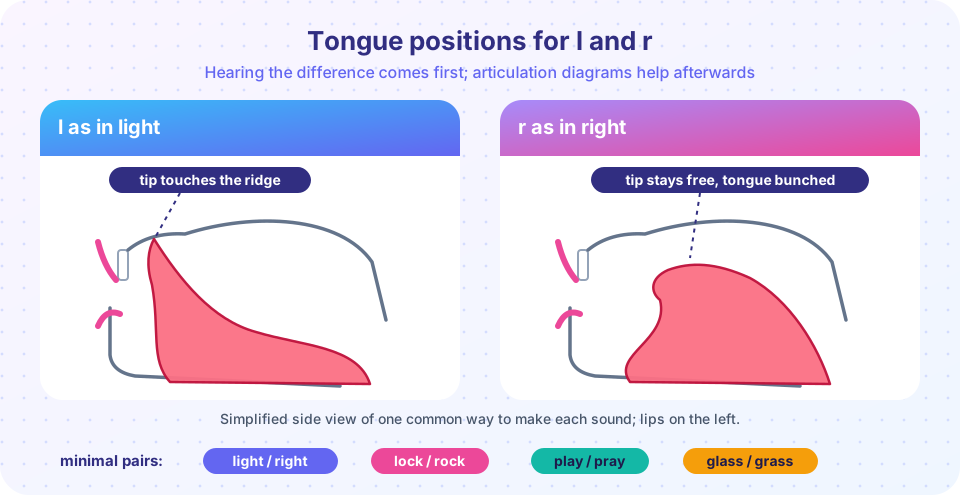
- Segmental errors that cause confusion. Errors that create other words (light for right) hurt more than errors that do not. These are the contrasts that fall in your native categories (lesson 2).
- Speaking rate and pauses. Both very slow and very fast speech reduce understanding.
For English as a lingua franca, Jennifer Jenkins (2000) proposed a "Lingua Franca Core" of features that she argued matter most for international communication: most consonant contrasts, vowel length, and the placement of nuclear stress, while minor features such as the th sounds and word-final stress patterns matter less. Her proposal is influential and debated, but it models the right kind of thinking: sort features by how much they affect being understood.
High-variability phonetic training
The best-tested method for perceptual training is high-variability phonetic training (HVPT). In a series of studies, Scott Lively, John Logan, David Pisoni and colleagues trained Japanese adult learners of English to distinguish /r/ and /l/. Listeners heard many different words, spoken by several different talkers, in several phonetic contexts, and chose which sound they heard, with immediate feedback. After about 15 sessions, they improved significantly in identification, generalized to new words and new talkers, and kept the gains months later (Logan, Lively and Pisoni, 1991; Lively and colleagues, 1993). Training with only one talker did not generalize as well, which is why variability matters.
Ann Bradlow, Pisoni and colleagues (1997) then showed that this perception training improved production: native English listeners judged the trained learners' pronunciation of /r/ and /l/ as better, even though the learners had not practiced speaking in the training, and the gains lasted three months. Later reviews, such as one by Ron Thomson and Tracey Derwing (2015), found HVPT effective for various contrasts. A caution: most studies involve laboratory training of a few contrasts, and transfer to natural conversation is smaller than gains on trained tasks.
The method has four ingredients that you can reproduce without a laboratory.
- Many talkers. Use recordings from several speakers, not one tutor.
- Many words and contexts. The target sound appears at the beginning, middle and end of words.
- A forced choice with feedback. Hear a word, pick one of two (light or right), then see the answer.
- Repetition over weeks. Fifteen sessions in the studies, so plan for a few minutes a day.
Many language apps and websites now provide minimal-pair training with multiple voices.
A production routine
Perception training helps production, but you should also train the mouth.
- Find your target contrasts. Use a pronunciation guide for your target language and your first language to see which sounds fall inside your native categories.
- Listen and identify with minimal pairs (HVPT-style) before producing.
- Learn the articulation. A diagram, a video of a side-view mouth, or a teacher's instruction explains where the tongue and lips go. Look in a mirror.
- Record yourself saying a short passage, then play it next to a native recording. Note two differences, not twenty.
- Get feedback. A teacher, tutor or speaker can tell you which differences matter. Automatic speech recognition and some apps also give visual feedback, but these tools can be inaccurate with accented speech, so use them as one source, not the judge.
- Practice rhythm. Shadow short passages (Chapter 4, lesson 3), copying stress and intonation.
- Repeat weekly, recording the same passage to track change.
"A native-like accent is the only good outcome." It is rarely reached, and it is not required for clear communication.
"Pronunciation should wait until grammar is good." Habits set early can persist, a pattern Larry Selinker called fossilization. Starting attention to sounds early helps.
"Apps with speech recognition tell me whether I sound right." They check whether the program recognizes you. That correlates with intelligibility but is not a judgment of how a person would understand you.
Try it
The first demonstration generates a minimal-pair practice sheet for a chosen contrast. You can use it with a partner who reads a word at random while you identify it, or record yourself reading both words. The pairs are English examples; for another language, replace them with pairs from your target contrast.
Press Run (or Ctrl + Enter) to see the console output here.
No output.
The second demonstration plots the English vowel space from approximate average first and second formants (F1, F2), the resonances that distinguish vowels. The values are approximate averages for adult male American English speakers reported in the classic study by Peterson and Barney (1952); individual speakers differ.
Press Run (or Ctrl + Enter) to see the result here.
Program input · what you'd type while the program runs
Type the answers before you press Run, one per line. Each time the program reads a line (with input()), it gets the next line from this box.
Check your understanding
Quick check · 5 questions
of 5 answered You scored / 5 · perfect!
-
1. Munro and Derwing (1995) found that speech can be
Accent, comprehensibility and intelligibility are related but separate. -
2. Which of these usually matters more for being understood?
Stress, rhythm and confusing contrasts affect understanding more than minor differences. -
3. What made high-variability training effective in the studies by Logan, Lively and Pisoni?
Variability helps the learner form categories that generalize to new voices and words. -
4. Bradlow and colleagues (1997) found that perception training
Listening training transferred to speaking, and the improvement lasted months. -
5. Why use speech-recognition feedback with caution?
Recognition correlates with intelligibility but is not the same, and it can fail on accented speech.
Summary
- Accent, comprehensibility and intelligibility are separate; train for being understood first.
- Stress, rhythm and meaning-changing contrasts matter most.
- High-variability phonetic training improves perception and production with many talkers and feedback.
- Record, compare and get human feedback; use apps as one source.
- Start early and keep sessions short and regular.
Next: Chapter 4 review
Track your progress
Create a free account to tick off lessons and pick up where you left off on any device.
of How to Learn a Language lessons completed