


















Lesson 15 of 48 · Vocabulary and Spaced Repetition
Choosing words to learn: frequency, Zipf's law and coverage
Why a few hundred words dominate speech, how Zipf's law shapes vocabulary, how to use frequency lists, and when to learn chunks and topic words instead.
A learner has a limited number of hours and a language with hundreds of thousands of words. Which words should come first? The answer has a mathematical backbone. Words are used very unevenly: a small group of words does most of the work, and a huge number of words appear rarely. Knowing this pattern lets you choose words by their return on investment instead of by the order of a textbook's chapters.
This lesson explains the pattern (Zipf's law), shows how frequency lists and coverage figures work, and then adds the cautions that stop frequency from being the whole story.
What you will learn
- What Zipf's law says and what it implies for vocabulary choice
- How coverage figures guide what to learn first
- Where frequency lists come from and how to use them
- When to depart from pure frequency: topics, chunks and personal needs
Key terms
Corpus: a large, organized collection of real texts or transcripts used to study language.
Frequency rank: the position of a word in a list sorted from most to least common.
Zipf's law: the observation, by George Kingsley Zipf, that a word's frequency is roughly inversely proportional to its rank.
Range: the number of different texts or topics a word appears in, as opposed to total count.
Formulaic sequence (chunk): a multiword unit stored and used as a whole, such as by the way or I would like.
Zipf's law
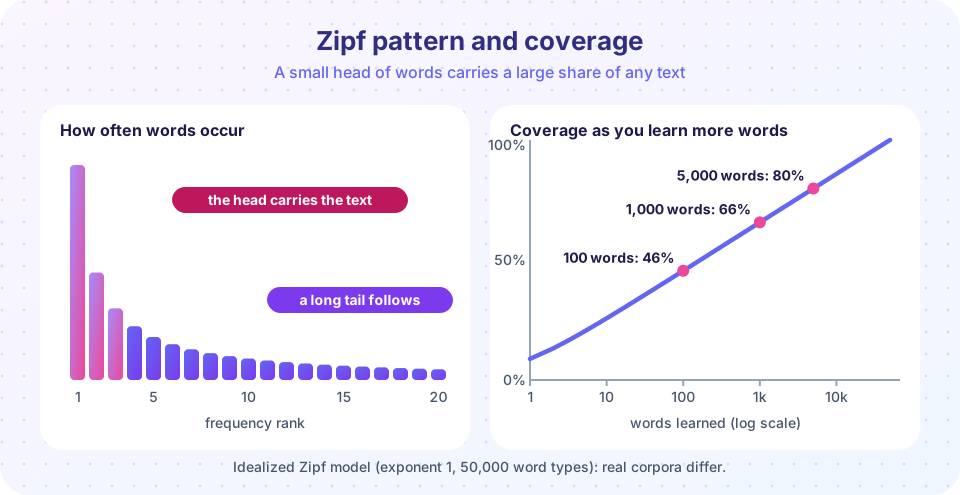
In the 1930s and 1940s, the linguist George Kingsley Zipf counted words in large bodies of text and found a striking regularity. If you rank words from most to least frequent, the frequency of the word at rank r is roughly proportional to 1/r. The most frequent word occurs about twice as often as the second, three times as often as the third, ten times as often as the tenth.
In English, the alone accounts for roughly 6 to 7 percent of the words in typical texts, and the ten most frequent words together make up around a fifth of all running words, mostly small function words (the, of, and, to, a, in). This pattern appears in many languages, though the details differ, and it appears for other things too, such as city sizes. Its exact cause is still debated, so treat it as an empirical regularity rather than a deep law.
The shape has two consequences.
- A small head carries a lot of the text. The most frequent words recur everywhere, so a small vocabulary gives disproportionate coverage.
- A very long tail exists. Many words occur only once in a corpus. Each is rare, but there are so many that together they make up a noticeable share of any text. That is why the last few percent of coverage are so expensive, as lesson 1 of Chapter 2 showed.
Coverage: what a few thousand words buy
Researchers count how much of a text is covered by the top N words. Estimates depend on the corpus and on whether you count word forms, lemmas or word families, but the pattern is consistent.
- Paul Nation's work on English suggests that the first 2,000 word families account for something like 80 percent of the running words in most written texts.
- For spoken English, which is simpler in vocabulary, Svenja Adolphs and Norbert Schmitt (2003) studied a corpus of casual conversation and found that around 2,000 word families gave about 95 percent coverage. Gains after that were slow.
- To reach the 95 to 98 percent coverage that makes independent reading comfortable, written text needs several thousand more families (about 8,000 to 9,000 for novels and newspapers, Nation 2006).
Reading these figures correctly: the first 1,000 to 2,000 words are vital and the biggest bargain in language learning. The next few thousand give steadily smaller returns, but are necessary for ease. The long tail of rare words is best learned incidentally, from reading, once the base is in place.
"Learn the 100 most common words and you can speak the language." They give coverage of text, but common words are mostly function words, which are hard to use without grammar. Coverage of tokens is not the same as being able to say what you want.
"Frequency lists are the final authority." They reflect the corpus they came from. A list built from news text underrepresents conversational words, and a list built from subtitles has a different flavor.
"Rare words are not worth learning." They are not worth learning first. If a topic matters to you (medicine, football), its words are valuable for you even if they are rare in general.
Where frequency lists come from, and what to use
Frequency lists are built by counting words in corpora. Well-known examples for English include Michael West's General Service List (1953, about 2,000 word families), Averil Coxhead's Academic Word List (2000, 570 word families common in university texts), and more recent lists built from larger corpora, such as the New General Service List by Charles Browne and colleagues (2013). For many other languages, you can find frequency dictionaries or corpus-based lists built from subtitles, news and web text; subtitle-based lists are often a good guide to spoken language.
How to use a list:
- Start at the top and work down in blocks of a few hundred, skipping words you already know.
- Check the list's type. Conversation lists suit speaking goals; news lists suit reading goals; academic lists suit study abroad.
- Mind inflected forms. Learn the lemma and the main forms together; do not treat run, ran and running as separate unrelated items.
- Use range. A word that appears in many texts is more useful than one that appears many times in a single text.
Beyond frequency: three adjustments
1. Topics and personal need. Combine a general frequency core with a list of words for your own situation: your job, hobbies, family, city. Words you will use this week are worth more than abstractly frequent ones you will not.
2. Chunks. Much everyday speech consists of ready-made sequences. Alison Wray (2002) called them formulaic sequences, and Andrew Pawley and Frances Syder (1983) argued that nativelike fluency depends on a large store of them. Learning I would like..., How do I get to...? and What do you mean? as units gives you fluent output from day one, with the grammar learned later by analysis.
3. Avoid clustering similar items. It seems natural to learn all colors or all days of the week at once. But studies by Tinkham (1993), Waring (1997) and others found that learning sets of semantically related words together can slow learning, because the words compete in memory and are confused with one another. A more effective approach is to spread them out and group words by theme only when they are not close in meaning, or after the individual words are secure.
A balanced word diet. Roughly: a general high-frequency core first, chunks for communication, a personal topic list for your goals, and the long tail learned through reading and listening.
Try it
The first demonstration plots an idealized Zipf distribution and its cumulative coverage for a vocabulary of 50,000 word types. Real texts differ in detail, so treat the numbers as a model of the shape, not as counts for any language.
Press Run (or Ctrl + Enter) to see the result here.
Program input · what you'd type while the program runs
Type the answers before you press Run, one per line. Each time the program reads a line (with input()), it gets the next line from this box.
The second demonstration counts words in a short text and shows how few words carry a large share of it. It works on any text you paste; a real analysis needs a much larger corpus.
Press Run (or Ctrl + Enter) to see the console output here.
No output.
Check your understanding
Quick check · 5 questions
of 5 answered You scored / 5 · perfect!
-
1. Zipf's law says that a word's frequency is roughly
The most frequent word occurs about twice as often as the second, three times as often as the third, and so on. -
2. Why is the last 2 percent of coverage so expensive?
The long tail contains many words, so reaching the last percent needs thousands more words. -
3. A good reason to avoid learning a whole set of near-synonyms at once is that
Studies by Tinkham and Waring found that semantically clustered sets were harder to learn than unrelated sets. -
4. Which is a limitation of frequency lists?
A list built from news differs from one built from conversation, so match the list to your goals. -
5. Why learn chunks such as 'I would like...' early?
Formulaic sequences let you communicate quickly and can be analyzed later.
Summary
- Word frequencies follow a Zipf pattern: a small head of very common words and a very long tail.
- The first 1,000 to 2,000 words give a large share of coverage; each later thousand gives less.
- Choose lists that match your goal (spoken, written, academic) and learn lemmas with their main forms.
- Add personal topic words and chunks to the frequency core.
- Spread near-synonyms out; learn the long tail from reading and listening.
Next: Chapter 3 review
Track your progress
Create a free account to tick off lessons and pick up where you left off on any device.
of How to Learn a Language lessons completed