


















Lesson 5 of 48 · Getting Started
Chapter 1 review: Getting started
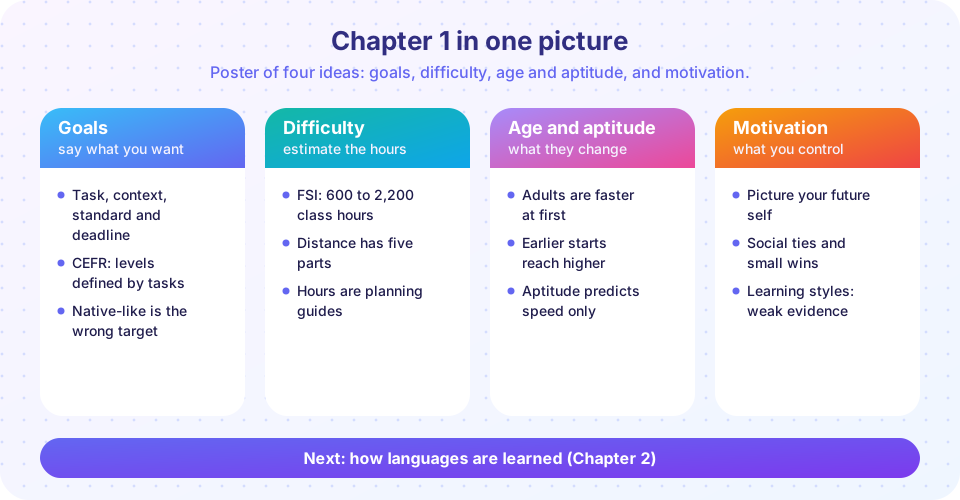
A one-picture recap of Chapter 1 on goals, fluency, FSI difficulty, age, aptitude and motivation, with a recap table, flashcards and a ten-question quiz.
Chapter 1 asked four questions before any studying begins: What exactly do I want? How long will it take? Is it too late for me? What is in my control? This review pulls the answers into one picture, then tests you on them. Remember the course advice: try the quiz from memory first, and come back in a few days to try again.
What you will learn
- A compact summary of the four lessons of Chapter 1
- How the ideas combine into a first plan
- Which claims from this chapter are firm and which are open
Key terms
CEFR: the A1 to C2 scale built on can-do descriptions.
FSI categories: four planning bands of difficulty for English speakers.
Ultimate attainment: the level a learner eventually reaches.
Aptitude: abilities that predict the speed of learning.
Ideal L2 self: a picture of your future self using the language.
The chapter in a table
| Lesson | Main idea | Firmness of evidence |
|---|---|---|
| Goals and fluency | Replace "fluent" with a task, context, standard and deadline; use the CEFR as a task scale; do not aim for native-like | Strong on definitions; the CEFR is a framework, not an experiment |
| How hard is your language | FSI categories give order-of-magnitude hours; distance has five parts; time depends on practice quality | Moderate: institutional estimates for a narrow group |
| Age, aptitude, motivation | Older learners are faster at first; earlier starters reach higher ceilings; aptitude predicts rate; motivation correlates moderately with results | Moderate to strong for the main patterns; mechanisms are debated |
| Learning styles and bilingual claims | Matching teaching to style has not been supported; bilingual brain-boost claims are weak | Strong against matching; open on dementia delay |
Putting it together: a first plan
A sensible first plan uses all four lessons.
- Write the goal (lesson 2): "In nine months I will describe my work and weekend to a colleague for 15 minutes."
- Estimate the hours (lesson 3): a Category I language at conversation level may need several hundred hours. At 5 hours per week for 40 weeks that is 200 hours, so either lower the standard or raise the time.
- Account for who you are (lesson 4): you are an adult, so you will learn fast early and should push pronunciation practice from the start, since accent is most age-sensitive. You will not depend on talent; you will depend on hours well spent.
- Protect motivation (lesson 4): attach the goal to a person or a place, and fix a minimum session that you can do on a bad day.
"The numbers in this chapter are exact." They are planning figures from institutions and large but self-selected samples. Use them to avoid absurd plans, not to predict your own date.
"If I am slower than the table, I am bad at languages." Study time, prior experience, exposure and practice quality all differ from the examples used in studies.
Try it
The first demonstration turns the recap into flashcards. Click a card to flip it; nothing is stored. Note that real retrieval practice means trying to answer before you flip.
The second demonstration builds a first weekly plan from your goal. The split is a reasonable starting point based on the research in this course, not a prescription.
Press Run (or Ctrl + Enter) to see the console output here.
No output.
Check your understanding
Quick check · 10 questions
of 10 answered You scored / 10 · perfect!
-
1. Which is the best-formed goal?
It names a task, a context, a standard and a deadline, so you can test it. -
2. The CEFR defines levels mainly by
The CEFR uses can-do descriptors rather than hours or word counts. -
3. Why can two learners with equal study hours reach different results?
Hours are necessary, but distance and the quality of practice change what the hours buy. -
4. The FSI categories were designed for
That narrow group is why the figures are planning guides, not general laws. -
5. Over the first year of learning, who tends to progress faster?
Snow and Hoefnagel-Höhle found older learners faster at first, while earlier starters tend to reach higher ceilings. -
6. Which language skill is the most age-sensitive?
Studies by Flege and others show foreign accent grows with age of arrival. -
7. Aptitude mainly predicts
Aptitude correlates moderately with rate, and time and good practice can compensate. -
8. A correlation of 0.3 between motivation and achievement tells you that
Correlation does not show cause; success may also raise motivation. -
9. What did Pashler and colleagues (2008) find about learning styles?
They searched for studies that tested matching and found no adequate support. -
10. Which is NOT a good reason to learn a language?
Early bilingual-advantage claims have weakened under larger studies, so do not rely on a brain boost.
Summary
- Set a testable goal, not "be fluent."
- Treat FSI and CEFR figures as planning guides.
- Age shifts the ceiling and the accent, not your ability to reach a useful level.
- Aptitude affects speed; time and quality can make up for it.
- Chapter 2 asks the main question: how does learning actually happen?
Track your progress
Create a free account to tick off lessons and pick up where you left off on any device.
of How to Learn a Language lessons completed