


















Lesson 8 of 48 · How Languages Are Learned
Output and interaction: why speaking and feedback matter
Why understanding is not enough: Swain's output hypothesis, Long's interaction hypothesis, recasts versus prompts, and how to get useful speaking practice as a self-learner.
Imagine a student who has attended French immersion classes for years. She understands her teacher, reads novels and follows films. Ask her to speak and her sentences come out with the wrong gender on nouns, missing verb endings and a limited range of structures. How can years of understanding not produce accurate speech?
This puzzle, noticed by the Canadian researcher Merrill Swain in the 1980s, led to a major idea: understanding and producing are different mental jobs, and production teaches things that listening cannot. This lesson covers that idea, the related work on conversation and feedback, and what it means for how you should practice speaking.
What you will learn
- The output hypothesis and the three jobs Swain says output does
- Michael Long's interaction hypothesis and "negotiation of meaning"
- How recasts, prompts and other feedback differ and what research found about them
- Practical ways to get real output and feedback when you study alone
Key terms
Output hypothesis: Swain's claim that producing language, not just comprehending it, is necessary for acquiring accurate use.
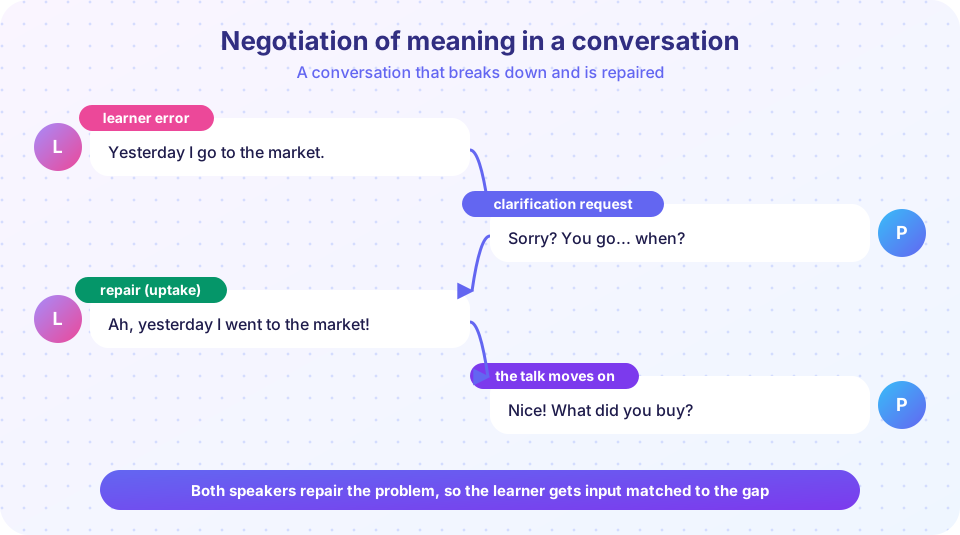
Negotiation of meaning: the back-and-forth in which speakers check and repair understanding ("Sorry, what do you mean?").
Recast: a reply that repeats what a learner said in corrected form, without pointing out the mistake.
Prompt: feedback that pushes the learner to correct themselves, such as "Yesterday I...?" or "Say that again."
Uptake: the learner's immediate response to feedback, such as repeating the corrected form.
Swain and the output hypothesis
Swain studied grade 6 students in French immersion programs in Canada, where much of the school day was taught in French. They scored well on comprehension and they were fluent in an everyday way, but their grammar in speaking and writing lagged behind. Swain proposed in 1985 that comprehensible input is necessary but not sufficient. You also need pushed output: being made to produce language that is precise and appropriate.
Why would producing help? Swain suggested three functions.
- The noticing function. When you try to say something and cannot, you notice a gap in your knowledge. "I want to say that I would have gone, but I do not know how." That moment of struggle focuses attention on forms you were able to ignore when listening.
- The hypothesis-testing function. When you say something, you are testing a guess about how the language works. The reply you get tells you whether your guess was right.
- The metalinguistic function. Talking and writing about language itself, such as working out with a partner why a sentence is wrong, strengthens conscious knowledge.
Listening allows a shortcut: you can understand a sentence from content words and context while ignoring the grammar. Speaking removes the shortcut. You must choose endings, word order and articles, and that is what practice builds.
The evidence is mixed in its details but supportive in outline. Laboratory studies of "pushed output" show that learners who produce and receive feedback learn the targeted forms better than learners who only listen. Swain herself later emphasized collaborative dialogue, where learners talk through language problems together.
Long and the interaction hypothesis
Michael Long, in 1981 and 1996, focused on conversation. When a native speaker talks to a learner and something is unclear, they adjust: they repeat, slow down, rephrase or check. Long called this negotiation of meaning. He argued it helps because it gives learners input that is tailored to what they did not understand, makes them notice problems and gives feedback.
Examples of negotiation moves:
- Clarification request: "Sorry, what?"
- Confirmation check: "You went to the market?"
- Comprehension check: "Do you see what I mean?"
A meta-analysis by Alison Mackey and Jaemyung Goo (2007) combined dozens of studies and found that learners who took part in interaction improved more than control groups, with effects that lasted over time. Interaction clearly helps. What is less clear is which part of interaction helps most: the extra input, the push to produce, or the feedback.
Feedback: recasts and prompts
When a learner makes an error, the other person can respond in several ways.
| Type | Example (learner: "Yesterday I go to market") | What happens |
|---|---|---|
| Recast | "Oh, you went to the market yesterday?" | Correct form is given back; learner may not notice it as a correction |
| Clarification request | "Sorry, when?" | Signals a problem without showing the fix |
| Prompt (elicitation) | "Yesterday I...?" | Pushes the learner to produce the correct form |
| Explicit correction | "Say 'went', not 'go'." | Directly supplies the form and says it is wrong |
| No feedback | "Nice. What did you buy?" | The error passes uncorrected |
Roy Lyster and Leila Ranta (1997) analyzed French immersion classrooms and found that teachers used recasts most of the time, but recasts led to the learner correcting themselves much less often than prompts did. In casual conversation, a recast often sounds like a natural reply, and learners may take it as agreement rather than as correction. A later meta-analysis by Lyster and Kazuya Saito (2010) found that corrective feedback in general helped learning, and that prompts were at least as effective as recasts in classroom studies. Other work, for example by Alison Mackey and Jenefer Philp (1998), suggests recasts can help when learners are ready for the form and notice the contrast.
A fair summary: feedback matters, learners need to notice it, and the best type depends on the learner and the error.
"Correction ruins confidence." Excessive correction can, but no feedback leaves errors fossilized. Most learners say they want correction; the issue is how it is done.
"Talking to natives is automatically good practice." If the native speaker simplifies endlessly, switches to English, or never lets you finish a sentence, you get little pushed output. Quality of interaction matters more than who the partner is.
Nation's four strands: a way to balance it all
Paul Nation, a vocabulary researcher, suggested that a balanced course should spend roughly equal time on four strands: meaning-focused input (reading and listening for understanding), meaning-focused output (speaking and writing to communicate), language-focused learning (deliberate study of vocabulary, grammar and sounds) and fluency development (practicing what you already know at speed). This lesson covers the second strand; the others appear in the neighbouring lessons.
Getting output when you study alone
You do not need a native speaker in your living room. Options, ordered from easiest to most demanding:
- Private speech. Describe what you are doing in the target language, or retell a story aloud. It is imperfect (there is no feedback) but it exposes gaps. Note the words you lacked and look them up afterwards.
- Writing with delayed feedback. Write a short paragraph daily, then compare it with a corrected version from a tutor, a language exchange partner or software.
- Recorded speaking. Record two minutes on a topic, listen back, note errors and gaps, and record again. This is a version of Swain's noticing loop.
- Paid tutoring or exchange. A tutor trained to give feedback is the most reliable source. Ask explicitly: "Please interrupt me when I make a mistake with verb tenses."
- Group classes or clubs. Cheaper, with less speaking time per person, so check how many minutes you actually talk.
A rule of thumb from classroom research: in many classes the teacher talks for most of the lesson. Counting your own speaking minutes is a good test of any program.
Try it
The first demonstration is a small conversation simulator. You are the tutor; choose a response to a learner's mistake and read what research would predict about its effect. It is a demonstration, not a model of any real learner.
The second demonstration counts talk time. Many learners are surprised at how little they speak in a lesson. Edit the turns below.
Press Run (or Ctrl + Enter) to see the console output here.
No output.
Check your understanding
Quick check · 5 questions
of 5 answered You scored / 5 · perfect!
-
1. Swain's observation that immersion students understood French well but spoke with errors suggested that
Her output hypothesis says producing language forces you to process grammar, which listening can skip. -
2. Which is NOT one of the functions Swain proposed for output?
Output has noticing, hypothesis-testing and metalinguistic functions; it does not replace input. -
3. A recast is
Recasts give the correct form implicitly; learners often do not realize it is a correction. -
4. Lyster and Ranta (1997) found that, compared with recasts, prompts
In the immersion classrooms they studied, prompts produced more repair by learners than recasts did. -
5. You study alone. Which activity best supplies pushed output and feedback?
Writing forces production, and delayed correction supplies the feedback.
Summary
- Understanding and producing are different jobs; output pushes you to process grammar.
- Swain's output hypothesis names noticing, hypothesis-testing and metalinguistic functions.
- Long's interaction work shows that negotiating meaning gives tailored input and feedback; meta-analyses find it helps.
- Prompts often lead to more self-correction than recasts, but all feedback depends on the learner noticing it.
- Get output by speaking, writing and recording, and check how much you talk.
Track your progress
Create a free account to tick off lessons and pick up where you left off on any device.
of How to Learn a Language lessons completed