


















Lesson 48 of 48 · Projects and Practice
Further study: where thermodynamics leads next
Plan your next steps after engineering thermodynamics: heat transfer, fluid mechanics, power systems, aerodynamics, materials, advanced topics and ways to practice.
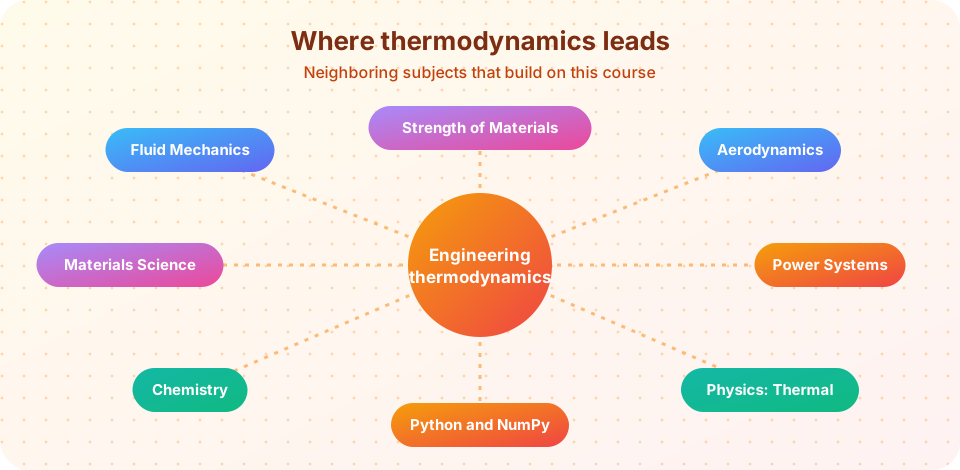
You now have the core toolkit of engineering thermodynamics: properties and states, the two laws, power and refrigeration cycles, mixtures, humid air and combustion. This closing lesson shows how these ideas connect to other subjects on this site and in engineering generally, and offers a plan for continuing.
What you will learn
- See which subjects build directly on thermodynamics.
- Choose a study path that matches your interests.
- Know which advanced topics lie beyond this course.
What you have covered
Looking back over the whole course: you defined systems and states, used property tables and the ideal gas model, applied the first law to closed and open systems, met entropy and the second law, and then used all of that to analyze Rankine, Otto, Diesel and Brayton power cycles, vapor-compression refrigeration and heat pumps, ideal gas mixtures, moist air and air-conditioning processes, and combustion with flame temperature. That is the content of a first university course in engineering thermodynamics.
Connected tracks on this site
| Track | How it connects |
|---|---|
| Fluid Mechanics | Turbines, compressors, nozzles and pumps are fluid machines. Their real efficiency depends on flow, which fluid mechanics explains. |
| Aerodynamics | Compressible flow and gas dynamics build on the Brayton cycle, isentropic relations and the speed of sound. |
| Power Systems | The electricity generated by the plants you analyzed has to be transmitted, controlled and protected. |
| Materials Science | Turbine inlet temperatures and boiler pressures are limited by materials: creep, fatigue and corrosion. |
| Strength of Materials | Pressure vessels, pipes and turbine discs are designed with stress analysis. |
| Physics: Thermal and Modern | The kinetic theory and statistical meaning of temperature and entropy behind the laws. |
| Chemistry: Energy and Equilibrium | The chemical equilibrium and reaction energetics that underlie combustion and dissociation. |
| Python and NumPy | Property libraries, cycle simulation and data analysis for real plants. |
Topics beyond this course
Heat transfer. Conduction, convection and radiation tell you how big the boiler, condenser and heat exchanger must be to move the heat that thermodynamics says must move. It is the natural next course.
Exergy analysis. Exergy measures the work potential of a state relative to the surroundings and pinpoints where cycles lose it. It turns the second law into a design tool.
Chemical equilibrium and dissociation. The next level of combustion analysis uses Gibbs free energy and equilibrium constants to predict real flame temperature and emissions.
Real-gas behavior and property models. Equations of state (van der Waals, Peng–Robinson), generalized compressibility charts and property libraries replace the ideal gas model at high pressures.
Compressible flow. Nozzles, diffusers and shock waves combine thermodynamics with fluid motion.
Fuel cells, batteries and renewable heat. Electrochemical conversion avoids the Carnot limit, while solar-thermal, geothermal and heat-pump systems apply the same cycles to different sources.
Statistical thermodynamics. It derives macroscopic laws from molecular behavior and explains entropy as a count of microstates.
How to keep practicing
- Work problems from several sources. Use different textbooks and exam papers; the same concept appears in many guises.
- Learn to use property software. Property libraries for steam, refrigerants and combustion products save hours and let you explore parameter studies.
- Build small simulations. A Python script that varies the pressure ratio, compressor efficiency or reheat pressure teaches more than one hand calculation.
- Study real equipment. Look at the data sheet of a gas turbine, a heat pump or a boiler, and check the numbers with the formulas of this course.
- Teach someone. Explaining why a heat pump delivers more heat than the electricity it uses is a good test of understanding.
Key terms
Exergy is the maximum useful work obtainable from a system as it comes to equilibrium with its surroundings. Heat exchanger is a device that transfers heat between two fluids. Compressibility factor Z measures the departure of a real gas from ideal behavior. Equation of state is a relation among pressure, volume and temperature.
Try it
Press Run (or Ctrl + Enter) to see the console output here.
No output.
Press Run (or Ctrl + Enter) to see the result here.
Program input · what you'd type while the program runs
Type the answers before you press Run, one per line. Each time the program reads a line (with input()), it gets the next line from this box.
Check your understanding
Quick check · 4 questions
of 4 answered You scored / 4 · perfect!
-
1. Which subject tells you how large a boiler or condenser must be to transfer the heat?
Thermodynamics gives the amount of heat; heat transfer gives the rate and the required area. -
2. What does exergy measure?
It is the work potential and shows where cycles destroy it. -
3. Why do real gases need equations of state beyond the ideal gas law?
Intermolecular forces and finite molecular volume matter in dense gases. -
4. Which advanced topic explains entropy as a count of microstates?
Boltzmann's S = k ln W connects entropy to microstates.
Summary
- You have the toolkit for a first course: properties, laws, power and refrigeration cycles, mixtures, humid air and combustion.
- Heat transfer, fluid mechanics, materials and power systems are the natural next steps.
- Exergy, chemical equilibrium and real-gas models deepen the analysis.
- Practice with simulations, property software and real equipment data.
Back to the course page: Engineering Thermodynamics
Track your progress
Create a free account to tick off lessons and pick up where you left off on any device.
of Engineering Thermodynamics lessons completed