


















Lesson 25 of 48 · Power Cycles
Reheat and regeneration
Learn how reheating steam and bleeding steam to feedwater heaters push Rankine efficiency higher, with an open feedwater heater mass balance worked step by step.
The simple Rankine cycle in the last lesson has two weaknesses. Its average heat-addition temperature is low because the cold liquid from the pump enters the boiler far below boiling temperature, and its turbine exit can be too wet. Real stations fix both problems with two tricks: reheat and regeneration. Almost every large steam plant on Earth uses both.
What you will learn
- Describe how reheat changes the turbine path and the exit quality.
- Explain why regeneration raises the average temperature of heat addition.
- Solve the mass balance of an open feedwater heater for the bleed fraction
y. - Compute the efficiency gain for a worked example.
Key terms
Reheat is expanding steam partway, heating it again at constant pressure, then finishing the expansion. Regeneration is using steam extracted from the turbine to preheat the feedwater. Open feedwater heater is a mixing chamber where bled steam and liquid mix directly. Bleed fraction y is the mass of steam extracted per kilogram flowing through the boiler.
Reheat: expand, heat again, expand
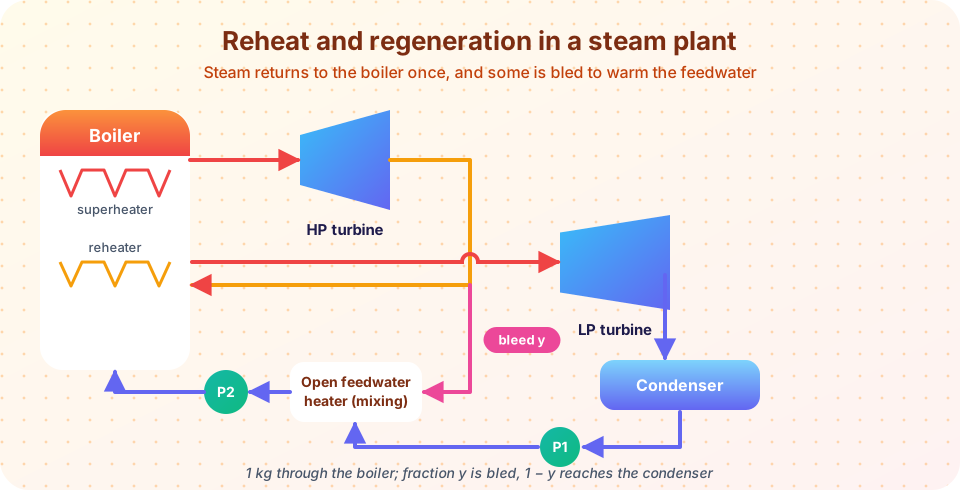
Raising the boiler pressure raises efficiency, but expanding from a very high pressure to the condenser pressure drives the exit state deep into the wet region. Reheating fixes that. The steam expands through a high-pressure turbine to an intermediate pressure, returns to the boiler's reheater where it is heated at constant pressure (often back to the original temperature), and then expands through the low-pressure turbine to the condenser pressure.
Two benefits follow. First, the steam enters the low-pressure turbine with more entropy, so it leaves drier, protecting the blades. Second, a part of the heat is added at high temperature, which raises the average temperature of heat addition. The gain in efficiency is modest, a few percent of the plant's efficiency, but the drier exhaust is often the main reason to reheat. The total turbine work is w_turb = (h₃ − h₄) + (h₅ − h₆) and the total heat input is q_in = (h₃ − h₂) + (h₅ − h₄), where states 3 and 5 are the two high-temperature points.
Regeneration: warm the water before it enters the boiler
In the simple cycle the feedwater enters the boiler at the pump's exit state, so heat from the flame is spent warming cold liquid. That heat is added at low temperature, which drags the average down. Regeneration removes this by bleeding some steam from the turbine and using it to warm the liquid.
The steam bled out no longer produces work in the rest of the turbine, but it also never reaches the condenser, so it does not reject heat there. The accounting works out in favor of the cycle: the heat in the bled steam is recovered instead of discarded.
Open feedwater heater
In an open feedwater heater the bled steam mixes directly with the liquid. Take 1 kg of steam entering the high-pressure turbine. A fraction y is extracted at the heater pressure; the remaining 1 − y goes on to the condenser and returns through the first pump. Both streams enter the heater and leave as saturated liquid at the heater pressure. The energy balance for an adiabatic mixing chamber gives:
y h₅ + (1 − y) h₂ = h₆
so
y = (h₆ − h₂) / (h₅ − h₂)
Here h₅ is the extracted steam, h₂ is the liquid from the first pump and h₆ is saturated liquid at the heater pressure. The mixture leaves at h₆, and a second pump raises it to boiler pressure.
Worked example
Use the earlier plant (4 MPa, 400 °C, 10 kPa) and add one open feedwater heater at 1 MPa. To keep the arithmetic readable we use round, illustrative values for the extraction state: h₅ = 2800 kJ/kg, and we reuse h₄ = 2144.0 kJ/kg as the condenser inlet. A real design would take h₅ from the isentropic path.
| Quantity | Value |
|---|---|
h₁ (saturated liquid, 10 kPa) |
191.8 kJ/kg |
w_p1 = v ΔP to 1 MPa |
1.0 kJ/kg, so h₂ = 192.8 |
h₆ (saturated liquid, 1 MPa) |
762.5 kJ/kg |
w_p2 = 0.001127 × (4000 − 1000) |
3.38 kJ/kg, so h₇ = 765.9 |
Bleed fraction: y = (762.5 − 192.8) / (2800 − 192.8) = 0.2185.
Turbine work per kilogram of steam entering: (3213.6 − 2800) + (1 − 0.2185)(2800 − 2144) = 413.6 + 512.7 = 926.3 kJ/kg. Pump work: (1 − 0.2185)(1.0) + 3.38 = 4.16 kJ/kg. Heat in: 3213.6 − 765.9 = 2447.7 kJ/kg. Net work: 922.1 kJ/kg.
η = 922.1 / 2447.7 = 37.7 %
The simple cycle gave 35.3 %, so one heater adds about 2.4 percentage points. Real plants use five to eight heaters, mostly closed heaters (shell-and-tube, no mixing) that need drains and a more careful balance but avoid extra pumps.
Why not bleed everything?
With infinitely many heaters the feedwater is heated along the liquid line, and the cycle gets the same average heat-addition temperature as a Carnot cycle. Each additional heater costs money, space and pressure drop, so engineers stop when the next heater no longer pays back its cost in fuel.
Common misconceptions
"Bled steam is lost energy." Its heat goes into the feedwater, so it is recovered, not lost. "Reheat is just for more power." The main gain is a drier exhaust and a modest efficiency gain. "More reheat stages always pay." Beyond two stages the gain does not justify the pipework.
Try it
Press Run (or Ctrl + Enter) to see the result here.
Program input · what you'd type while the program runs
Type the answers before you press Run, one per line. Each time the program reads a line (with input()), it gets the next line from this box.
Check your understanding
Quick check · 5 questions
of 5 answered You scored / 5 · perfect!
-
1. What is the main purpose of reheating steam?
Reheat moves the expansion path to the right on the T-s diagram, so the last stages see drier steam, and some heat is added at high temperature. -
2. In an open feedwater heater, bled steam and feedwater...
Open means direct contact mixing. Closed heaters use tube walls. -
3. What is y in y = (h6 − h2) / (h5 − h2)?
It comes from the energy balance of the mixing chamber and is the bled mass per kilogram flowing through the boiler. -
4. Why does regeneration raise efficiency?
Warm feedwater means less heat is added at low temperature, raising the average heat-addition temperature. -
5. In the worked example, y = 0.2185. What mass flows through the condenser per kilogram entering the turbine?
1 − 0.2185 = 0.7815 kg continues to the condenser.
Summary
- Reheat splits the expansion in two and reheats in between, giving drier exhaust and a small efficiency gain.
- Regeneration bleeds steam to warm the feedwater so heat is added at a higher average temperature.
- For an open heater,
y = (h₆ − h₂) / (h₅ − h₂). - The worked example rises from 35.3 % to about 37.7 % with one heater (illustrative extraction state).
Next: Otto and Diesel engines
Track your progress
Create a free account to tick off lessons and pick up where you left off on any device.
of Engineering Thermodynamics lessons completed