


















Lesson 15 of 48 · The First Law
Steady-Flow Devices
Apply the steady-flow energy equation to turbines, compressors, pumps, nozzles, throttling valves and heat exchangers, with worked examples and the assumptions behind each.
A power plant, a jet engine and an air conditioner are all built from a small set of components, each doing one job to a flowing fluid. Once you know the energy equation, every component reduces to a short formula because most terms are zero. This lesson goes through the five classic devices and shows how to spot which terms to drop.
What you will learn
- The simplifying assumptions typical of each device.
- The energy relation for turbines, compressors, pumps, nozzles, throttles and heat exchangers.
- How to calculate work, exit velocity, exit state and heat rate.
- Why throttling is a constant-enthalpy process.
Key terms
Turbine: a device that produces shaft work by expanding a fluid.
Compressor / pump: devices that consume shaft work to raise pressure of a gas / liquid.
Nozzle / diffuser: ducts that accelerate / decelerate a fluid by changing area.
Throttling valve: a restriction that drops pressure without work or significant heat transfer.
The master equation
q − w = (h₂ − h₁) + (V₂² − V₁²)/2 + g (z₂ − z₁) (per kg), or Q̇ − Ẇ = ṁ [Δh + ΔKE + ΔPE].
For each device, ask: is there shaft work? Is heat transfer significant? Do speed or height change meaningfully?
Turbines and compressors
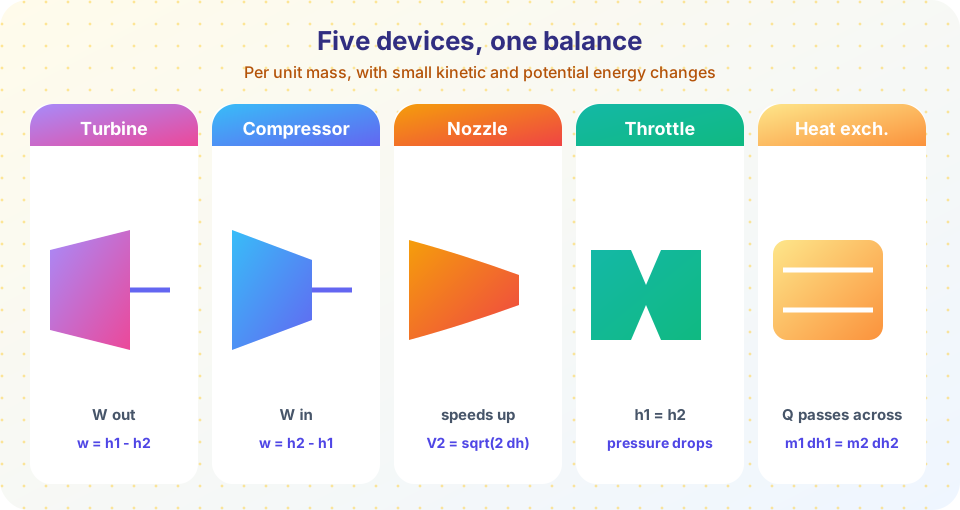
A turbine expands high-pressure fluid and produces work. Heat loss is small compared with the work, KE and PE changes are small, so w = h₁ − h₂. Example: steam enters at 4 MPa and 400 °C (h₁ ≈ 3,213.6 kJ/kg) and leaves at 10 kPa as a mixture with x = 0.90: h₂ = 191.81 + 0.90 × 2392.1 = 2,344.7 kJ/kg. Then w = 3213.6 − 2344.7 = 868.9 kJ/kg. With ṁ = 10 kg/s the power is Ẇ ≈ 8,689 kW, about 8.7 MW.
A compressor consumes work to raise the pressure of a gas. For air with small heat loss, w_in = h₂ − h₁ = c_p (T₂ − T₁). Example: air enters at 300 K and leaves at 520 K with ṁ = 0.5 kg/s: w_in = 1.005 × 220 = 221.1 kJ/kg and Ẇ_in = 110.5 kW. A pump does the same for a liquid; since v is nearly constant, w_in ≈ v (P₂ − P₁). Pumping water (v = 0.001 m³/kg) from 100 kPa to 5 MPa takes only 0.001 × 4900 = 4.9 kJ/kg, which is why pumping liquid is cheap compared with compressing gas, a fact that makes steam power cycles efficient.
Nozzles and diffusers
A nozzle has a decreasing flow area and speeds the fluid up; a diffuser does the opposite. There is no work, heat loss is negligible and ΔPE ≈ 0, so
h₁ + V₁²/2 = h₂ + V₂²/2
If the inlet speed is small, V₂ = √(2 (h₁ − h₂)) with h in J/kg. Example: air cools from 400 K to 350 K in a nozzle while entering at negligible speed. Δh = 1.005 × 50 = 50.25 kJ/kg = 50,250 J/kg, so V₂ = √(2 × 50,250) = 317 m/s. Nozzles convert enthalpy into kinetic energy; this is how jets and rockets produce thrust and how steam gets onto turbine blades.
Throttling valves
A partly closed valve, a capillary tube or a porous plug causes a large pressure drop. The device is small, so heat transfer is negligible; there is no work; and the change in speed is small. The balance becomes
h₁ ≈ h₂
an isenthalpic process. For an ideal gas h depends only on T, so the temperature does not change. For a liquid-vapor fluid it falls, which is the heart of a refrigerator's expansion valve. Example: saturated liquid water at 1 MPa (h = 762.51 kJ/kg) is throttled to 100 kPa. At 100 kPa, h_f = 417.51 and h_fg = 2257.5, so x = (762.51 − 417.51)/2257.5 = 0.153 and the temperature drops from 179.9 °C to 99.6 °C. The liquid flashes partially to vapor.
Heat exchangers
In a heat exchanger two fluid streams exchange heat without mixing. Choose the whole exchanger as the control volume: no shaft work and (if insulated from the outside) no external heat. Then Σ ṁ_in h_in = Σ ṁ_out h_out, or for liquids ṁ_hot c ΔT_hot = ṁ_cold c ΔT_cold. Example: 2 kg/s of cold water is warmed from 20 °C to 60 °C: Q̇ = 2 × 4.18 × 40 = 334.4 kW. Hot water at 3 kg/s supplies it from 90 °C: ΔT = 334.4/(3 × 4.18) = 26.7 K, so it leaves at 63.3 °C. Alternatively take just one stream as the system, and Q̇ is the heat it exchanges.
Common misconceptions
"A turbine works because the fluid cools." The enthalpy drop is what gives work; for steam the temperature drop is accompanied by condensation.
"Throttling cools every fluid." An ideal gas stays at the same temperature; real gases can cool or heat depending on the state.
"A nozzle does work." No shaft work; it converts enthalpy into kinetic energy.
Try it
The first block is a device calculator running the examples above. The second plots nozzle exit speed against enthalpy drop.
Press Run (or Ctrl + Enter) to see the result here.
Program input · what you'd type while the program runs
Type the answers before you press Run, one per line. Each time the program reads a line (with input()), it gets the next line from this box.
Press Run (or Ctrl + Enter) to see the result here.
Program input · what you'd type while the program runs
Type the answers before you press Run, one per line. Each time the program reads a line (with input()), it gets the next line from this box.
Check your understanding
Quick check · 5 questions
of 5 answered You scored / 5 · perfect!
-
1. Which relation applies to an adiabatic turbine with negligible KE and PE changes?
q = 0 and delta KE, delta PE negligible give -w = h2 - h1, so w = h1 - h2. -
2. A throttling valve is an
With q = w = 0 and small KE change, h1 = h2. -
3. A nozzle with negligible inlet speed has an enthalpy drop of 80 kJ/kg. The exit speed is about
V2 = sqrt(2 x 80,000) = 400 m/s. -
4. Why is a liquid pump much cheaper to run than a gas compressor for the same pressure rise?
Work is about v times the pressure rise, and liquid v is about a thousand times smaller than gas v. -
5. For an insulated heat exchanger, the heat gained by the cold stream equals
No external heat or work means the energy leaving one stream enters the other.
Summary
- Start from
q − w = Δh + ΔKE + ΔPEand drop the terms that are negligible. - Turbine
w = h₁ − h₂; compressorw_in = h₂ − h₁; pumpw_in ≈ v ΔP. - Nozzle
V₂ = √(2 Δh); throttleh₁ = h₂; heat exchanger: energy lost by one stream equals energy gained by the other. - These building blocks combine into cycles in chapter 5.
Next: Chapter 3 Review
Track your progress
Create a free account to tick off lessons and pick up where you left off on any device.
of Engineering Thermodynamics lessons completed