


















Lesson 28 of 48 · Power Cycles
Chapter 5 review: power cycles
Review Rankine, reheat, regeneration, Otto, Diesel and Brayton cycles in one recap table, a comparison chart and a ten-question quiz.
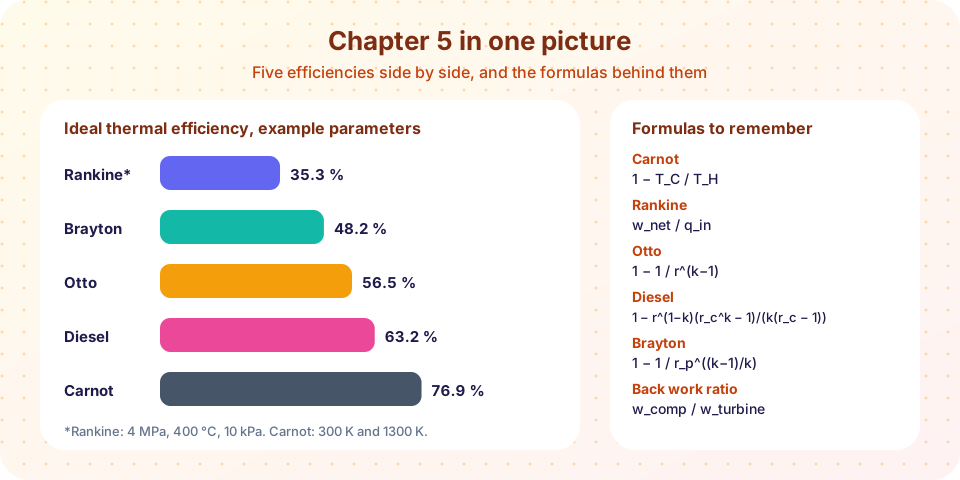
You have now met the four workhorse cycles. This review puts them side by side so that you can see what they share: heat in at high temperature, work out, heat rejected at low temperature, with efficiency set by the average temperatures of those heat flows.
Recap table
| Cycle | Working fluid | Heat added | Efficiency driver | Typical use |
|---|---|---|---|---|
| Rankine | water and steam | constant pressure (boiler) | boiler T, P; condenser P |
power stations |
| Rankine with reheat | water and steam | two constant-pressure steps | drier exhaust, high-T heat |
large stations |
| Rankine with regeneration | water and steam | boiler after feedwater heating | higher average heat-in T |
all large stations |
| Otto | air (ideal gas) | constant volume | compression ratio r |
petrol engines |
| Diesel | air (ideal gas) | constant pressure | r and cutoff ratio r_c |
trucks, ships |
| Brayton | air (ideal gas) | constant pressure | pressure ratio r_p |
jets, gas plants |
The ideas that matter most
Net work is Q_H − Q_C. Whatever the cycle, apply the first law to the whole loop. Pumping a liquid is cheap; compressing a gas is not. That is why the Rankine cycle has a back work ratio under 1 % and Brayton has about 45 % even when ideal. Average temperature wins. Reheat, regeneration, higher boiler temperatures, lower condenser pressures and higher compression ratios all raise the average temperature of heat addition or lower the average temperature of heat rejection. Real is not ideal. Isentropic efficiencies of compressors and turbines turn 48 % into 33 % in the Brayton example, and ideal Otto numbers in the 50s become 25 to 35 % in cars.
Try it
Press Run (or Ctrl + Enter) to see the result here.
Program input · what you'd type while the program runs
Type the answers before you press Run, one per line. Each time the program reads a line (with input()), it gets the next line from this box.
Press Run (or Ctrl + Enter) to see the console output here.
No output.
Check your understanding
Quick check · 10 questions
of 10 answered You scored / 10 · perfect!
-
1. Net work of a cycle equals...
From the first law over a closed cycle, ΔU = 0, so W_net = Q_H − Q_C. -
2. Which cycle has a back work ratio below 1 %?
Pumping a liquid costs v ΔP, tiny compared with compressing a gas. -
3. An Otto engine has r = 9 and k = 1.4. Roughly what is the ideal efficiency?
1 − 1/9^0.4 = 1 − 1/2.408 = 0.585, about 58 %. -
4. What does the regenerator in a gas turbine require?
The exhaust must be hotter than the compressed air to heat it. -
5. Why is reheat used in steam turbines?
A second heating makes the steam leave the low-pressure turbine drier. -
6. Which limit most restricts the compression ratio of a petrol engine?
Spark-ignition engines compress a fuel-air mixture that may self-ignite. -
7. Two Otto engines have the same compression ratio. One has a higher peak temperature. Which has the higher ideal efficiency?
Ideal Otto efficiency depends only on r and k. -
8. At which pressure ratio does the example Brayton cycle (300 K, 1300 K) give maximum net work?
r_p,opt = (T3/T1)^(k/(2(k−1))) = 4.333^1.75, about 13. -
9. Bleeding steam to an open feedwater heater changes the cycle by...
Warmer feedwater means less heat is added at low temperature. -
10. A steam plant receives 3000 kJ/kg and rejects 1900 kJ/kg. What is its efficiency?
W_net = 3000 − 1900 = 1100, so η = 1100/3000 = 36.7 %.
Summary
- Every cycle is bounded by Carnot and ranked by the average temperatures of its heat flows.
- Rankine: boiler, turbine, condenser, pump; improved by reheat and regeneration.
- Otto and Diesel depend on compression ratio (and cutoff); Brayton on pressure ratio.
- Gas cycles lose far more to component inefficiency because their back work ratios are large.
Track your progress
Create a free account to tick off lessons and pick up where you left off on any device.
of Engineering Thermodynamics lessons completed