


















Lesson 29 of 48 · Refrigeration Cycles
Chapter 6 overview: refrigeration cycles
A map of Chapter 6: how refrigerators and heat pumps move heat uphill with work, how COP is defined, and what the reversed Carnot cycle says about limits.
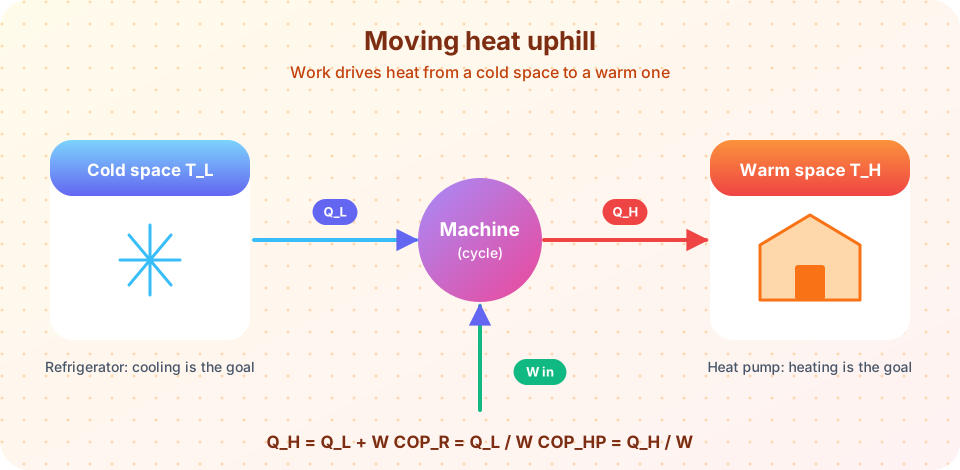
Heat flows from hot to cold on its own. A refrigerator makes it flow the other way. By spending work, it lifts heat from a cold space (the food compartment) and delivers it to a warm one (your kitchen). A heat pump is the same machine used for a different purpose: it collects heat from cold outdoor air and delivers it into a warm house. Run the heat engine of Chapter 5 backwards and you get these machines.
The big picture
For a refrigeration cycle the first law gives Q_H = Q_L + W. The coefficient of performance (COP) is the useful effect divided by the work you pay for:
COP_R = Q_L / W (refrigerator)
COP_HP = Q_H / W (heat pump)
Since Q_H = Q_L + W, it follows that COP_HP = COP_R + 1. Unlike efficiency, a COP can be greater than 1, because the machine moves heat instead of making it. A COP of 4 means that 1 kWh of electricity moves 4 kWh of heat.
The best possible COP comes from the reversed Carnot cycle:
COP_R,Carnot = T_L / (T_H − T_L) and COP_HP,Carnot = T_H / (T_H − T_L)
with absolute temperatures. The smaller the temperature lift T_H − T_L, the cheaper it is to move heat. That one idea explains why you keep the freezer door closed and why heat pumps work best in mild weather.
Heat uphill
Two machines, one cycle
The four parts
Smaller lift, bigger COP
What each lesson covers
| Lesson | Topic |
|---|---|
| The vapor-compression cycle | The four-component cycle, P–h diagram, COP calculation, effect of compressor losses |
| Heat pumps and refrigerants | Heating COP, seasonal behavior, refrigerant choice, absorption systems |
| Chapter review | Recap picture, table and ten-question quiz |
Key terms
COP is the useful heat transfer divided by the work input. Refrigerant is the working fluid that evaporates and condenses in the cycle. Evaporator absorbs heat from the cold space. Condenser rejects heat to the warm space. Ton of refrigeration is a traditional unit equal to 3.517 kW of cooling.
Common misconceptions
"A COP above 1 breaks the first law." The machine does not create energy: it moves it, and Q_H = Q_L + W holds exactly. "Leaving the fridge door open cools the kitchen." The compressor's work and the condenser's heat go into the room, so the room warms. "A heat pump produces heat from nothing." It takes heat from outdoors and charges you for the work of moving it.
Try it
Press Run (or Ctrl + Enter) to see the result here.
Program input · what you'd type while the program runs
Type the answers before you press Run, one per line. Each time the program reads a line (with input()), it gets the next line from this box.
Check your understanding
Quick check · 5 questions
of 5 answered You scored / 5 · perfect!
-
1. What is the COP of a refrigerator?
COP_R = Q_L / W: the useful effect (cooling) per unit of work. -
2. A refrigerator has COP 3 and removes 600 W from the cold space. How much heat does it deliver to the room?
W = 600/3 = 200 W, so Q_H = Q_L + W = 800 W. -
3. A heat pump has COP_HP = 4.2. What is COP_R of the same cycle?
COP_HP = COP_R + 1, so COP_R = 3.2. -
4. Which temperature pair gives the higher Carnot COP_R?
270/30 = 9 versus 250/60 = 4.2: a smaller lift gives a larger COP. -
5. Why can a COP be greater than 1?
The work only drives the transfer of existing heat from cold to warm.
Summary
- Refrigerators and heat pumps use work to move heat from cold to warm:
Q_H = Q_L + W. COP_R = Q_L/W,COP_HP = Q_H/W = COP_R + 1.- The reversed Carnot cycle gives the upper limits
T_L/(T_H − T_L)andT_H/(T_H − T_L). - Small temperature lifts give high COPs.
Track your progress
Create a free account to tick off lessons and pick up where you left off on any device.
of Engineering Thermodynamics lessons completed