


















Lesson 3 of 48 · Getting Started
Units, Dimensions and Pressure
Master SI units, prefixes and dimensional checks for thermodynamics, then learn absolute, gauge and vacuum pressure and how to read a manometer with worked examples.
Thermodynamics problems fail more often because of units than because of physics. A pressure in kPa multiplied by a volume in m³ gives kilojoules, but a pressure in bar multiplied by a volume in litres gives something else entirely. This lesson sets up the unit system used throughout the course, and then studies the first property you meet in almost every problem: pressure, including the crucial difference between gauge and absolute values.
What you will learn
- The SI base and derived units used in thermodynamics and the common prefixes.
- How to check an equation by dimensions and convert units without mistakes.
- The difference between absolute, gauge and vacuum pressure.
- How to compute pressure from a column of fluid with
P = ρ g h.
Key terms
SI: the International System of Units; base units here are the kilogram, meter, second and kelvin.
Pascal (Pa): the SI unit of pressure, 1 Pa = 1 N/m²; 1 kPa = 1000 Pa, 1 bar = 100 kPa.
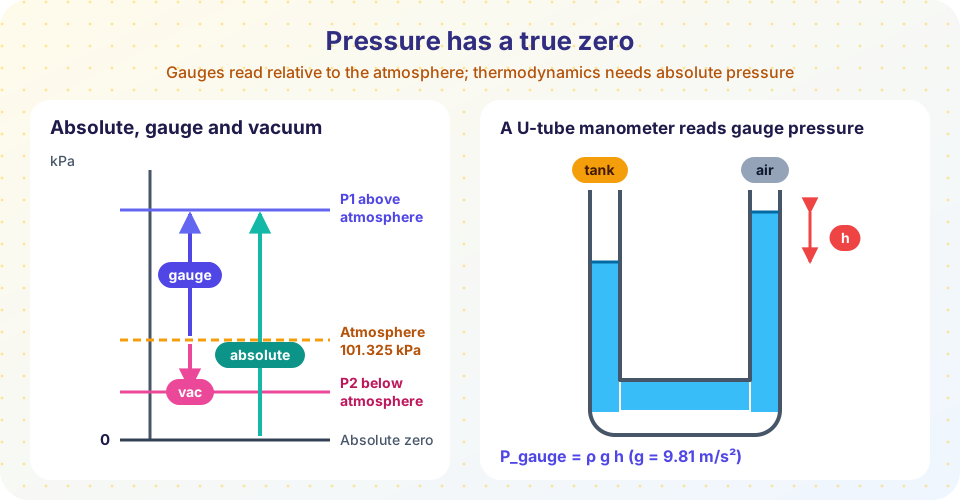
Absolute pressure: pressure measured from perfect vacuum (zero).
Gauge pressure: absolute pressure minus the local atmospheric pressure.
Vacuum pressure: atmospheric pressure minus the absolute pressure, when the latter is below atmospheric.
SI units you will use every day
| Quantity | Unit | Symbol | In base units |
|---|---|---|---|
| Mass | kilogram | kg | base |
| Length | meter | m | base |
| Time | second | s | base |
| Temperature | kelvin | K | base |
| Force | newton | N | kg·m/s² |
| Pressure | pascal | Pa | N/m² = kg/(m·s²) |
| Energy, work, heat | joule | J | N·m = kg·m²/s² |
| Power | watt | W | J/s |
Prefixes keep numbers readable: kilo k = 10³, mega M = 10⁶, giga G = 10⁹. In practice we write energy in kJ, pressure in kPa or MPa, power in kW or MW. A very handy identity is
1 kPa × 1 m³ = 1 kJ
because Pa·m³ = (N/m²)·m³ = N·m = J. It means that when pressure is in kPa and volume in m³, pressure times volume comes out directly in kJ. Other units appear in the wild: the bar (1 bar = 100 kPa), the standard atmosphere (1 atm = 101.325 kPa), and in US customary units the psi (1 psi ≈ 6.895 kPa) and Btu (1 Btu ≈ 1.055 kJ). We use SI almost exclusively and mention others when they matter.
Unit and dimension discipline
Every term in a valid equation has the same dimensions: you cannot add a pressure to a temperature. Write units next to every number and let them cancel as you multiply. Example: the kinetic energy of 2 kg of air moving at 30 m/s is
KE = ½ m V² = 0.5 × 2 kg × (30 m/s)² = 900 kg·m²/s² = 900 J = 0.9 kJ
A frequent trap is mass versus weight. Mass (kg) is a property of matter; weight is the force gravity exerts, F = m g, in newtons, with g = 9.81 m/s² at the Earth's surface. A 10 kg object weighs 98.1 N. In thermodynamics we almost always work with mass.
When a problem gives you a number with an unusual unit (litres, bar, minutes, kWh), convert it to kg, kPa, m³, s, kJ and K first. Convert the answer back at the end if asked.
Pressure and its three scales
Pressure is the normal force a fluid exerts per unit area, P = F/A. At sea level the atmosphere presses down with about 101.325 kPa, the standard atmosphere. Local atmospheric pressure varies with weather and altitude (it is about 80 kPa in a city at 2,000 m).
Most pressure gauges, such as a tire gauge or a boiler gauge, read relative to the atmosphere. A tire gauge reading 220 kPa means the air inside is 220 kPa above the outside air. Thermodynamic equations and tables, however, always require absolute pressure:
P_gauge = P_abs − P_atmwhenP_abs > P_atmP_vac = P_atm − P_abswhenP_abs < P_atm
Example: a tank gauge reads 250 kPa on a day when the barometer reads 99 kPa. Then P_abs = 250 + 99 = 349 kPa. A condenser with a vacuum gauge reading 90 kPa at the same atmospheric pressure has P_abs = 99 − 90 = 9 kPa, a deep vacuum. Use P_abs in every ideal-gas calculation and every steam-table lookup. Forgetting this conversion is the single most common beginner error.
Pressure in a fluid column
In a fluid at rest, pressure grows with depth because the fluid above must be supported. Balancing the weight of a column of height h and cross-section A gives
ΔP = ρ g h
where ρ is the density (kg/m³). Water has ρ ≈ 1000 kg/m³, so each meter of depth adds 1000 × 9.81 × 1 = 9,810 Pa ≈ 9.81 kPa. At 10 m the gauge pressure is about 98 kPa: roughly one extra atmosphere. This is also why the atmosphere can hold up a water column about 101.325 kPa / 9.81 kPa/m ≈ 10.3 m high, but a mercury column (ρ ≈ 13,600 kg/m³) only about 0.76 m, which is why barometers use mercury.
Reading a manometer
A manometer is a U-shaped tube partly filled with a liquid. If one end is connected to a tank at pressure P and the other is open to the atmosphere, the liquid is pushed down on the tank side and up on the open side, and the height difference h gives the gauge pressure P_gauge = ρ g h.
Example. A mercury manometer shows h = 200 mm. Then P_gauge = 13,600 × 9.81 × 0.200 = 26,683 Pa ≈ 26.7 kPa. If the atmospheric pressure is 101 kPa the tank is at an absolute pressure of about 127.7 kPa.
Common misconceptions
"Gauge pressure of zero means no pressure." It means the pressure equals the atmosphere; the absolute pressure is still about 101 kPa.
"A bar and an atmosphere are the same." They are close but not equal: 1 bar = 100 kPa, 1 atm = 101.325 kPa.
"Pressure depends on the shape of a container." In a fluid at rest it depends only on depth, density and g.
Try it
First, plot how pressure grows when you dive. Then use the manometer explorer (a simple model that applies P = ρ g h) to see how the fluid choice changes the height needed.
Press Run (or Ctrl + Enter) to see the result here.
Program input · what you'd type while the program runs
Type the answers before you press Run, one per line. Each time the program reads a line (with input()), it gets the next line from this box.
Check your understanding
Quick check · 5 questions
of 5 answered You scored / 5 · perfect!
-
1. Which identity lets you read pressure in kPa times volume in m3 directly as energy?
Pa times m3 is N/m2 times m3 = N m = J, so kPa times m3 is kJ. -
2. A tank gauge reads 300 kPa and the barometer reads 100 kPa. What absolute pressure should you put in the ideal-gas law?
Absolute pressure is gauge plus atmospheric: 300 + 100 = 400 kPa. -
3. A condenser has an absolute pressure of 10 kPa on a day with 101 kPa atmosphere. Its vacuum pressure is
Vacuum pressure = atmospheric minus absolute = 101 - 10 = 91 kPa. -
4. Roughly how much does the pressure in water increase for each 10 m of depth?
rho g h = 1000 x 9.81 x 10 = 98.1 kPa, about one atmosphere. -
5. Why are barometers traditionally filled with mercury rather than water?
With a density 13.6 times that of water, mercury balances the atmosphere with a column about 0.76 m tall instead of 10.3 m.
Summary
- Work in SI: kg, m, s, K, with kPa, kJ and kW; remember
1 kPa × 1 m³ = 1 kJ. - Check dimensions and write units on every number; mass is in kg, weight is
m gin N. - Gauge pressure is relative to the atmosphere; always use absolute pressure in equations and tables.
- In a static fluid
ΔP = ρ g h; manometers and barometers use this directly.
Track your progress
Create a free account to tick off lessons and pick up where you left off on any device.
of Engineering Thermodynamics lessons completed