


















Lesson 37 of 48 · Gas Mixtures and Psychrometrics
Chapter 7 review: gas mixtures and psychrometrics
Review ideal gas mixtures, humid air properties and air-conditioning processes with a one-picture summary, a formula table and a ten-question quiz.
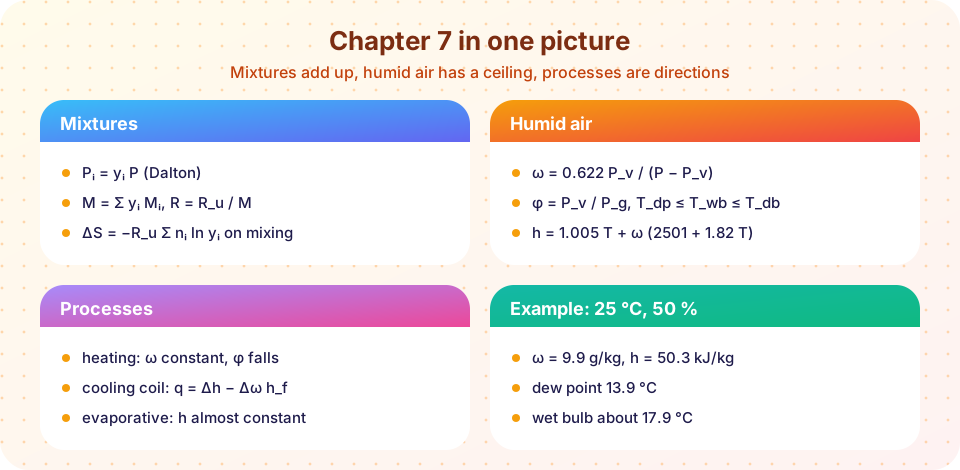
This chapter extended the single-substance thermodynamics you already knew to mixtures, and then used one particular mixture, moist air, to explain humidity control. The recipe is always the same: choose the composition measure (moles or mass), apply Dalton's law for pressures, weight properties by composition, and remember that water vapor in air is limited by saturation.
Recap table
| Topic | Key formulas |
|---|---|
| Composition | yᵢ = nᵢ/n, mfᵢ = mᵢ/m, M = Σ yᵢ Mᵢ, R = R_u/M |
| Dalton and Amagat | Pᵢ = yᵢ P, Vᵢ = yᵢ V |
| Mixture properties | c_p = Σ mfᵢ c_pᵢ; entropy evaluated at partial pressures |
| Entropy of mixing | ΔS = −R_u Σ nᵢ ln yᵢ |
| Humidity ratio | ω = 0.622 P_v/(P − P_v) |
| Relative humidity | φ = P_v / P_g(T) |
| Moist-air enthalpy | h = 1.005 T + ω (2501 + 1.82 T) (T in °C) |
| Dew point | saturation temperature at P_v |
| Cooling and dehumidifying | q = Δh − Δω h_f |
| Mixing | mass-weighted ω and h |
The ideas that matter most
Mole fractions drive pressure; mass fractions drive energy. Partial pressures use mole fractions, while c_p and h of a mixture use mass fractions. Everything in psychrometrics is per kilogram of dry air, because dry-air mass is the conserved quantity. Saturation sets the ceiling. Relative humidity changes when temperature changes, but ω and T_dp change only when water is added or removed. Condensation costs energy. The latent part of the load can be almost half of the total in warm humid air.
Key terms. Dalton's law: partial pressures add. Humidity ratio: kg vapor per kg dry air. Relative humidity: P_v/P_g. Dew point: temperature at which condensation starts. Wet bulb: evaporation-limited temperature. Sensible and latent heat: temperature change versus moisture change.
Try it
Press Run (or Ctrl + Enter) to see the result here.
Program input · what you'd type while the program runs
Type the answers before you press Run, one per line. Each time the program reads a line (with input()), it gets the next line from this box.
Press Run (or Ctrl + Enter) to see the console output here.
No output.
Check your understanding
Quick check · 10 questions
of 10 answered You scored / 10 · perfect!
-
1. A mixture has 0.6 kmol N2 and 0.4 kmol O2 at 200 kPa. What is the partial pressure of O2?
y(O2) = 0.4, so P = 0.4 × 200 = 80 kPa. -
2. Which composition measure do you use to find partial pressures?
Pᵢ = yᵢ P. -
3. If moist air is cooled at constant pressure without condensation, ω...
No water is added or removed. -
4. At 100 % relative humidity, the dew-point temperature equals...
P_v = P_g(T), so the saturation temperature at P_v is T itself. -
5. Which statement about mixing entropy is correct?
ΔS = −R_u Σ nᵢ ln yᵢ is positive. -
6. Why does a cooling coil take more energy in humid air?
Condensing water vapor releases about 2450 kJ/kg. -
7. Air at 25 °C has ω = 0.010 kg/kg. Which is the best estimate of its enthalpy?
1.005 × 25 + 0.010 × (2501 + 45.5) = 25.1 + 25.5 = 50.6 kJ/kg. -
8. What is the lowest temperature an ideal evaporative cooler can deliver?
Evaporation stops at saturation along the constant wet-bulb line. -
9. The mixed state of two air streams lies...
ω and h are mass-weighted averages. -
10. Why is humid air less dense than dry air at the same T and P?
M(H2O) = 18 versus about 29 for dry air.
Summary
- Mixtures: Dalton's law, mole and mass fractions, weighted properties, entropy rises on mixing.
- Moist air:
ω,φ,h, dew point and wet bulb describe the state; everything is per kg of dry air. - Processes: sensible changes keep
ω; cooling coils dehumidify below the dew point; evaporative cooling is constanth; mixing averages by mass flow.
Track your progress
Create a free account to tick off lessons and pick up where you left off on any device.
of Engineering Thermodynamics lessons completed