


















Lesson 41 of 48 · Combustion and Applications
Flame temperature and applications
Find the adiabatic flame temperature of methane, see how excess air and dissociation change it, and apply combustion thermodynamics to boilers, engines, CO2 emissions and NOx.
How hot can a flame get? The answer decides what materials a furnace needs, how much NOx an engine makes, and how efficiently a turbine can run. If a fuel burns in a perfectly insulated chamber, all the released energy ends up as sensible enthalpy of the products, and the resulting temperature is the adiabatic flame temperature. It is an upper limit: a real flame is always cooler because of heat loss, incomplete combustion and dissociation.
What you will learn
- Compute the adiabatic flame temperature from the first law.
- Explain how excess air and dissociation lower it.
- Calculate boiler efficiency and CO₂ per megajoule for common fuels.
- Link combustion temperature to NOx formation and the Chapter 5 cycles.
Key terms
Adiabatic flame temperature is the product temperature for complete combustion with no heat loss and no work. Dissociation is the splitting of CO₂ and H₂O into CO, H₂, O₂ and radicals at very high temperature, which absorbs energy. Thermal NOx is nitric oxide formed from air's nitrogen and oxygen at high temperature. Stack loss is the energy that leaves in the exhaust gases.
The energy balance
For a steady-flow chamber with Q = 0 and W = 0, reactant enthalpy equals product enthalpy:
Σ_R n_r (h_f° + Δh)_r = Σ_P n_p (h_f° + Δh)_p
Reactants at 25 °C have Δh = 0, so the sensible enthalpy of the products at the flame temperature must equal the heat of combustion:
Σ_P n_p Δh_p(T_flame) = −Q_combustion = 802,310 kJ/kmol (methane, LHV basis)
The unknown T hides inside the sensible enthalpies, so we solve by iteration: guess T, look up Δh of CO₂, H₂O and N₂, compare the sum with 802,310, and adjust.
Worked example: methane with theoretical air
Products: 1 CO₂ + 2 H₂O + 7.52 N₂. From tables (kJ/kmol above 298 K):
| T (K) | CO₂ | H₂O(g) | N₂ | Σ products |
|---|---|---|---|---|
| 2200 | 103,562 | 83,153 | 63,362 | 746,354 |
| 2400 | 115,779 | 93,741 | 70,640 | 834,474 |
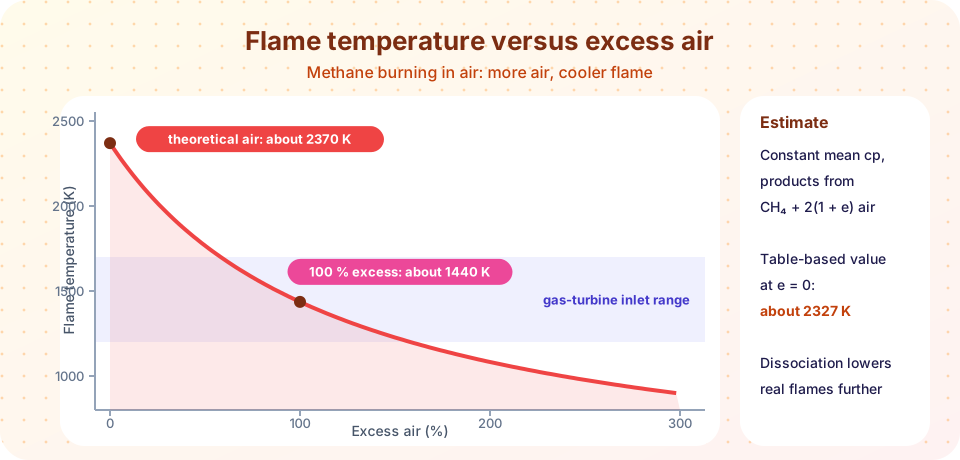
The target 802,310 lies between them. Linear interpolation gives T = 2200 + 200 × (802,310 − 746,354) / (834,474 − 746,354) = 2327 K, about 2054 °C. A flame this hot would need exotic materials, which is why real systems use much more air or cool the walls.
Excess air cools the flame
Add 100 % excess air (twice the theoretical air) and the product gas now includes an extra 2 O₂ and 7.52 N₂. The same 802,310 kJ is spread over many more moles of gas, so the temperature rises less. With constant mean specific heats the rise falls from about 2070 K at stoichiometric to about 1140 K at 100 % excess air. Gas turbine combustors use 200 to 300 % excess air for exactly this reason: the turbine blades survive only at 1200 to 1700 K or so (with cooling), not at 2300 K.
Dissociation
Above roughly 2000 K, CO₂ and H₂O begin to dissociate: CO₂ ⇌ CO + ½ O₂. These reactions absorb energy, so the true flame temperature is a few hundred kelvin lower than the no-dissociation value. Handling this requires chemical equilibrium (Gibbs free energy and equilibrium constants), a topic for a physical chemistry or advanced thermodynamics course. Modern software performs the calculation automatically.
Applications
Boilers and furnaces. Boiler efficiency is η = useful heat / (fuel mass flow × heating value). If 0.5 kg/s of methane (LHV 50,010 kJ/kg, so 25.0 MW) produces 22.5 MW of steam heat, η = 90 % on the LHV. Most of the loss is the stack loss, which grows with exhaust temperature and excess air. Economizers (preheating feedwater with exhaust) and condensing designs recover part of it.
Spark-ignition and diesel engines. The peak flame temperature (2200 K and higher) sets the heat input for the Otto and Diesel cycles and the NOx emissions. Above about 1800 K, nitrogen and oxygen react by the Zeldovich mechanism, producing NO at a rate that rises very steeply with temperature. That is why exhaust gas recirculation, which dilutes the charge and lowers the flame temperature, cuts NOx.
Gas turbines. Dry low-NOx combustors premix fuel with a large amount of air, keeping the flame cool and the NOx low, then add more air downstream for cooling.
Carbon dioxide. Complete combustion converts every carbon atom to CO₂. Per kilogram of fuel: methane makes 44.01 / 16.043 = 2.74 kg; octane makes 8 × 44.01 / 114.23 = 3.08 kg. Per megajoule of lower heating value that is about 55 g for methane and 69 g for octane. Hydrogen-rich fuels have lower carbon per unit energy, and hydrogen itself has none at the point of use.
Second-law view
Combustion is highly irreversible: the chemical energy is converted into thermal energy at a high but not infinite temperature, and heat transfer from the flame to the working fluid destroys more work potential. In a fuel cell the same reaction can generate electricity directly, avoiding the Carnot limit of a heat engine, which is why fuel cells can reach higher conversion efficiencies than combustion engines.
Common misconceptions
"A hotter flame is always better." It gives more Carnot potential but forms more NOx and needs better materials. "Flame temperature equals fuel energy." It depends on how many moles of gas share that energy. "Complete combustion means zero emissions." CO₂ and H₂O are still produced, and NOx forms from air's nitrogen.
Try it
Press Run (or Ctrl + Enter) to see the result here.
Program input · what you'd type while the program runs
Type the answers before you press Run, one per line. Each time the program reads a line (with input()), it gets the next line from this box.
Press Run (or Ctrl + Enter) to see the result here.
Program input · what you'd type while the program runs
Type the answers before you press Run, one per line. Each time the program reads a line (with input()), it gets the next line from this box.
Check your understanding
Quick check · 6 questions
of 6 answered You scored / 6 · perfect!
-
1. What does the adiabatic flame temperature assume?
All the heat of combustion goes into sensible enthalpy of the products. -
2. What happens to flame temperature when excess air is increased?
The same energy heats more moles of gas. -
3. Why does dissociation lower flame temperature?
Dissociation reactions are endothermic. -
4. Roughly how much CO2 does burning 1 kg of methane produce?
44.01 / 16.043 = 2.74 kg. -
5. Which approach lowers NOx formation in engines?
Thermal NOx forms very rapidly at high temperature, so dilution reduces it. -
6. A boiler burns 0.4 kg/s of fuel with LHV 50,000 kJ/kg and delivers 18 MW of heat. Its efficiency on LHV is...
Fuel power is 0.4 × 50,000 = 20 MW, and 18 / 20 = 90 %.
Summary
- Adiabatic flame temperature: product sensible enthalpy equals the heat of combustion; methane with theoretical air gives about 2327 K without dissociation.
- Excess air and dissociation lower it; gas turbines use large excess air to protect blades.
- Boiler efficiency compares useful heat with fuel power; stack loss is the main loss.
- CO₂ per MJ is about 55 g for methane and 69 g for octane, and NOx rises steeply with peak temperature.
Next: Chapter 8 review
Track your progress
Create a free account to tick off lessons and pick up where you left off on any device.
of Engineering Thermodynamics lessons completed