


















Lesson 47 of 48 · Projects and Practice
Cheat sheet: formulas for cycles, mixtures and combustion
A one-page recap of the main formulas from power cycles, refrigeration, gas mixtures, psychrometrics and combustion, with constants and a small formula library to reuse.
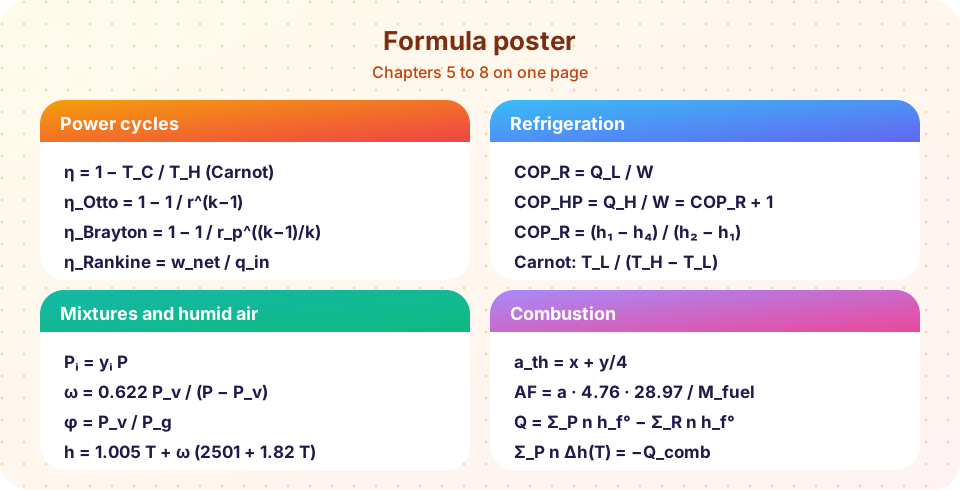
This page gathers the formulas of Chapters 5 to 8 in one place. It is not a substitute for understanding, since every formula carries assumptions, but it is a handy reference when you are working problems. Each formula is listed with the conditions that make it valid.
What you will learn
- Recall the key formulas and the conditions where they apply.
- Use the constants for air, gases and water.
- Reuse a small formula library in Python.
Constants and conversions
| Quantity | Value |
|---|---|
Universal gas constant R_u |
8.314 kJ/(kmol·K) |
Air: M, R, k, c_p, c_v |
28.97 kg/kmol, 0.287 kJ/(kg·K), 1.4, 1.005, 0.718 kJ/(kg·K) |
| Water vapor molar mass | 18.015 kg/kmol |
| Air composition for combustion | 1 O₂ : 3.76 N₂ |
| Standard atmosphere | 101.325 kPa |
| Ton of refrigeration | 3.517 kW |
Power cycles
| Item | Formula |
|---|---|
| Net work | W_net = Q_H − Q_C; η = W_net / Q_H |
| Carnot | η = 1 − T_C / T_H |
| Rankine | w_pump = v ΔP, η = (w_turb − w_pump) / (h₃ − h₂) |
| Open feedwater heater | y = (h₆ − h₂) / (h₅ − h₂) |
| Otto | η = 1 − 1 / r^(k−1) |
| Diesel | η = 1 − r^(1−k) (r_c^k − 1) / (k (r_c − 1)) |
| Brayton | η = 1 − 1 / r_p^((k−1)/k); T₂ = T₁ r_p^((k−1)/k) |
| Brayton, max net work | r_p = (T₃/T₁)^(k / (2(k−1))) |
| Isentropic efficiency | turbine (h₃ − h₄)/(h₃ − h₄s); compressor (h₂s − h₁)/(h₂ − h₁) |
Refrigeration and heat pumps
| Item | Formula |
|---|---|
| COP | COP_R = Q_L / W, COP_HP = Q_H / W = COP_R + 1 |
| Reversed Carnot | T_L / (T_H − T_L) and T_H / (T_H − T_L) |
| Vapor compression | COP_R = (h₁ − h₄) / (h₂ − h₁), h₄ = h₃ |
Mixtures and humid air
| Item | Formula |
|---|---|
| Fractions | yᵢ = nᵢ/n, mfᵢ = mᵢ/m, M = Σ yᵢ Mᵢ |
| Dalton | Pᵢ = yᵢ P |
| Humidity ratio | ω = 0.622 P_v / (P − P_v) |
| Relative humidity | φ = P_v / P_g |
| Moist-air enthalpy | h = 1.005 T + ω (2501 + 1.82 T) (T in °C, kJ/kg dry air) |
| Volume | v = R_a T / P_a per kg dry air |
| Cooling coil | q = h₁ − h₂ − (ω₁ − ω₂) h_f |
| Mixing | ω₃, h₃ mass-weighted averages |
Combustion
| Item | Formula |
|---|---|
| Theoretical O₂ | a_th = x + y/4 for C_x H_y |
| Air-fuel ratio | AF = a × 4.76 × 28.97 / M_fuel |
| Heat of combustion | Q = Σ_P n h_f° − Σ_R n h_f° |
| Enthalpy | h̄ = h̄_f° + Δh̄ |
| Adiabatic flame temperature | Σ_P n Δh(T) = −Q_comb |
| Methane | LHV 50.0 MJ/kg, HHV 55.5 MJ/kg, AF 17.19, T_ad ≈ 2327 K |
Reminder. Every formula has conditions: ideal gas, constant specific heats, reversible processes, steady flow. Check them before using the formula, and always use kelvin in ratios of absolute temperature.
Try it
Press Run (or Ctrl + Enter) to see the result here.
Program input · what you'd type while the program runs
Type the answers before you press Run, one per line. Each time the program reads a line (with input()), it gets the next line from this box.
Press Run (or Ctrl + Enter) to see the console output here.
No output.
Check your understanding
Quick check · 4 questions
of 4 answered You scored / 4 · perfect!
-
1. Which formula gives theoretical oxygen for a hydrocarbon C_x H_y?
Each carbon needs one O2 and each four hydrogen need one O2. -
2. What is COP_HP if COP_R is 3?
COP_HP = COP_R + 1. -
3. Which temperature scale must be used in efficiency formulas with temperature ratios?
Ratios of temperatures only make sense on an absolute scale. -
4. What is the Brayton efficiency formula's exponent?
η = 1 − 1 / r_p^((k−1)/k).
Summary
- Efficiencies: Carnot, Otto, Diesel and Brayton each depend on one or two ratios.
- COP: refrigerator
Q_L/W, heat pumpQ_H/W = COP_R + 1. - Mixtures and humid air:
Pᵢ = yᵢ P,ω = 0.622 P_v/(P − P_v),h = 1.005 T + ω(2501 + 1.82 T). - Combustion:
a_th = x + y/4, heat of combustion fromh_f°, flame temperature from the first law.
Next: Further study
Track your progress
Create a free account to tick off lessons and pick up where you left off on any device.
of Engineering Thermodynamics lessons completed