


















Lesson 23 of 48 · Power Cycles
Chapter 5 overview: power cycles
A map of Chapter 5: how heat engines turn heat into work, why every engine needs a cold sink, and how Rankine, Otto, Diesel and Brayton cycles fit together.
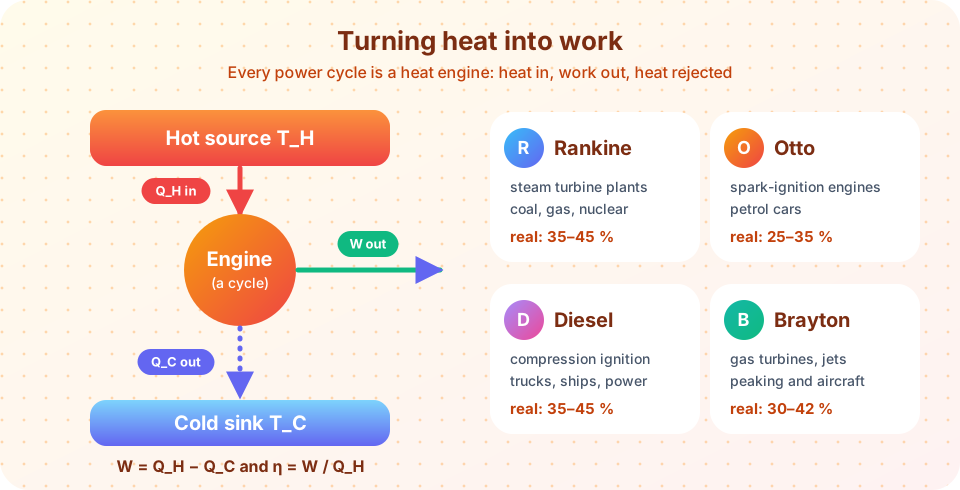
Almost every kilowatt-hour of electricity and almost every kilometer you travel in a vehicle begins as heat. A boiler burns fuel, a cylinder fires, a turbine inhales hot gas. The job of a power cycle is to turn part of that heat into useful work, again and again, with a working fluid that returns to its starting state at the end of every loop.
The big picture
In Chapters 3 and 4 you met the two laws that govern every engine. The first law says energy is conserved, so over one full cycle the net work equals the heat received minus the heat rejected: W_net = Q_H − Q_C. The second law says you cannot make Q_C zero. Some heat must always go to a colder place, and that limit is what makes engines interesting to design.
The thermal efficiency of a cycle is what you get divided by what you pay for:
η = W_net / Q_H = 1 − Q_C / Q_H
The best any engine can do between two fixed temperatures is the Carnot efficiency, η_Carnot = 1 − T_C / T_H, with temperatures in kelvin. Real cycles fall below it, and this chapter shows by how much and why.
Why cycles?
Two kinds of engine
Same four jobs
The limit
No real engine beats it.
What each lesson covers
| Lesson | Cycle | Where you meet it |
|---|---|---|
| Rankine steam cycle | Rankine | coal, gas and nuclear plants |
| Reheat and regeneration | Improved Rankine | modern steam stations |
| Otto and Diesel engines | Otto, Diesel | cars, trucks, ships |
| Brayton gas turbines | Brayton | jet engines, peaking plants |
| Chapter review | all of them | one-page summary and quiz |
Idealizations that make cycles solvable
Real engines are messy: friction, pressure drops, heat leaking through walls. We analyze ideal cycles, which assume reversible processes, no pressure losses, and a simple working fluid. They are not predictions of real efficiency, but they rank designs correctly and show which parameter matters. For gas cycles we use the air-standard assumptions: the working fluid is air behaving as an ideal gas, combustion is replaced by heat addition from outside, and exhaust is replaced by heat rejection.
Two diagrams carry most of the thinking. On a T–s diagram the area under a process curve is heat. On a P–v diagram the area under a curve is boundary work. For a closed loop, the enclosed area on either diagram is the net work (P–v) or the net heat (T–s), and the two are equal by the first law.
Key terms. Thermal efficiency is net work divided by heat input. Heat engine is a device that works in a cycle between a hot and a cold reservoir. Working fluid is the substance that goes around the cycle. Air-standard cycle is a gas cycle modeled with air as an ideal gas.
Common misconceptions
"A better engine wastes no heat." The second law forbids it: some heat must be rejected. A 40 % efficient plant still dumps 60 % of its heat input. "Efficiency can be 100 % if friction is removed." Even a perfect, frictionless engine is capped by Carnot.
Try it
Press Run (or Ctrl + Enter) to see the result here.
Program input · what you'd type while the program runs
Type the answers before you press Run, one per line. Each time the program reads a line (with input()), it gets the next line from this box.
Check your understanding
Quick check · 5 questions
of 5 answered You scored / 5 · perfect!
-
1. What does the first law say about the net work of a complete power cycle?
Over a full cycle the internal energy returns to its start, so W_net = Q_H − Q_C. -
2. A heat engine runs between 800 K and 300 K. What is the Carnot efficiency?
1 − 300/800 = 0.625, so 62.5 %. -
3. Why must a heat engine reject heat?
Friction lowers efficiency further, but even a frictionless engine must reject heat because of the second law. -
4. On a T–s diagram, what does the enclosed area of a cycle represent?
Area under a T–s curve is heat. The enclosed area is Q_H − Q_C, which equals W_net. -
5. Which cycle belongs to a steam power plant?
Rankine is the standard model for steam plants. Otto and Diesel model piston engines, Brayton models gas turbines.
Summary
- A power cycle returns its working fluid to the start and delivers net work
W_net = Q_H − Q_C. - Thermal efficiency is
η = W_net / Q_H, capped by Carnot,1 − T_C / T_H. - Rankine uses a condensing vapor; Otto, Diesel and Brayton are gas cycles analyzed with air-standard assumptions.
- Enclosed area on T–s is net heat; on P–v it is net work.
Next: Rankine steam cycle
Track your progress
Create a free account to tick off lessons and pick up where you left off on any device.
of Engineering Thermodynamics lessons completed