


















Lesson 42 of 48 · Combustion and Applications
Chapter 8 review: combustion and applications
Review combustion stoichiometry, enthalpy of formation, heating values and adiabatic flame temperature with a summary picture, a formula table and a ten-question quiz.
Chapter 8 connected thermodynamics to chemistry. You balanced reactions, used enthalpies of formation to find the heat released, and learned why the flame is cooler than the fuel's energy alone would suggest. Together these results close the loop with Chapter 5: the heat that drives a cycle comes from a reaction you can now quantify.
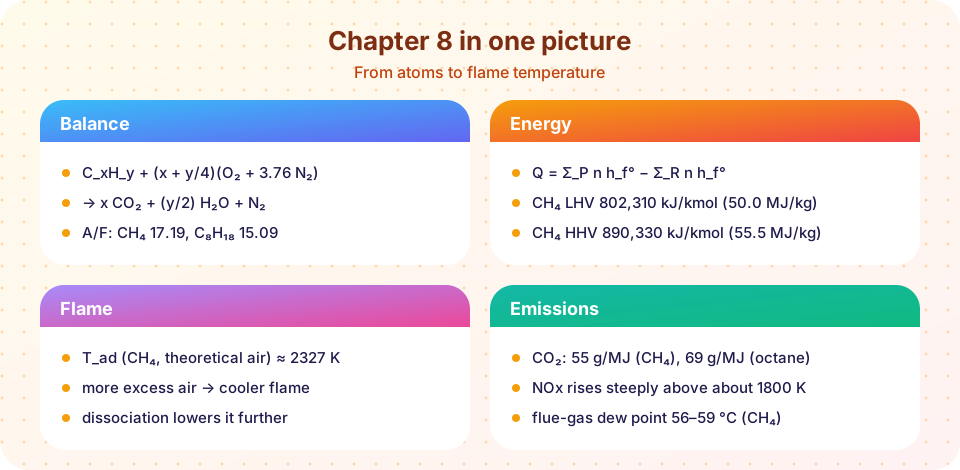
Recap table
| Topic | Key result |
|---|---|
Theoretical oxygen for C_x H_y |
a_th = x + y/4 |
| Air in combustion | each O₂ comes with 3.76 N₂ (4.76 mol air per mol O₂) |
| Air-fuel ratio | AF = a × 4.76 × 28.97 / M_fuel; methane 17.19 |
| Excess air | air = (1 + e) × a_th; leftover O₂ = e × a_th |
| Dry exhaust | O₂ reading reveals excess air |
| Exhaust dew point | saturation temperature at y_H₂O × P |
| Absolute enthalpy | h̄ = h̄_f° + Δh̄ |
| Heat of combustion | Q = Σ_P n h_f° − Σ_R n h_f° |
| Heating values | HHV (liquid water) and LHV (vapor); methane 55.5 and 50.0 MJ/kg |
| Adiabatic flame temperature | Σ_P n Δh(T) = −Q_comb; methane about 2327 K |
| Carbon dioxide | methane about 55 g per MJ, octane about 69 g per MJ |
Key terms. Stoichiometric: the exact proportions for complete combustion. Excess air: air beyond that. Enthalpy of formation: chemical enthalpy relative to elements. HHV / LHV: heating values with condensed or vapor water. Adiabatic flame temperature: the upper limit set by the first law.
Common misconceptions
"Each mole of fuel needs one mole of oxygen." The ratio depends on the fuel's carbon and hydrogen: 2 for methane, 12.5 for octane. "More air always means better combustion." There is an optimum: enough for complete burning, but not so much that the stack loses heat.
Try it
Press Run (or Ctrl + Enter) to see the result here.
Program input · what you'd type while the program runs
Type the answers before you press Run, one per line. Each time the program reads a line (with input()), it gets the next line from this box.
Press Run (or Ctrl + Enter) to see the console output here.
No output.
Check your understanding
Quick check · 10 questions
of 10 answered You scored / 10 · perfect!
-
1. How many kmol of O2 does 1 kmol of ethane (C2H6) need?
a_th = 2 + 6/4 = 3.5. -
2. Which fuel has the largest stoichiometric air-fuel ratio by mass?
Hydrogen needs about 34 kg of air per kg because it has so little mass per unit of energy released. -
3. Burning methane with 50 % excess air leaves how many kmol O2 in the products per kmol fuel?
Leftover O2 = 0.5 × 2 = 1.0 kmol. -
4. What is the heating value that assumes liquid water in the products?
HHV includes the latent heat of condensation. -
5. What is h_f of N2 at 25 °C?
Stable elements have zero enthalpy of formation. -
6. Why is real flame temperature below the adiabatic value?
Real flames lose heat and dissociation absorbs energy. -
7. Which reduces thermal NOx most directly?
NO formation from nitrogen and oxygen rises steeply with temperature. -
8. At 20 % excess air, the dry-exhaust CO2 of methane is about...
1 / 10.424 = 9.6 %. -
9. Which is the main reason a condensing boiler can exceed 100 % efficiency on the LHV?
LHV leaves out the latent heat of the water, which the condensing boiler recovers. -
10. Burning 1 kg of methane releases about how much CO2?
44.01 / 16.043 = 2.74 kg.
Summary
- Balance first (
a_th = x + y/4), then apply the first law with enthalpies of formation. - HHV versus LHV depends on the state of the product water; flame temperature falls with excess air and dissociation.
- CO₂ output is fixed by the fuel's carbon content; NOx depends on temperature.
- These calculations supply the heat input
Q_Hof the power cycles of Chapter 5.
Track your progress
Create a free account to tick off lessons and pick up where you left off on any device.
of Engineering Thermodynamics lessons completed