


















Lesson 8 of 48 · Properties and State
Steam Tables and Quality
Learn to read saturated and superheated steam tables, compute the quality of a liquid-vapor mixture with the lever rule, and interpolate between rows with worked examples.
Water and steam are the working fluids of most power plants, so engineers keep a compact record of their properties in steam tables. A table looks intimidating at first, but it is only a lookup of v, u, h and s for a given pair of independent properties. In this lesson you learn which table to open, how to handle the tricky middle zone where liquid and vapor coexist, and how to interpolate when your numbers fall between rows.
What you will learn
- Which table (saturated, superheated, compressed liquid) to use for a given state.
- How to compute properties of a saturated mixture with the quality
x. - How to interpolate linearly between table rows.
- How to find the quality from
v,u,hors.
Key terms
Quality x: mass of vapor divided by total mass of a saturated mixture, 0 ≤ x ≤ 1.
Subscripts f, g, fg: f is saturated liquid, g is saturated vapor, fg is the difference g − f.
Superheat: how far the vapor temperature is above T_sat at the same pressure.
Enthalpy h: h = u + P v; it appears naturally in flow and heating problems (lesson 3.4).
Which table?
First compare the given T and P with saturation (lesson 2.2):
- Saturated tables list
T_sat,P_sat,v_f,v_g,u_f,u_fg,u_g,h_f,h_fg,h_g,s_f,s_fg,s_g. They come in a temperature-indexed and a pressure-indexed form. Use them for saturated liquid, saturated vapor and mixtures. - Superheated tables list
v, u, h, sagainstPandTfor vapor above saturation. - Compressed liquid data are rare; for ordinary pressures treat the liquid as saturated liquid at the same temperature:
v ≈ v_f(T),h ≈ h_f(T)(a good approximation).
A few rounded saturated rows (pressure-indexed):
P (kPa) |
T_sat (°C) |
v_f |
v_g (m³/kg) |
h_f |
h_fg |
h_g (kJ/kg) |
|---|---|---|---|---|---|---|
| 10 | 45.81 | 0.001010 | 14.670 | 191.81 | 2392.1 | 2583.9 |
| 100 | 99.61 | 0.001043 | 1.6941 | 417.51 | 2257.5 | 2675.0 |
| 1000 | 179.88 | 0.001127 | 0.19437 | 762.51 | 2013.6 | 2776.1 |
Two superheated rows: at 1 MPa, 300 °C, v ≈ 0.2580 m³/kg, h ≈ 3051.6 kJ/kg, s ≈ 7.1246 kJ/(kg·K); at 4 MPa, 400 °C, v ≈ 0.0734 m³/kg, h ≈ 3213.6 kJ/kg, s ≈ 6.769 kJ/(kg·K). Values differ in the last digit between editions of printed tables.
Saturated mixtures and quality
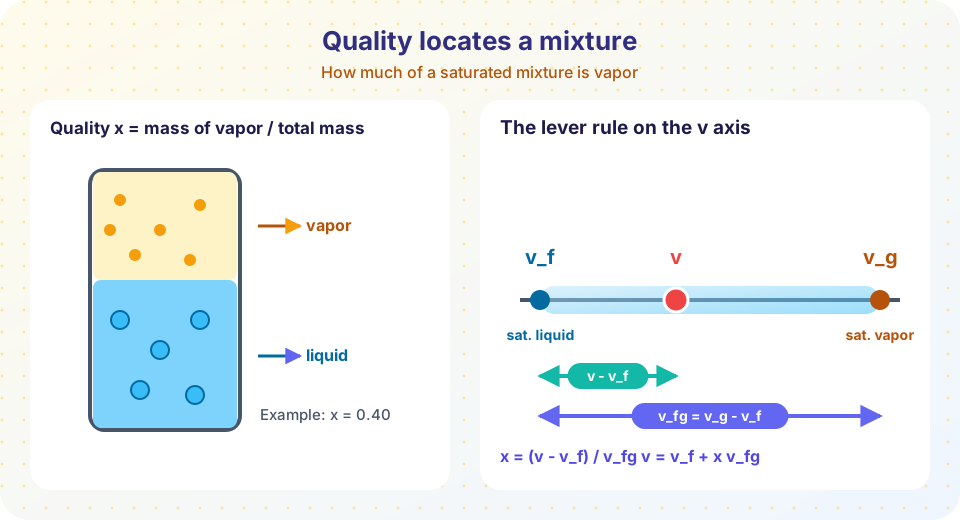
Inside the dome, P and T are tied together, so you need one more property. The natural one is the quality:
x = m_vapor / m_total
With x = 0 the state is saturated liquid and with x = 1 it is saturated vapor. The mixture has the mass-weighted average of the liquid and vapor properties:
v = v_f + x v_fg, u = u_f + x u_fg, h = h_f + x h_fg, s = s_f + x s_fg
Here v_fg = v_g − v_f. Rearranged, the quality is x = (v − v_f) / v_fg, which is the lever rule pictured above: how far the state sits between the liquid and vapor ends.
Example 1. A rigid vessel holds a mixture at 100 kPa with v = 0.5 m³/kg. Then x = (0.5 − 0.001043)/(1.6941 − 0.001043) = 0.295. The enthalpy is h = 417.51 + 0.295 × 2257.5 = 1,083 kJ/kg.
Example 2. A kettle's steam at 100 kPa has h = 2,200 kJ/kg. Then x = (2200 − 417.51)/2257.5 = 0.790: 79 % vapor by mass.
Quality is only defined inside the dome. If your calculated x is below 0 the state is compressed liquid, and if it is above 1 it is superheated vapor. Use that as a phase check.
Interpolation
When your pressure or temperature falls between table rows, interpolate linearly. For a property y between rows (x1, y1) and (x2, y2):
y = y1 + (x − x1)(y2 − y1)/(x2 − x1)
Example: the saturated vapor enthalpy at 550 kPa lies between 500 kPa (h_g = 2748.1) and 600 kPa (h_g = 2756.1): h_g ≈ 2748.1 + 0.5 × 8.0 = 2752.1 kJ/kg. Linear interpolation works well over small gaps; for wide gaps (say 100 kPa to 1 MPa) the curves bend and the error grows. Double interpolation (in both P and T) is needed for superheated states that fall between both rows and columns.
Common misconceptions
"Quality can be read for any steam." Only for saturated mixtures.
"x = 0.5 means half the volume is vapor." It means half the mass is vapor; the vapor takes far more volume.
"Specific volumes can be interpolated in a mixture." Use v = v_f + x v_fg rather than a table lookup in a single row.
Try it
The first block is a mixture calculator (it applies the lever rule using the table rows above). The second plots how enthalpy and specific volume change with quality at 100 kPa.
Press Run (or Ctrl + Enter) to see the result here.
Program input · what you'd type while the program runs
Type the answers before you press Run, one per line. Each time the program reads a line (with input()), it gets the next line from this box.
Press Run (or Ctrl + Enter) to see the result here.
Program input · what you'd type while the program runs
Type the answers before you press Run, one per line. Each time the program reads a line (with input()), it gets the next line from this box.
Check your understanding
Quick check · 5 questions
of 5 answered You scored / 5 · perfect!
-
1. A mixture at 100 kPa has x = 0.2. What is its enthalpy (hf = 417.51, hfg = 2257.5 kJ/kg)?
h = hf + x hfg = 417.51 + 0.2 x 2257.5 = 869.0 kJ/kg. -
2. You compute x = 1.3 from a specific volume. What does it mean?
Quality is limited to 0..1 inside the dome. Larger values signal superheated vapor. -
3. Which table do you use for water at 1 MPa and 300 C?
300 C is well above T_sat = 179.9 C at 1 MPa, so the vapor is superheated. -
4. What does x = 0.5 mean?
Quality is a mass fraction. -
5. Hg at 500 kPa is 2748.1 and at 600 kPa is 2756.1 kJ/kg. Interpolate hg at 520 kPa.
2748.1 + 0.2 x 8.0 = 2749.7 kJ/kg.
Summary
- Compare
TandPwith saturation to choose the saturated, superheated or compressed-liquid table. - Treat compressed liquid as saturated liquid at the same temperature.
- In a mixture
x = (v − v_f)/v_fgandy = y_f + x y_fgforv, u, h, s. - Interpolate linearly between close rows; quality outside 0 to 1 means the state is not a mixture.
Track your progress
Create a free account to tick off lessons and pick up where you left off on any device.
of Engineering Thermodynamics lessons completed