


















Lesson 5 of 48 · Getting Started
Chapter 1 Review: Getting Started
Review chapter 1 of engineering thermodynamics: systems, states, processes, SI units, absolute and gauge pressure, temperature scales and the zeroth law, with a 9-question quiz.
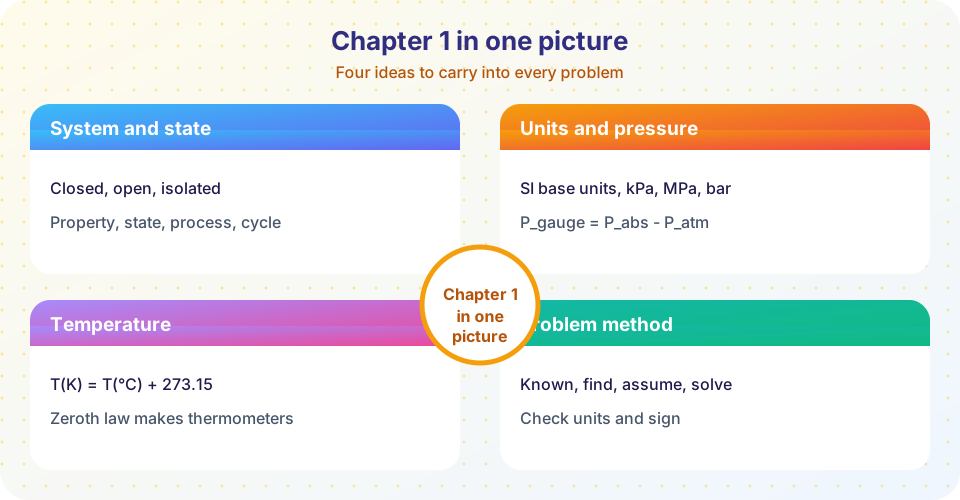
Chapter 1 gave you the alphabet of thermodynamics. You can now choose a system and draw its boundary, describe its state with properties, work in clean SI units, convert gauge pressure to absolute pressure and temperature to kelvin. Every later chapter relies on these four habits, so this review gathers them in one picture, one table and one longer quiz.
What you will learn
- Which chapter 1 ideas you already own and which need another look.
- How to combine them into a short, repeatable problem-solving routine.
- How to check your own work with units, absolute scales and sign checks.
Recap table
| Topic | The key rule | Common slip |
|---|---|---|
| Closed system | Fixed mass; heat and work may cross | Calling an insulated system "closed" automatically |
| Open system | Mass flows across the control surface | Forgetting the energy carried by the flow |
| Property | Depends only on the state (P, T, v, u, h, s) |
Treating heat or work as a property |
| Intensive vs extensive | Intensive do not scale with size; v = V/m |
Mixing V and v |
| Units | 1 kPa × 1 m³ = 1 kJ; 1 bar = 100 kPa |
Using litres or bar without converting |
| Pressure | P_gauge = P_abs − P_atm; ΔP = ρ g h |
Using gauge pressure in the ideal-gas law |
| Temperature | T(K) = T(°C) + 273.15 |
Using Celsius in ratios or the gas law |
| Zeroth law | Equal to a third body means equal to each other | Thinking contact is required |
A routine for every problem
- Sketch the system and boundary; label states 1, 2, ...
- List knowns and unknowns with units; convert to kg, m, s, K, kPa, kJ.
- State assumptions: closed or open, steady, ideal gas, quasi-equilibrium.
- Choose equations from the laws and property relations (the next chapters).
- Solve symbolically first, then plug in numbers; check that units cancel.
- Sanity-check the answer: sign, size and units. Is the temperature above absolute zero? Is the pressure positive?
A worked review problem
A rigid tank of volume 0.5 m³ holds a gas at a gauge pressure of 200 kPa on a day when P_atm = 100 kPa. The tank is heated from 20 °C to 120 °C. What are the absolute temperatures and the final absolute pressure if the gas behaves ideally?
T1 = 293.15 K,T2 = 393.15 K.P1 = 200 + 100 = 300 kPa(absolute).- Rigid tank means
Vand mass are constant, soP2/P1 = T2/T1, givingP2 = 300 × 393.15/293.15 = 402.3 kPa(absolute), or302.3 kPagauge.
Notice that using Celsius numbers would have predicted 300 × 120/20 = 1,800 kPa, a wrong answer by a factor of four. Absolute scales are not optional.
Try it
The first block packages this chapter's tools as small functions and tests them against known answers. The second is a quick calculator that combines the pressure and temperature conversions.
Press Run (or Ctrl + Enter) to see the result here.
Program input · what you'd type while the program runs
Type the answers before you press Run, one per line. Each time the program reads a line (with input()), it gets the next line from this box.
Check your understanding
Quick check · 9 questions
of 9 answered You scored / 9 · perfect!
-
1. A turbine with steam entering and leaving is best analyzed as
Mass flows through the device, so we draw a control volume around it. -
2. Which pair contains only extensive properties?
Mass and volume scale with the size of the system. Temperature, pressure, density and specific volume do not. -
3. How many independent intensive properties fix the state of a simple compressible substance?
The state postulate: two independent intensive properties are enough. -
4. A tire gauge reads 220 kPa at sea level (101.3 kPa). What is the absolute pressure?
Absolute = gauge + atmospheric = 220 + 101.3 = 321.3 kPa. -
5. What is the gauge pressure at 20 m depth in fresh water (rho = 1000 kg/m3, g = 9.81 m/s2)?
rho g h = 1000 x 9.81 x 20 = 196.2 kPa gauge (about 297 kPa absolute). -
6. Convert 127 degrees Celsius to kelvin.
127 + 273.15 = 400.15 K. -
7. Two objects are each in thermal equilibrium with a third. The zeroth law says the two objects
Equilibrium with a common third body means equal temperatures. -
8. A rigid sealed tank is heated from 300 K to 600 K. If the gas is ideal, the absolute pressure
At constant volume and mass, P is proportional to absolute T, so doubling T doubles P. -
9. Which is NOT a property?
Heat is energy transfer that depends on the path, not a property of a state.
Summary
- Choose the system, boundary and states before writing equations.
- Properties describe states; heat and work describe processes.
- Work in SI; use absolute pressure and kelvin in every equation.
- A six-step routine (sketch, list, assume, equations, solve, check) keeps problems under control.
Track your progress
Create a free account to tick off lessons and pick up where you left off on any device.
of Engineering Thermodynamics lessons completed