


















Lesson 27 of 48 · Power Cycles
Brayton cycle and gas turbines
Analyze the air-standard Brayton cycle for gas turbines and jet engines: pressure ratio, back work ratio, net work, real compressor and turbine losses, and regeneration.
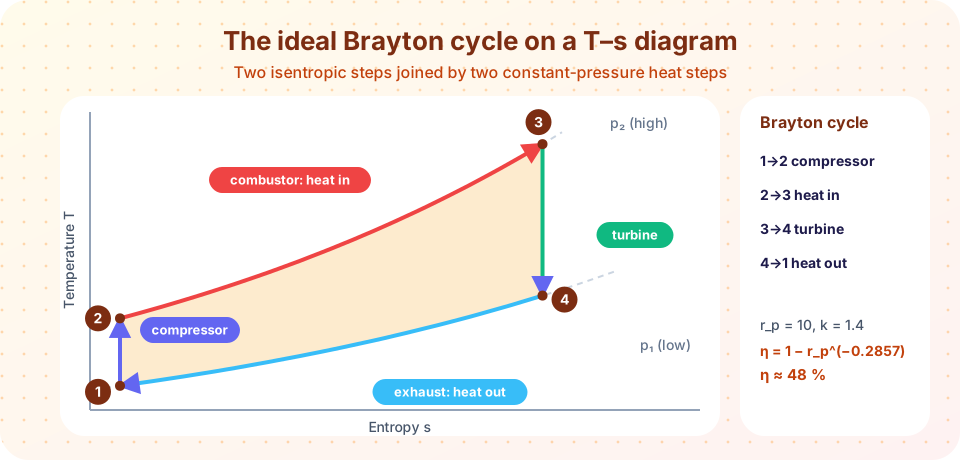
A gas turbine is a steady-flow engine with only three main parts: a compressor, a combustor and a turbine. Air enters, is compressed, heated by burning fuel, and expands through the turbine, which drives both the compressor and a load (a generator, a propeller or, in a jet, the thrust of the exhaust itself). The ideal model of this machine is the Brayton cycle, named after the American engineer George Brayton, and it powers aircraft, ships, peaking power stations and, combined with steam, the most efficient power plants in the world.
What you will learn
- Describe the four processes of the air-standard Brayton cycle.
- Calculate temperatures, work, heat, efficiency and back work ratio from the pressure ratio.
- Explain why a gas turbine wastes so much of its turbine work on the compressor.
- Estimate how component losses and regeneration change the result.
Key terms
Pressure ratio r_p is P₂ / P₁, compressor exit over inlet. Back work ratio is w_comp / w_turb, the fraction of turbine work spent driving the compressor. Turbine inlet temperature (TIT) is T₃, limited by blade materials. Isentropic efficiency compares real component work with the ideal isentropic work.
The four processes
With k = 1.4, c_p = 1.005 kJ/(kg·K):
- 1 → 2: isentropic compression,
T₂ = T₁ r_p^((k−1)/k);w_comp = c_p (T₂ − T₁). - 2 → 3: constant-pressure heat addition in the combustor,
q_in = c_p (T₃ − T₂). - 3 → 4: isentropic expansion in the turbine,
T₄ = T₃ / r_p^((k−1)/k);w_turb = c_p (T₃ − T₄). - 4 → 1: constant-pressure heat rejection,
q_out = c_p (T₄ − T₁).
Both heat steps are at constant pressure and both work steps are isentropic, so as with Otto the efficiency depends on a single ratio:
η_Brayton = 1 − 1 / r_p^((k−1)/k)
Gas turbines gain efficiency by raising the pressure ratio, just as piston engines gain by raising the compression ratio.
Worked example
Air enters the compressor at 300 K with r_p = 10, and the turbine inlet temperature is 1300 K.
T₂ = 300 × 10^0.2857 = 579.2 K,T₄ = 1300 / 1.9307 = 673.3 K.w_comp = 1.005 × (579.2 − 300) = 280.6 kJ/kg.w_turb = 1.005 × (1300 − 673.3) = 629.8 kJ/kg.w_net = 629.8 − 280.6 = 349.2 kJ/kg.q_in = 1.005 × (1300 − 579.2) = 724.4 kJ/kg.
η = 349.2 / 724.4 = 48.2 %
Notice the back work ratio: 280.6 / 629.8 = 44.6 %. Almost half of the turbine's output just drives the compressor. That differs sharply from the steam plant, where the pump took less than 1 % of the turbine work, because compressing a gas costs far more than pumping a liquid. This is also why gas turbines are very sensitive to compressor and turbine efficiency.
The best pressure ratio depends on what you want
Efficiency rises forever with r_p, but net work per kilogram of air does not. For fixed T₁ and T₃ the net work peaks at
r_p,opt = (T₃ / T₁)^(k / (2(k−1)))
For 300 K and 1300 K this is 4.333^1.75 = 13.0. A small, light engine (a jet fighter) is designed near the maximum of net work; a large power station, where fuel cost matters more than size, goes higher. At the work-maximizing ratio the compressor and turbine exits have the same temperature, T₂ = T₄ = 624.5 K here.
Real machines are not isentropic
A real compressor needs more work than the ideal one, and a real turbine produces less. With a compressor isentropic efficiency of 0.85 and a turbine efficiency of 0.88 in the same example:
T₂ = 300 + (579.2 − 300) / 0.85 = 628.5 K.T₄ = 1300 − 0.88 × (1300 − 673.3) = 748.5 K.w_comp = 330.1 kJ/kg,w_turb = 554.2 kJ/kg,w_net = 224.1 kJ/kg.q_in = 1.005 × (1300 − 628.5) = 674.9 kJ/kg, soη = 33.2 %.
The back work ratio has jumped to about 60 %, and efficiency has fallen from 48 % to 33 %. This is typical: a real simple-cycle gas turbine reaches 30 to 40 %.
Regeneration and combined cycles
The turbine exhaust at 748 K is hotter than the compressor exit at 628 K. A regenerator (a heat exchanger) lets the hot exhaust preheat the compressed air before the combustor, cutting the fuel needed. It only works when T₄ > T₂, which is why it helps at low pressure ratios and not at the work-maximizing one.
Large plants go further. The exhaust gas still contains lots of heat at 500 to 600 °C, so a combined cycle passes it through a boiler that produces steam for a Rankine cycle. Gas-turbine topping with steam bottoming gives modern plants efficiencies near 60 %, the highest of any large fuel-burning plant.
Jet engines use a Brayton cycle with a different goal: the turbine extracts only enough work to drive the compressor, and the remaining gas expands in a nozzle to produce thrust.
Common misconceptions
"The turbine produces the net work." Only the difference between turbine and compressor work is net. "Higher pressure ratio always gives more work." Net work per kilogram peaks and then falls. "A regenerator always helps." If T₄ < T₂ the exhaust is colder than the compressed air and the regenerator cannot heat it.
Try it
Press Run (or Ctrl + Enter) to see the result here.
Program input · what you'd type while the program runs
Type the answers before you press Run, one per line. Each time the program reads a line (with input()), it gets the next line from this box.
Press Run (or Ctrl + Enter) to see the result here.
Program input · what you'd type while the program runs
Type the answers before you press Run, one per line. Each time the program reads a line (with input()), it gets the next line from this box.
Check your understanding
Quick check · 5 questions
of 5 answered You scored / 5 · perfect!
-
1. In the ideal Brayton cycle heat is added at...
The combustor operates at essentially constant pressure. -
2. A Brayton cycle has r_p = 8 and k = 1.4. Which expression gives its efficiency?
η = 1 − 1/r_p^((k−1)/k) and (k−1)/k = 0.2857. -
3. Why is the back work ratio of a gas turbine so much larger than that of a steam plant?
Compressing a gas takes work proportional to its large specific volume, while liquid pumping takes v ΔP with a tiny v. -
4. What happens to real efficiency when compressor and turbine efficiencies drop?
Back work grows and net work shrinks. The example fell from 48.2 % to 33.2 %. -
5. When does a regenerator help a Brayton cycle?
The hot exhaust can preheat the compressed air only if T₄ is above T₂.
Summary
- Brayton: isentropic compression and expansion, constant-pressure heat addition and rejection;
η = 1 − 1/r_p^((k−1)/k). - Example:
r_p = 10, 300 K to 1300 K gives 48.2 % and a back work ratio of 44.6 %. - Real components cut the example to 33.2 %; net work peaks at
r_p = 13.0. - Regeneration and steam bottoming recover exhaust heat, giving combined-cycle plants near 60 %.
Next: Chapter 5 review
Track your progress
Create a free account to tick off lessons and pick up where you left off on any device.
of Engineering Thermodynamics lessons completed