


















Lesson 22 of 48 · The Second Law and Entropy
Chapter 4 Review: The Second Law and Entropy
Review chapter 4: Kelvin-Planck and Clausius, thermal efficiency and COP, Carnot limits, entropy change, entropy generation and isentropic efficiency, with a 9-question quiz.
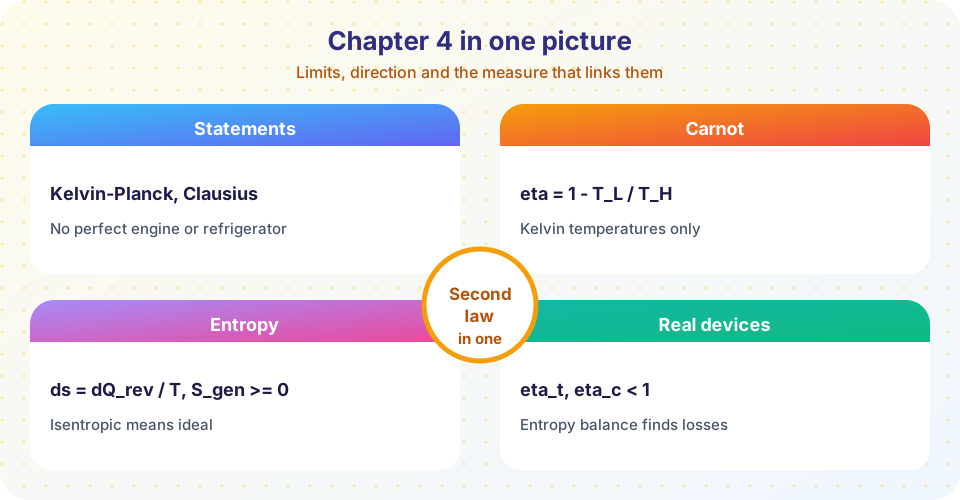
You have reached the end of the theory half of the course. The first law taught you to count energy; the second law taught you that conversions have a direction and a limit, and entropy gave you a number to measure it. Chapters 5 to 9 use both laws on real cycles and mixtures. This review gathers the second-law results on one page and tests them.
What you will learn
- The second-law formulas in one table.
- How to check whether a machine or process is possible.
- A test of the whole chapter.
Recap table
| Topic | Key result |
|---|---|
| Heat engine | η = W_net/Q_H = 1 − Q_L/Q_H |
| Refrigerator / heat pump | COP_R = Q_L/W, COP_HP = Q_H/W = COP_R + 1 |
| Kelvin-Planck | No cyclic engine converts all heat to work |
| Clausius | No cyclic device moves heat from cold to hot without work |
| Carnot | η = 1 − T_L/T_H; COP_R = T_L/(T_H − T_L); COP_HP = T_H/(T_H − T_L) |
| Entropy | dS = δQ_rev/T; ΔS_isolated ≥ 0 |
| Ideal gas | Δs = c_p ln(T₂/T₁) − R ln(P₂/P₁); isentropic: T₂/T₁ = (P₂/P₁)^((k−1)/k) |
| Entropy balance | ΔS = Σ Q/T + S_gen, S_gen ≥ 0 |
| Isentropic efficiency | η_t = Δh_actual/Δh_s; η_c = Δh_s/Δh_actual |
A three-question possibility test
For any claimed machine or process:
- First law: does the energy balance close?
- Second law (Carnot): is the efficiency (or COP) at or below the Carnot limit, with temperatures in kelvin?
- Entropy: is
S_gen ≥ 0, with the right boundary temperatures?
Worked review. An inventor claims an engine between 500 K and 300 K that takes 200 kJ and produces 90 kJ. First law: Q_L = 110 kJ, fine. Carnot limit: 1 − 300/500 = 0.40 and the claim is 90/200 = 0.45 > 0.40. It violates the second law. Entropy check: S_gen = Q_L/T_L − Q_H/T_H = 110/300 − 200/500 = 0.367 − 0.400 = −0.033 kJ/K < 0. Impossible, in agreement.
Try it
Press Run (or Ctrl + Enter) to see the result here.
Program input · what you'd type while the program runs
Type the answers before you press Run, one per line. Each time the program reads a line (with input()), it gets the next line from this box.
Check your understanding
Quick check · 9 questions
of 9 answered You scored / 9 · perfect!
-
1. An engine takes 400 kJ and rejects 250 kJ. Its efficiency is
W = 150 kJ and eta = 150/400 = 0.375. -
2. The Carnot efficiency between 900 K and 300 K is
1 - 300/900 = 0.667. -
3. A heat pump with COP 5 delivers 10 kW. The power input is
W = Q_H/COP = 10/5 = 2 kW. -
4. Which statement is equivalent to the Kelvin-Planck statement?
Violating either statement would allow violating the other. -
5. Air (cp = 1.005) is heated from 300 K to 600 K at constant pressure. The entropy change per kg is about
1.005 ln 2 = 0.697 kJ/kg K. -
6. S_gen for a process is found to be -0.05 kJ/K. This means the process
Entropy generation cannot be negative. -
7. A turbine has h1 = 3200, h2s = 2300 and h2 = 2500 kJ/kg. The isentropic efficiency is
(3200 - 2500)/(3200 - 2300) = 700/900 = 0.778. -
8. The thermodynamic reason a heat pump works better in mild weather is
COP_HP = T_H/(T_H - T_L) rises as the lift shrinks. -
9. 1200 kJ flows from 600 K to 400 K. The entropy generated is
1200/400 - 1200/600 = 3 - 2 = 1 kJ/K.
Summary
- Engines reject heat;
η ≤ 1 − T_L/T_Hand COPs follow the same Carnot logic. - Entropy is a property with
ΔS ≥ ΣQ/TandS_gen ≥ 0; isentropic means reversible and adiabatic. - Isentropic efficiency compares real turbines and compressors with the ideal.
- Use the three-question test (first law, Carnot limit, entropy generation) on any claim.
Track your progress
Create a free account to tick off lessons and pick up where you left off on any device.
of Engineering Thermodynamics lessons completed