


















Lesson 2 of 48 · Getting Started
Systems, States and Processes
Learn to choose a thermodynamic system and boundary, describe its state with properties, and tell isobaric, isothermal, isochoric and adiabatic processes and cycles apart.
Every thermodynamics problem begins with a choice that nobody else can make for you: what are you looking at? The gas inside a cylinder, the water flowing through a pump, the whole refrigerator. Once you draw a line around the thing you care about, everything crossing the line is something you can count, and everything inside it is something you can describe by a short list of numbers. This lesson gives you the vocabulary for both steps.
What you will learn
- The difference between a closed system, an open system (control volume) and an isolated system.
- What a property and a state are, and why two independent properties fix the state of a simple substance.
- How intensive and extensive properties differ, and what specific volume means.
- How to describe a process by its path and recognize the four classic processes and a cycle.
Key terms
Boundary: the real or imaginary surface separating the system from its surroundings.
Property: any measurable quantity that depends only on the state, such as P, T, V, m.
State: the condition of a system described completely by its properties.
Process: a change from one state to another; the path is the series of states in between.
Cycle: a process whose final state equals its initial state.
Systems and boundaries
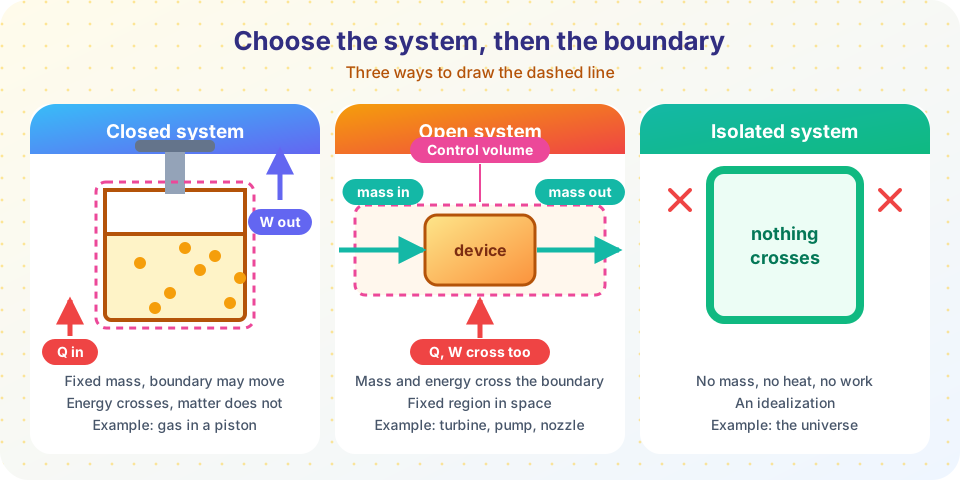
A system is the quantity of matter or region of space chosen for study. Everything else is the surroundings, and the surface between them is the boundary. The boundary can be real (the cylinder wall) or imaginary (a dashed line drawn across a pipe), fixed or moving (a piston face).
- A closed system (also called a control mass) contains a fixed amount of matter. Energy can cross the boundary as heat or work but mass cannot. Gas trapped in a piston-cylinder is the classic example.
- An open system (a control volume) is a region of space with mass flowing through it. A turbine, a pump, a nozzle or a whole jet engine is usually analyzed this way. The boundary is called the control surface.
- An isolated system exchanges neither mass nor energy with anything. It is a useful idealization (the universe is the only perfect example).
There is no single correct system for a problem, but there is usually a smart one. To study a balloon being inflated from a tank, you could choose the balloon plus tank as a closed system, or the balloon alone as an open system with mass flowing in. Both work; one makes the algebra much simpler.
Properties and state
A property describes the system at an instant and does not care how it got there. Pressure, temperature, volume, mass, density and later energy, enthalpy and entropy are properties. Heat and work are not properties: they describe energy in transit during a process.
Properties come in two kinds:
- Extensive properties scale with the size of the system: mass
m, volumeV, total energyE. Cut the system in half and these halve. - Intensive properties do not: temperature
T, pressureP, densityρ. Cut the system in half and they stay the same.
Dividing an extensive property by the mass gives a specific property, which is intensive. The most common are specific volume v = V/m (m³/kg), the reciprocal of density ρ = m/V (kg/m³). Lowercase letters mean "per unit mass" throughout this course: u, h, s, v.
A state is the complete set of property values. Remarkably, for a simple compressible substance (a pure substance without electrical, magnetic or surface effects) the state postulate says that two independent intensive properties fix the state. For a gas, T and v do; for steam, P and T do, unless it is in the middle of boiling, where P and T are no longer independent (you will see why in lesson 2.2).
Equilibrium and quasi-equilibrium processes
Thermodynamics describes equilibrium states: states in which nothing changes without outside influence. Equilibrium has several parts: thermal (no temperature differences), mechanical (no pressure imbalances), phase and chemical equilibrium.
A real process pushes a system out of equilibrium, so how can we use state properties along a path? We imagine a quasi-equilibrium (quasi-static) process: one so slow that the system is always infinitesimally close to equilibrium. Compressing a gas slowly with a piston is a good approximation. Slamming the piston in violently is not, because pressure then differs from place to place, and no single value of P describes the whole gas.
Processes and cycles
A process takes a system from state 1 to state 2. Plotting it on a property diagram (pressure against volume, say) shows its path. Four paths appear everywhere:
| Process | Constant property | Typical ideal-gas path on a P-V plot |
|---|---|---|
| Isobaric | pressure | horizontal line |
| Isochoric (isometric) | volume | vertical line |
| Isothermal | temperature | hyperbola, P V = constant |
| Adiabatic (reversible) | no heat transfer (isentropic) | steeper curve, P V^k = constant |
Here k = cp/cv is the specific heat ratio (about 1.4 for air, a number you will meet in chapter 3). A cycle is a sequence of processes that returns to the start. All engines and refrigerators operate in cycles, because they must keep working. On a P-V plot a cycle is a closed loop, and the area inside the loop equals the net work (you will prove this in lesson 3.2).
A process is also steady if properties at each point do not change with time (the flow through a running turbine), and uniform if properties are the same everywhere in the region. These words matter in chapter 3.
A worked example
A gas starts at P1 = 500 kPa and V1 = 0.2 m³ and expands to V2 = 0.6 m³. Take the isobaric path: the pressure stays at 500 kPa, the path is a horizontal line, and the area under it is 500 kPa × 0.4 m³ = 200 kJ. If instead the gas expands isothermally, P falls as P = P1 V1 / V, so P2 = 500 × 0.2 / 0.6 = 166.7 kPa. The two paths end at different states even though they start at the same one, and the area under each curve is different. This is why heat and work are path functions and properties are point functions.
Common misconceptions
"A closed system is one that is insulated." Closed means no mass crosses. A closed system can still exchange heat and work.
"Heat and work are properties of a system." They are energy transfers during a process; a system does not "contain" heat or work.
"Temperature and pressure always fix the state." For a liquid-vapor mixture they are linked, so you need another property such as quality (lesson 2.3).
Try it
The first block draws the four classic processes on a P-V diagram from the same starting state, and the second plots a rectangular cycle and computes its net work from the area enclosed.
Press Run (or Ctrl + Enter) to see the result here.
Program input · what you'd type while the program runs
Type the answers before you press Run, one per line. Each time the program reads a line (with input()), it gets the next line from this box.
Press Run (or Ctrl + Enter) to see the result here.
Program input · what you'd type while the program runs
Type the answers before you press Run, one per line. Each time the program reads a line (with input()), it gets the next line from this box.
Check your understanding
Quick check · 5 questions
of 5 answered You scored / 5 · perfect!
-
1. A sealed, insulated gas cylinder with a movable piston and a fixed mass of gas is best called
The mass is fixed, so it is closed. It is not isolated because the piston lets it exchange work with the surroundings. -
2. Which of these is an intensive property?
Temperature does not depend on how much material there is. Volume, mass and total energy scale with size. -
3. A system has 2 kg and occupies 0.5 m3. What is its specific volume?
v = V/m = 0.5 m3 / 2 kg = 0.25 m3/kg. Its density is the reciprocal, 4 kg/m3. -
4. Why are heat and work not properties?
Properties are fixed by the state. Heat and work are energy transfers that differ along different paths between the same two states. -
5. A process that returns a system to its initial state is called
A cycle ends where it started, so all properties return to their original values.
Summary
- Choose a system and its boundary first; closed systems have fixed mass, open systems (control volumes) have flow, isolated systems exchange nothing.
- Properties depend only on the state; two independent properties fix the state of a simple compressible substance.
- Extensive properties scale with size; dividing by mass gives intensive specific properties (
v = V/m). - Quasi-equilibrium processes are slow enough that state properties are defined at every step.
- Heat and work depend on the path; a cycle returns to its start, and its
P-Vloop area is the net work.
Track your progress
Create a free account to tick off lessons and pick up where you left off on any device.
of Engineering Thermodynamics lessons completed