


















Lesson 14 of 48 · The First Law
Energy Balance for Control Volumes
Derive the steady-flow energy equation: mass conservation, flow work, why enthalpy h = u + Pv appears, and how to apply it to ducts, heaters and pipes with worked numbers.
Most real thermodynamic equipment is open: air flows through a compressor, steam through a turbine, coolant through a radiator. You cannot follow a fixed mass of fluid through them easily; instead you stand still, draw a boundary around the device (a control volume) and count what flows in and out. This lesson extends the first law to open systems and explains where enthalpy comes from.
What you will learn
- The mass balance for a control volume and the mass flow rate
ṁ = A V / v. - Why pushing fluid into a control volume costs flow work
P vand gives rise to enthalpy. - The steady-flow energy equation in rate and per-kilogram form.
- When kinetic and potential energy can be neglected.
Key terms
Mass flow rate ṁ: mass crossing a section per unit time (kg/s), ṁ = ρ A V = A V / v.
Flow work: work needed to push a unit mass of fluid into or out of the control volume, P v.
Steady flow: properties at every point of the control volume do not change with time, so dm_cv/dt = 0 and dE_cv/dt = 0.
Enthalpy h: h = u + P v, the energy carried by flowing fluid per unit mass.
Conservation of mass
For a control volume, the rate of change of stored mass equals the mass flowing in minus the mass flowing out:
dm_cv/dt = Σ ṁ_in − Σ ṁ_out
At steady state the right side is zero: Σ ṁ_in = Σ ṁ_out. For a single stream, ṁ₁ = ṁ₂. The mass flow rate through a section of area A with average velocity V is ṁ = ρ A V = A V / v.
Example. Water (ρ = 1000 kg/m³) flows through a 50 mm diameter pipe at 2 m/s. A = π (0.05)²/4 = 1.963 × 10⁻³ m², so ṁ = 1000 × 1.963 × 10⁻³ × 2 = 3.93 kg/s.
Example. Air at 100 kPa and 300 K (ρ = P/(R T) = 100/(0.287 × 300) = 1.161 kg/m³) flows at 10 m/s in a duct of 0.1 m²: ṁ = 1.161 × 0.1 × 10 = 1.16 kg/s.
Flow work and enthalpy
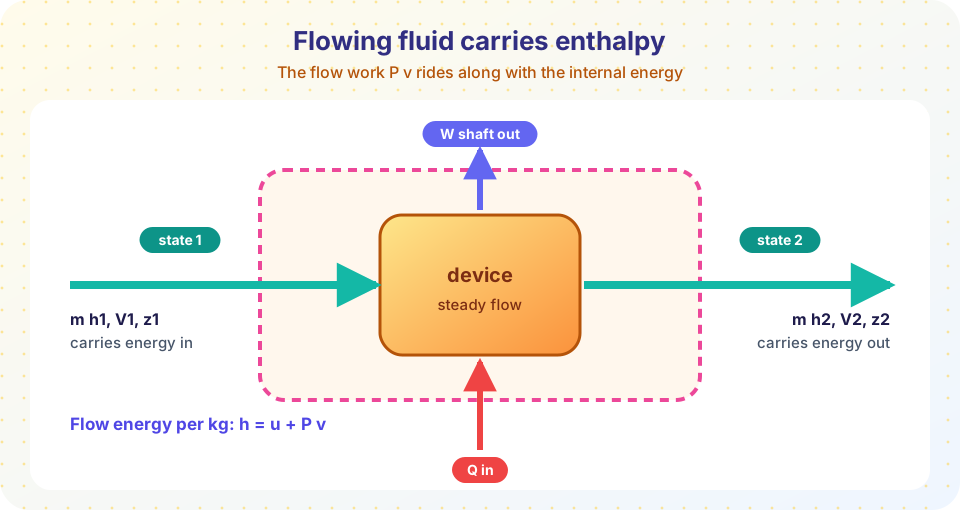
Fluid entering the control volume must be pushed in against the pressure inside. Imagine a slug of mass m and volume V at pressure P entering through an area A. The pushing force is P A acting through a length V/A, so the work is P V for the slug, or P v per unit mass. This flow work is not extra energy; it is energy supplied by the surrounding fluid.
So each kilogram of fluid crossing the boundary carries u + P v + V²/2 + g z. Because u + P v appears together, it is given its own name: enthalpy h = u + P v. That is the entire reason enthalpy exists as a property: it packages the internal energy and the flow work.
The steady-flow energy equation
With the energy carried in and out by mass, heat, and shaft work:
Q̇ − Ẇ = Σ ṁ_out (h + V²/2 + g z) − Σ ṁ_in (h + V²/2 + g z)
For a single stream steady flow, divide by ṁ:
q − w = (h₂ − h₁) + (V₂² − V₁²)/2 + g (z₂ − z₁)
where q = Q̇/ṁ and w = Ẇ/ṁ are in kJ/kg. Mind the units: V²/2 comes out in m²/s² = J/kg, so divide by 1,000 to get kJ/kg.
When can you neglect KE and PE?
A speed of 30 m/s corresponds to V²/2 = 450 J/kg = 0.45 kJ/kg; an elevation change of 10 m gives g z = 98 J/kg = 0.098 kJ/kg. Enthalpy changes in turbines or compressors are tens to hundreds of kJ/kg, so KE and PE are usually negligible there. In nozzles, where the purpose is to change speed, KE is the main term.
Example: duct heater. Air flows through a duct at ṁ = 0.05 kg/s, and a heater adds Q̇ = 2 kW. With no work and negligible KE and PE: Q̇ = ṁ c_p ΔT, so ΔT = 2 / (0.05 × 1.005) = 39.8 K.
Unsteady (filling and emptying) flow
When a tank is being filled, mass and energy inside change with time. The general balance is dE_cv/dt = Q̇ − Ẇ + Σ ṁ_in θ_in − Σ ṁ_out θ_out with θ = h + V²/2 + g z. In the uniform-state, uniform-flow approximation you integrate over the filling time. Studying these cases is a fine project for the later chapters; here we concentrate on steady flow.
Common misconceptions
"Enthalpy is the heat content of a system." It is a property combining u and P v; heat is transferred energy.
"Flow work is lost." It is an exchange: the fluid behind pushes fluid in and the fluid ahead is pushed out, so the book-keeping is included in h.
"Steady means no change from inlet to outlet." Steady means no change with time at a given point; properties may differ between inlet and outlet.
Try it
First, a mass-flow and duct-heater calculator. Then a plot showing why kinetic energy is negligible at low speeds but matters at high speeds, by comparing V²/2 with typical enthalpy changes.
Press Run (or Ctrl + Enter) to see the result here.
Program input · what you'd type while the program runs
Type the answers before you press Run, one per line. Each time the program reads a line (with input()), it gets the next line from this box.
Press Run (or Ctrl + Enter) to see the result here.
Program input · what you'd type while the program runs
Type the answers before you press Run, one per line. Each time the program reads a line (with input()), it gets the next line from this box.
Check your understanding
Quick check · 5 questions
of 5 answered You scored / 5 · perfect!
-
1. Why is enthalpy defined as h = u + Pv?
Fluid entering a control volume carries its internal energy plus the flow work P v needed to push it in. -
2. Water (1000 kg/m3) flows at 3 m/s through a pipe of area 0.002 m2. The mass flow rate is
m = rho A V = 1000 x 0.002 x 3 = 6 kg/s. -
3. In steady flow, which quantity is zero for the control volume?
Steady flow means no change with time inside the control volume. -
4. A stream's speed rises from 0 to 30 m/s. The kinetic energy per kg increases by
V^2/2 = 900/2 = 450 J/kg = 0.45 kJ/kg. -
5. An air heater adds 3 kW to 0.1 kg/s of air (cp = 1.005 kJ/kg K). The temperature rise is about
dT = 3 / (0.1 x 1.005) = 29.9 K.
Summary
- Mass:
Σ ṁ_in = Σ ṁ_outin steady flow, withṁ = A V / v. - Flow work
P vplusugives enthalpyh; flowing fluid carriesh + V²/2 + g z. - Steady flow:
Q̇ − Ẇ = Σ ṁ_out θ_out − Σ ṁ_in θ_in, orq − w = Δh + ΔKE + ΔPEper kg. - KE and PE are often negligible, except in nozzles and high-speed flows.
Next: Steady-Flow Devices
Track your progress
Create a free account to tick off lessons and pick up where you left off on any device.
of Engineering Thermodynamics lessons completed