


















Lesson 21 of 48 · The Second Law and Entropy
Entropy Balance and Isentropic Efficiency
Write entropy balances for closed and open systems, compute entropy generation, and use isentropic efficiency to compare real turbines, compressors and nozzles with ideal ones.
The first law is a balance of energy: what comes in minus what goes out equals what is stored. The second law gets its own balance, but with a twist: entropy can be created. The amount created tells you how irreversible a process is, and therefore how much useful work was wasted. In this lesson you write entropy balances, compute S_gen, and meet isentropic efficiency, the measure engineers use to rate real turbines, compressors and pumps.
What you will learn
- The entropy balance for closed systems and control volumes.
- How to compute entropy generation and decide whether a process is possible.
- Isentropic efficiency of turbines, compressors, pumps and nozzles.
- How to apply them to steam and air with worked examples.
Key terms
Entropy generation S_gen: entropy produced inside the system by irreversibilities; S_gen ≥ 0.
Entropy transfer: entropy carried by heat (Q/T_b, with T_b the boundary temperature) and by mass (ṁ s).
Isentropic efficiency: ratio of actual to ideal (isentropic) work for a turbine, or ideal to actual for a compressor.
Lost work: work potential destroyed by irreversibility, T_0 S_gen.
Entropy balance
Entropy change = entropy transfer in − out + entropy generated:
ΔS_system = Σ Q_k/T_k + S_gen
For a control volume in rate form at steady state:
0 = Σ Q̇_k/T_k + Σ ṁ_in s_in − Σ ṁ_out s_out + Ṡ_gen
so for a single stream, Ṡ_gen = ṁ (s₂ − s₁) − Σ Q̇_k/T_k. Entropy generation is never negative: S_gen > 0 means irreversible, S_gen = 0 reversible, S_gen < 0 impossible. This gives a test for whether a proposed process is possible, regardless of the first law.
Example 1: heat conduction. 1,000 kJ conducts from a 500 K reservoir to a 300 K reservoir. Taking both as the system: S_gen = 1000/300 − 1000/500 = 1.33 kJ/K. Possible and irreversible. Lost work potential (with T_0 = 300 K): T_0 S_gen = 400 kJ, which is the work a Carnot engine could have extracted from that flow (1000 × (1 − 300/500) = 400 kJ).
Example 2: a questionable compressor. Air at 100 kPa and 300 K is compressed adiabatically to 600 kPa and 450 K in steady flow. Does it satisfy the second law? Δs = 1.005 ln(450/300) − 0.287 ln 6 = 0.4075 − 0.5142 = −0.107 kJ/(kg·K). For an adiabatic device s_gen = Δs, which is negative, so impossible: air cannot be compressed to 600 kPa with only 150 K temperature rise. The minimum exit temperature is the isentropic one, about 500 K.
Isentropic efficiency
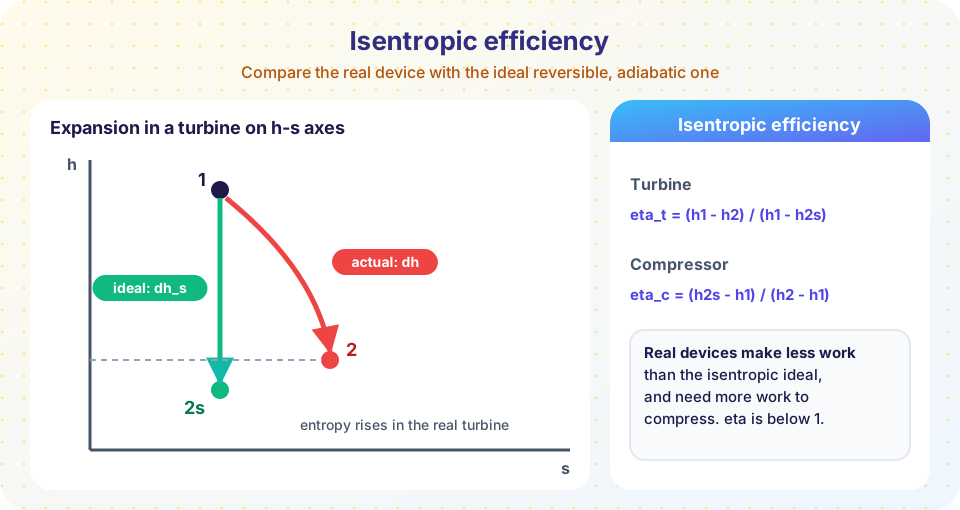
An isentropic process is the ideal limit for an adiabatic device. We compare actual performance with it using states 1 (inlet), 2 (actual exit) and 2s (isentropic exit at the same exit pressure, s₂s = s₁).
Turbine: η_t = w_actual / w_isentropic = (h₁ − h₂)/(h₁ − h₂s)
Compressor or pump: η_c = w_isentropic / w_actual = (h₂s − h₁)/(h₂ − h₁)
Nozzle: η_N = V₂² / V₂s² (ratio of actual to isentropic exit kinetic energy).
Typical values: turbines 80 to 90 %, compressors 75 to 85 %, pumps 70 to 85 %.
Example 3: steam turbine. Steam enters at 4 MPa and 400 °C (h₁ = 3213.6 kJ/kg, s₁ = 6.769 kJ/(kg·K)) and leaves at 10 kPa. At 10 kPa: s_f = 0.6492, s_fg = 7.4996, h_f = 191.81, h_fg = 2392.1. The isentropic exit has x₂s = (6.769 − 0.6492)/7.4996 = 0.816 and h₂s = 191.81 + 0.816 × 2392.1 = 2143.8 kJ/kg, so w_s = 3213.6 − 2143.8 = 1069.8 kJ/kg. If the actual exit enthalpy is h₂ = 2344.7 kJ/kg (quality 0.90, as in lesson 3.5), w = 868.9 kJ/kg and η_t = 868.9/1069.8 = 0.812.
Example 4: air compressor. Air at 100 kPa and 300 K is compressed to 600 kPa with η_c = 0.80. Isentropic exit temperature T₂s = 300 × 6^(0.2857) ≈ 500.6 K. Then w_s = 1.005 × 200.6 = 201.6 kJ/kg and the actual work w = 201.6/0.80 = 251.9 kJ/kg, giving T₂ = 300 + 251.9/1.005 = 550.7 K. The 20 % inefficiency costs an extra 50 kJ/kg of work and a hotter exit.
Common misconceptions
"A 100 % isentropic efficiency is an engineering target." It is a limit; real machines have friction and turbulence.
"Entropy generation is destroyed energy." Energy is conserved; what is lost is the quality (potential to do work).
"Heat transfer always increases the system's entropy." Heat out lowers the entropy of the system; it is the total, including surroundings, that cannot decrease.
Try it
Press Run (or Ctrl + Enter) to see the result here.
Program input · what you'd type while the program runs
Type the answers before you press Run, one per line. Each time the program reads a line (with input()), it gets the next line from this box.
Press Run (or Ctrl + Enter) to see the result here.
Program input · what you'd type while the program runs
Type the answers before you press Run, one per line. Each time the program reads a line (with input()), it gets the next line from this box.
Check your understanding
Quick check · 5 questions
of 5 answered You scored / 5 · perfect!
-
1. In a steady adiabatic device, the entropy generated per kg equals
With no heat transfer, s_gen = s_out - s_in, which must be >= 0. -
2. A turbine has h1 = 3000, h2s = 2200 and h2 = 2400 kJ/kg. Its isentropic efficiency is
eta = (3000 - 2400) / (3000 - 2200) = 600/800 = 0.75. -
3. Compressor isentropic efficiency is defined as
The ideal compressor needs less work, so the ratio ideal/actual is below 1. -
4. An adiabatic process calculates s2 - s1 = -0.2 kJ/kg K. This means
Entropy generation cannot be negative, so the process cannot occur. -
5. 1500 kJ flows from 600 K to 300 K. The entropy generated is
1500/300 - 1500/600 = 5 - 2.5 = 2.5 kJ/K.
Summary
ΔS = Σ Q/T + S_gen, withS_gen ≥ 0; a negative result means the process is impossible.- Isentropic efficiency compares real devices with the ideal:
η_t = Δh_actual/Δh_s,η_c = Δh_s/Δh_actual. - Lost work is
T₀ S_gen; irreversibility wastes work potential, not energy. - Real turbines and compressors typically reach 75 to 90 % of the ideal.
Next: Chapter 4 Review
Track your progress
Create a free account to tick off lessons and pick up where you left off on any device.
of Engineering Thermodynamics lessons completed