


















Lesson 45 of 48 · Projects and Practice
Practice problem set
Eight mixed practice problems on cycles, refrigeration, gas mixtures, humid air and combustion, with a method checklist and a solver that checks your answers.
Reading about thermodynamics is not the same as solving problems. This lesson gives you eight problems that range across Chapters 5 to 8, a checklist for tackling any thermodynamics problem and a script that prints the answers so you can check your work. Try each problem on paper first.
What you will learn
- Apply a consistent five-step method to thermodynamics problems.
- Practice calculations with cycles, refrigeration, mixtures, humid air and combustion.
- Check your answers and learn from the common slips.
Key terms
Knowns and unknowns are the quantities given and requested. Model is the set of assumptions, such as ideal gas, steady flow or adiabatic. Sanity check is a quick estimate that shows whether an answer is plausible, for example an efficiency above the Carnot value.
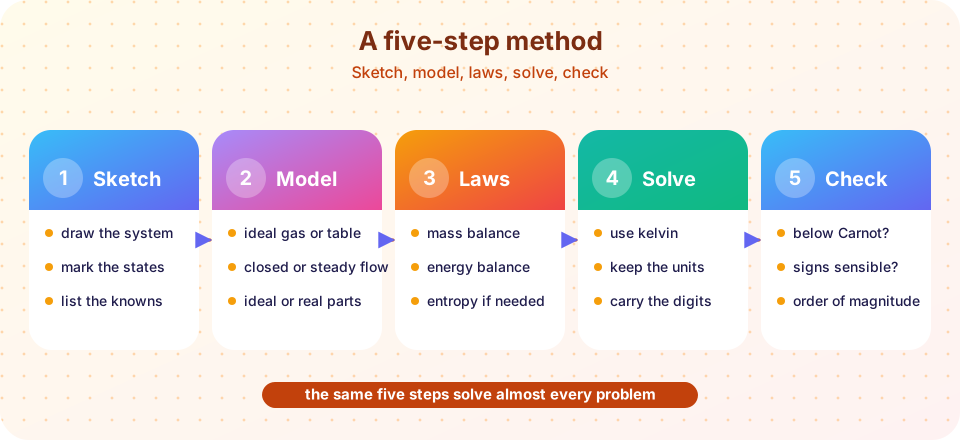
The five-step method
- Sketch the system and list what is known and what is asked. Draw the boundary and the state points.
- Choose the model: ideal gas or tables, steady flow or closed system, reversible or with losses.
- Write the conservation laws: mass, energy, and entropy if the second law is involved.
- Solve with units: keep kelvin for temperature ratios and kJ/kg for specific energies.
- Sanity-check: compare with a limit (Carnot, 100 % efficiency, saturation) and with order-of-magnitude values you know.
The problems
Problem 1: Carnot. A heat engine receives heat at 900 K and rejects it at 300 K. What is the maximum possible efficiency?
Problem 2: Rankine. A simple Rankine cycle has h₂ = 200, h₃ = 3400, h₄ = 2300 kJ/kg and a pump work of 5 kJ/kg (all illustrative values). Find the thermal efficiency.
Problem 3: Otto. An ideal Otto cycle with k = 1.4 has a compression ratio of 10. The intake air is at 290 K. Find the thermal efficiency and the temperature at the end of compression.
Problem 4: Brayton. An ideal Brayton cycle with k = 1.4 has a pressure ratio of 12. Find its thermal efficiency.
Problem 5: Refrigerator. A refrigerator removes 3 kW of heat from its cold space with a COP of 2.5. Find the compressor power and the heat rejected to the room.
Problem 6: Gas mixture. A tank contains 2 kmol of N₂, 1 kmol of O₂ and 1 kmol of CO₂ at 400 kPa. Find the partial pressures and the molar mass of the mixture (28, 32 and 44 kg/kmol).
Problem 7: Humid air. Air at 30 °C and 70 % relative humidity is at 101.325 kPa. The saturation pressure at 30 °C is 4.247 kPa. Find the humidity ratio and the dew-point temperature.
Problem 8: Combustion. Propane (C₃H₈, 44.097 kg/kmol) burns with 10 % excess air. Find the air-fuel ratio by mass and the CO₂ percentage in the dry products.
Hints
- Problem 2:
η = (w_turbine − w_pump) / q_inwithw_turbine = h₃ − h₄andq_in = h₃ − h₂. - Problem 3:
T₂ = T₁ r^(k−1)andη = 1 − 1/r^(k−1). - Problem 5:
COP = Q_L / W, andQ_H = Q_L + W. - Problem 7:
ω = 0.622 P_v / (P − P_v); the dew point is the saturation temperature atP_v. - Problem 8: theoretical oxygen is
x + y/4 = 5; with excess air the supply is5 × 1.1, and the leftover O₂ is0.5kmol.
Try it
Press Run (or Ctrl + Enter) to see the result here.
Program input · what you'd type while the program runs
Type the answers before you press Run, one per line. Each time the program reads a line (with input()), it gets the next line from this box.
Press Run (or Ctrl + Enter) to see the console output here.
No output.
Check your understanding
Quick check · 4 questions
of 4 answered You scored / 4 · perfect!
-
1. Which step of the method guards against impossible answers?
Comparing with known limits catches errors like an efficiency above Carnot. -
2. A heat engine claims 70 % efficiency between 300 K and 800 K. Is this possible?
1 − 300/800 = 0.625, which no engine can exceed. -
3. In the mixture problem, which gas has the largest partial pressure?
N2 is half the moles, so it carries half the pressure. -
4. Why use kelvin in Otto and Brayton calculations?
Formulas such as T₂ = T₁ r^(k−1) are only valid for absolute temperatures.
Summary
- Use the five-step method: sketch, model, conservation laws, solve with units, sanity-check.
- Cycle problems reduce to enthalpy or temperature differences; refrigeration to COP and energy balance.
- Mixtures use mole fractions; humid air uses
ωand saturation pressure; combustion uses atom balances. - Always compare the answer against a physical limit.
Next: Glossary
Track your progress
Create a free account to tick off lessons and pick up where you left off on any device.
of Engineering Thermodynamics lessons completed