


















Lesson 4 of 48 · Getting Started
Temperature and the Zeroth Law
Understand thermal equilibrium, the zeroth law, Celsius, Kelvin, Fahrenheit and Rankine scales, absolute zero and the constant-volume gas thermometer with worked conversions.
Everyone has a feel for hot and cold, but feelings make poor engineering data. Put one hand in warm water and the other in cold, then plunge both into lukewarm water and each hand reports something different. To build engines and refrigerators we need temperature to be an objective number. This lesson shows what that number really means, why a thermometer works, and why engineers always convert to kelvin.
What you will learn
- What thermal equilibrium is and how the zeroth law makes temperature measurable.
- How Celsius, Kelvin, Fahrenheit and Rankine relate, and how to convert between them.
- Why absolute zero exists and how a gas thermometer points to it.
- When to use a temperature difference instead of a temperature level.
Key terms
Thermal equilibrium: the state in which two bodies in contact stop changing and no heat flows between them.
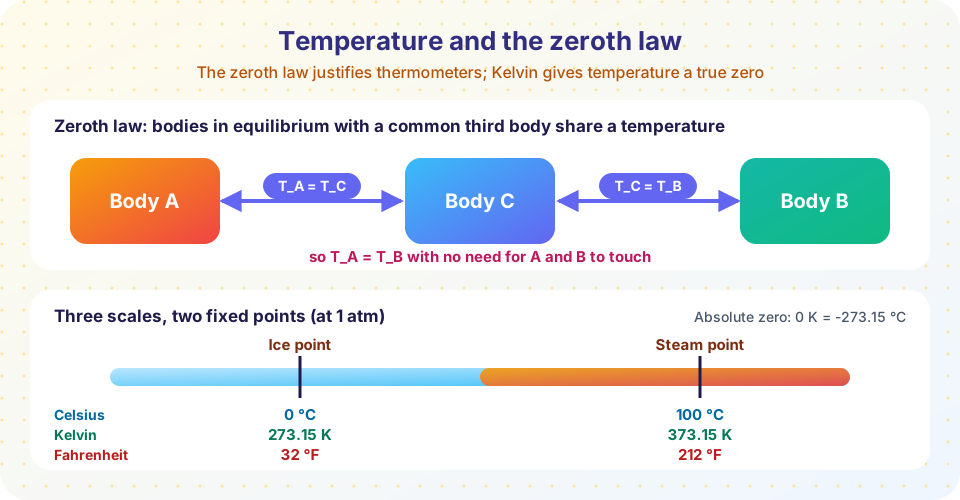
Zeroth law: if A and B are each in thermal equilibrium with C, then A and B are in equilibrium with each other.
Absolute zero: the lowest possible temperature, 0 K = −273.15 °C.
Absolute temperature: temperature measured from absolute zero (kelvin or rankine).
Thermal equilibrium and the zeroth law
Place a hot metal block against a cool one. Heat flows from the hot block to the cold one until nothing changes any more: they have reached thermal equilibrium, and we say they have the same temperature. Heat flows because of a temperature difference, always from higher to lower; this is the everyday meaning of "hot" and "cold" in thermodynamics.
The zeroth law of thermodynamics states that if body A is in thermal equilibrium with body C, and body B is also in thermal equilibrium with C, then A and B are in thermal equilibrium with each other. It sounds obvious, and it was named "zeroth" because it was recognized as a basis for the first and second laws only after those were already famous. Its power is practical: body C can be a thermometer. If a mercury thermometer reads the same when touching A and when touching B, you know A and B have equal temperatures without ever bringing A and B together.
Temperature scales
A scale needs reference points that anyone can reproduce. Two historical choices were the freezing and boiling points of water at atmospheric pressure.
- Celsius (°C): ice point 0 °C, steam point 100 °C.
- Fahrenheit (°F): ice point 32 °F, steam point 212 °F. So 100 Celsius degrees span 180 Fahrenheit degrees.
Neither has a natural zero. Thermodynamic equations (the ideal-gas law, efficiency of engines) need an absolute scale, in which zero means the complete absence of thermal motion:
- Kelvin (K): the SI unit, with
T(K) = T(°C) + 273.15. The kelvin is the same size as a Celsius degree. - Rankine (°R): the absolute scale in Fahrenheit-size steps,
T(°R) = T(°F) + 459.67 = 1.8 T(K).
Since 2019 the kelvin is defined by fixing the Boltzmann constant at exactly k = 1.380649 × 10⁻²³ J/K. For practical work, remember the triple point of water, where ice, liquid and vapor coexist, is 273.16 K (0.01 °C).
| Conversion | Formula |
|---|---|
| °C to K | T(K) = T(°C) + 273.15 |
| °C to °F | T(°F) = 1.8 T(°C) + 32 |
| °F to °C | T(°C) = (T(°F) − 32) / 1.8 |
| K to °R | T(°R) = 1.8 T(K) |
Example 1. Room temperature 25 °C is 298.15 K and 1.8 × 25 + 32 = 77 °F.
Example 2. The surface of a steam pipe is at 350 K. In Celsius, 350 − 273.15 = 76.85 °C.
Example 3. A heater raises water from 20 °C to 80 °C. The change is ΔT = 60 °C = 60 K (a difference in Celsius equals a difference in kelvin) and 108 °F (since 60 × 1.8). Never add 273.15 to a difference.
Use kelvin for every equation that contains a temperature level (ideal gas law, Carnot efficiency, entropy). Use either K or °C for differences, but never mix them in one expression.
The gas thermometer and absolute zero
How could anyone decide that nothing can be colder than −273.15 °C? One clue comes from a constant-volume gas thermometer: a rigid bulb filled with a low-density gas, connected to a pressure gauge. Immerse the bulb at a series of known temperatures and plot pressure against temperature. For many different gases and amounts, the points fall on straight lines. Extend each line backwards and they all hit zero pressure at the same temperature, about −273.15 °C. Since pressure cannot go negative, this is the natural origin of the temperature scale, and for an ideal gas P is directly proportional to absolute temperature T.
A caveat: real gases liquefy before reaching absolute zero, so the line is an extrapolation, not a measurement. The third law of thermodynamics also says absolute zero can be approached but never reached in a finite number of steps. Laboratories have reached billionths of a kelvin, but never zero.
Common misconceptions
"Doubling the Celsius temperature doubles the heat." Only absolute temperature has a meaningful zero, so ratios of Celsius values mean nothing. 40 °C is not "twice as hot" as 20 °C; the ratio of absolute temperatures is 313.15 / 293.15 ≈ 1.07.
"Temperature measures heat." Temperature measures the thermal state; heat is energy in transit because of a temperature difference. A bathtub of warm water holds far more thermal energy than a hot spark.
"Metal feels colder than wood, so it is colder." Both are at room temperature; metal conducts heat away from your hand faster.
Try it
The first block converts a list of temperatures and checks the two fixed points. The second simulates a constant-volume gas thermometer using the ideal-gas model and extrapolates to absolute zero (a demonstration, not a measurement).
Press Run (or Ctrl + Enter) to see the result here.
Program input · what you'd type while the program runs
Type the answers before you press Run, one per line. Each time the program reads a line (with input()), it gets the next line from this box.
Press Run (or Ctrl + Enter) to see the result here.
Program input · what you'd type while the program runs
Type the answers before you press Run, one per line. Each time the program reads a line (with input()), it gets the next line from this box.
Check your understanding
Quick check · 5 questions
of 5 answered You scored / 5 · perfect!
-
1. What does the zeroth law allow us to do?
If A and B each match C, they match each other, so a third body (the thermometer) can compare them without contact. -
2. Convert 20 degrees Celsius to kelvin.
T(K) = 20 + 273.15 = 293.15 K. -
3. A temperature rises by 25 K. What is the rise in degrees Celsius?
A kelvin and a Celsius degree are the same size, so differences are identical. -
4. Which temperature should you use in the ideal-gas law?
The ideal-gas law relies on proportionality to absolute temperature, so kelvin (or rankine) is required. -
5. Why do the pressure lines of different gases in a constant-volume thermometer meet at -273.15 degrees C?
For an ideal gas at constant volume P is proportional to T in kelvin, so P extrapolates to zero when T = 0 K.
Summary
- Bodies in thermal equilibrium have equal temperature; the zeroth law makes thermometers meaningful.
T(K) = T(°C) + 273.15,T(°F) = 1.8 T(°C) + 32,T(°R) = 1.8 T(K).- Absolute zero (0 K) is the natural origin; use kelvin whenever a temperature level appears in an equation.
- Temperature differences are the same in K and °C; ratios of Celsius values are meaningless.
Next: Chapter 1 Review
Track your progress
Create a free account to tick off lessons and pick up where you left off on any device.
of Engineering Thermodynamics lessons completed