


















Lesson 10 of 48 · Properties and State
Chapter 2 Review: Properties and State
Review chapter 2: phases of water, the T-v dome, saturated mixtures and quality, the ideal gas law, compressibility and how to pick the right property tool, with a 9-question quiz.
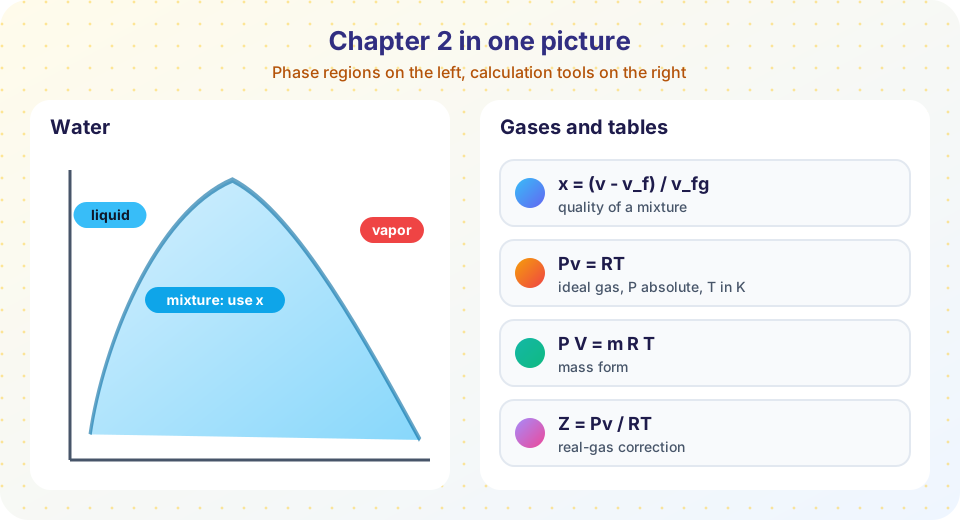
Chapter 2 gave you the tools that turn two known properties into every other property. This review puts the chapter on one page: which region of the dome you are in, which tool applies there, and the handful of formulas you will use again and again in the energy and entropy chapters.
What you will learn
- A decision path from given properties to the correct property tool.
- The formulas of the chapter in one table.
- Where your understanding still needs work, by answering a nine-question quiz.
Recap table
| Situation | Tool | Key relation |
|---|---|---|
P above P_sat(T) |
Compressed liquid | v ≈ v_f(T), h ≈ h_f(T) |
On the dome, two properties incl. x |
Saturated tables | y = y_f + x y_fg |
Mixture, v known |
Lever rule | x = (v − v_f)/v_fg |
P below P_sat(T) |
Superheated tables | read v, u, h, s; interpolate |
Gas at low P_r, high T_r |
Ideal gas | P v = R T, R = R_u/M |
| Gas near critical | Generalized chart | Z = P v/(R T) |
| Critical point of water | Landmark | 22.064 MPa, 373.95 °C |
A decision path
- Is it water or a refrigerant? Compare
PwithP_sat(T)(orTwithT_sat(P)). - Above the dome (compressed liquid) or to the right (superheated)? Open the matching table.
- On the dome? You need a third piece of information:
x,v,hors. - Is it a gas such as air, far from condensing? Use
P v = R Tand checkZ.
Worked review. Steam at 1 MPa has v = 0.1 m³/kg. From the 1 MPa row (v_f = 0.001127, v_g = 0.19437) it is a mixture with x = (0.1 − 0.001127)/(0.19437 − 0.001127) = 0.5117 and h = 762.51 + 0.5117 × 2013.6 = 1,792.8 kJ/kg. Compare air at 1 MPa and 400 K with v = R T/P = 0.287 × 400/1000 = 0.1148 m³/kg: a gas and a mixture can have similar volumes but are described by completely different tools.
Try it
Press Run (or Ctrl + Enter) to see the result here.
Program input · what you'd type while the program runs
Type the answers before you press Run, one per line. Each time the program reads a line (with input()), it gets the next line from this box.
Check your understanding
Quick check · 9 questions
of 9 answered You scored / 9 · perfect!
-
1. Water at 200 C has a saturation pressure of about 1555 kPa. At 500 kPa and 200 C it is
500 kPa is below P_sat, so the water cannot stay liquid; it is superheated vapor. -
2. How many independent properties are needed to fix the state of a saturated mixture?
P and T are dependent in the dome, so use one of them plus x or v, for example. -
3. For compressed liquid at ordinary pressure, a good approximation for h is
Liquid enthalpy depends strongly on temperature and only weakly on pressure. -
4. A mixture has v = vf + 0.4 vfg. Its quality is
By definition x = (v - vf)/vfg = 0.4. -
5. Which gas has the largest specific gas constant here?
R = R_u/M, and helium has the smallest molar mass of the four. -
6. Air at 101 kPa and 300 K is best treated with
At low reduced pressure and high reduced temperature, Z is essentially 1. -
7. What is the pressure at the critical point of water?
The critical point of water is 22.064 MPa and 373.95 C. -
8. A computed quality of -0.1 means the state is
Negative x means the specific volume is below vf: compressed liquid. -
9. Z = 0.7 for a gas indicates that
Z = Pv/RT, so v = 0.7 R T / P, 30 percent below the ideal-gas value.
Summary
- Locate the state relative to the dome, then choose tables, the lever rule or the ideal gas law.
- In a mixture
y = y_f + x y_fgandx = (v − v_f)/v_fg. P v = R Tfor gases far from condensation; useZotherwise.- Next up: the first law uses these properties to count energy.
Track your progress
Create a free account to tick off lessons and pick up where you left off on any device.
of Engineering Thermodynamics lessons completed