


















Lesson 35 of 48 · Gas Mixtures and Psychrometrics
Properties of humid air
Calculate humidity ratio, relative humidity, dew point, wet-bulb temperature, enthalpy and specific volume of moist air and read them off a psychrometric chart.
Air is never completely dry. Even in a desert it holds some water vapor, and on a warm, humid day up to about 3 % of its mass may be water. That vapor changes how comfortable air feels, how fast clothes dry, whether windows fog and how much energy an air conditioner must use, because condensing water releases a lot of heat. To handle all of this we treat moist air as an ideal-gas mixture of two components: dry air and water vapor.
What you will learn
- Define humidity ratio, relative humidity, dew point and wet-bulb temperature.
- Compute
ω,handvof moist air from temperature and relative humidity. - Explain how a sling psychrometer and the adiabatic saturation process give wet-bulb temperature.
- Read a psychrometric chart.
Key terms
Humidity ratio ω = m_v / m_a, kilograms of vapor per kilogram of dry air. Relative humidity φ = P_v / P_g, where P_g is the saturation pressure at the air temperature. Dew-point temperature T_dp is the temperature at which vapor starts to condense when air is cooled at constant ω. Wet-bulb temperature T_wb is the temperature read by a thermometer wrapped in a wet wick in moving air. Dry-bulb temperature is the ordinary air temperature.
The mixture model
Atmospheric pressure P is the sum of the dry-air partial pressure P_a and the vapor partial pressure P_v (Dalton's law): P = P_a + P_v. At normal conditions the vapor is superheated (its pressure is well below saturation), so treating it as an ideal gas works well. From the ideal gas law for each component:
ω = (M_v / M_a) × P_v / P_a = 0.622 × P_v / (P − P_v)
where 0.622 = 18.015 / 28.97. Relative humidity compares the actual vapor pressure to the maximum possible at that temperature:
φ = P_v / P_g(T), so P_v = φ P_g.
Using φ we find that ω = 0.622 φ P_g / (P − φ P_g).
Enthalpy is measured per kilogram of dry air because the dry-air mass stays constant through heating, cooling and humidifying. With T in °C:
h = c_p,a T + ω h_g ≈ 1.005 T + ω (2501 + 1.82 T) in kJ per kg of dry air.
Specific volume is also per kilogram of dry air: v = R_a T / P_a, with R_a = 0.287 kJ/(kg·K).
Dew point and wet bulb
The dew point is easy to find: cool air at constant pressure and ω (so constant P_v) until P_v equals the saturation pressure. So T_dp is the saturation temperature that corresponds to P_v. If a glass of cold drink fogs up, its surface is below the dew point of the room air.
The wet-bulb temperature is harder, but the idea is physical. Evaporation cools the wet wick. The drier the air, the more water evaporates and the lower the wet-bulb reading. At 100 % relative humidity there is no evaporation, so T_wb = T_db. A closely related quantity is the adiabatic saturation temperature, obtained when air flows over a long water surface in an insulated duct until it is saturated. It follows from an energy balance and for air-water mixtures is almost equal to the wet-bulb temperature. A sling psychrometer (two thermometers, one with a wet wick, whirled in the air) uses the two readings to find φ or ω.
Always T_dp ≤ T_wb ≤ T_db, with all three equal at saturation.
Worked example
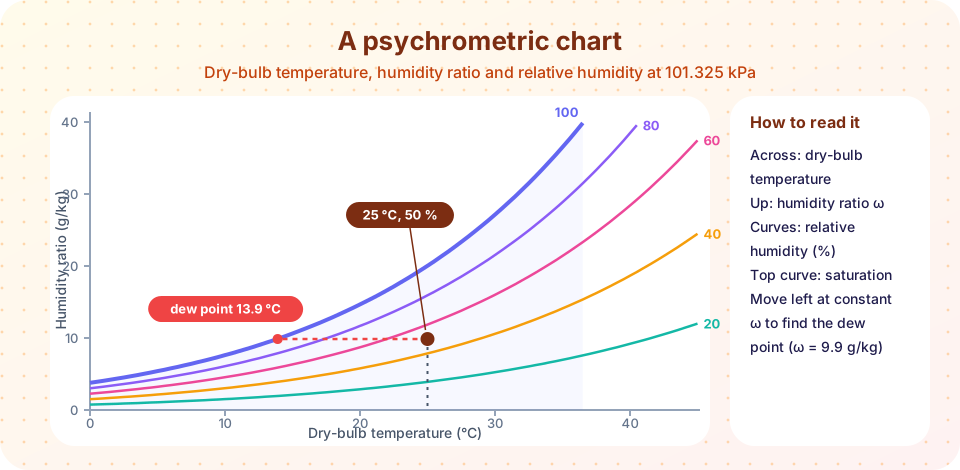
Air at 25 °C and 50 % relative humidity, at 101.325 kPa. The saturation pressure at 25 °C is P_g = 3.17 kPa (from tables).
P_v = 0.5 × 3.17 = 1.585 kPa, soP_a = 101.325 − 1.585 = 99.74 kPa.ω = 0.622 × 1.585 / 99.74 = 0.00988 kg/kg(about 9.9 g of vapor per kg of dry air).h = 1.005 × 25 + 0.00988 × (2501 + 1.82 × 25) = 25.13 + 25.16 = 50.3 kJ/kg.v = 0.287 × 298.15 / 99.74 = 0.858 m³ per kg dry air.- Dew point: the temperature where
P_g = 1.585 kPa, about 13.9 °C. - Wet bulb: solving the adiabatic saturation balance gives about 17.9 °C.
For a 60 m³ room at these conditions, the dry air mass is 60 / 0.858 = 69.9 kg and the water vapor mass is 69.9 × 0.00988 = 0.69 kg.
Reading the psychrometric chart
A psychrometric chart puts all these relations on one page. Dry-bulb temperature runs along the bottom, humidity ratio up the right-hand side, curves of constant relative humidity sweep up and to the right, and the top curve is saturation (100 %). Slanted lines give wet-bulb temperature and enthalpy, and a family of steeper lines gives specific volume. Given any two independent properties (for example dry-bulb and relative humidity) you can find a point, and then read the rest. Processes such as heating, cooling and humidifying become straight lines or paths between points, as the next lesson shows.
Note that the chart is drawn for a specific total pressure, usually sea-level 101.325 kPa. At high altitude, ω for a given P_v is larger, and you need a chart (or formulas) for the local pressure.
Common misconceptions
"Relative humidity is the percentage of water in the air." It is a ratio of pressures, and it changes with temperature even when the amount of water stays the same: cool air and its φ rises. "Dew point depends on relative humidity only." It depends on ω (that is, P_v) alone. "Dry-bulb and wet-bulb are two different air temperatures." Only the dry-bulb is the air temperature; the wet bulb is a temperature set by the evaporation balance.
Try it
The calculators below use a formula for saturation pressure instead of steam tables, so their last digit can differ slightly from the table-based hand calculations above (for example, 0.00986 instead of 0.00988).
Press Run (or Ctrl + Enter) to see the result here.
Program input · what you'd type while the program runs
Type the answers before you press Run, one per line. Each time the program reads a line (with input()), it gets the next line from this box.
Press Run (or Ctrl + Enter) to see the result here.
Program input · what you'd type while the program runs
Type the answers before you press Run, one per line. Each time the program reads a line (with input()), it gets the next line from this box.
Check your understanding
Quick check · 6 questions
of 6 answered You scored / 6 · perfect!
-
1. Air at 30 °C has P_v = 2.12 kPa and P_g = 4.25 kPa. What is the relative humidity?
φ = P_v / P_g = 2.12 / 4.25 = 0.499, about 50 %. -
2. Why is enthalpy of moist air given per kilogram of dry air?
The dry-air mass flow is constant in a duct, so it is the natural basis. -
3. Which ordering is always true?
They are equal at saturation; otherwise dew point is lowest and dry-bulb highest. -
4. If you cool air at constant pressure without removing moisture, which quantity stays constant?
ω depends on the mass of vapor and dry air, which do not change until condensation begins. -
5. What does a wet-bulb temperature equal to the dry-bulb temperature tell you?
With no evaporation possible, the wick stays at the air temperature. -
6. In the worked example (25 °C, 50 %), roughly how much water vapor is in each kilogram of dry air?
ω = 0.00988 kg/kg, about 9.9 g.
Summary
- Moist air is a mixture of dry air and water vapor:
P = P_a + P_v. ω = 0.622 P_v/(P − P_v),φ = P_v/P_g,h ≈ 1.005 T + ω(2501 + 1.82 T),v = R_a T / P_a.- Dew point is the saturation temperature at
P_v; wet bulb comes from the evaporation (adiabatic saturation) balance. - The example at 25 °C and 50 % gives
ω = 0.00988,h = 50.3 kJ/kg, dew point 13.9 °C, wet bulb about 17.9 °C.
Track your progress
Create a free account to tick off lessons and pick up where you left off on any device.
of Engineering Thermodynamics lessons completed