


















Lesson 40 of 48 · Combustion and Applications
The first law for reacting systems
Extend the first law to chemical reactions: enthalpy of formation, heat of combustion, higher and lower heating values, and a steady-flow energy balance for a burner.
In earlier chapters the first law dealt with kinetic, potential and internal energy. When a fuel burns, a new kind of energy matters: the energy stored in chemical bonds. Breaking weak bonds in the fuel and oxygen and forming strong bonds in CO₂ and H₂O leaves surplus energy, which appears as heat. To apply the first law to reactions we need a common zero for enthalpy across all substances, and that is what the enthalpy of formation provides.
What you will learn
- Use enthalpy of formation to write the enthalpy of any substance.
- Compute the heat of combustion and the higher and lower heating values.
- Write the steady-flow energy balance for a combustion chamber.
- Estimate the heat released when products leave hot.
Key terms
Enthalpy of formation h_f° is the enthalpy change when 1 kmol of a compound forms from its elements in their stable forms at 25 °C and 1 atm. By convention, h_f° = 0 for stable elements (O₂, N₂, H₂, C as graphite). Sensible enthalpy Δh = h(T) − h(298 K) is the thermal part. Heat of combustion is the heat released when fuel burns completely, with reactants and products both at 25 °C. HHV and LHV are the higher and lower heating values.
Absolute enthalpy
The enthalpy of a substance at temperature T is the sum of two parts:
h̄(T) = h̄_f° + (h̄(T) − h̄°_298)
The first term is its chemical energy relative to the elements; the second is the ordinary sensible enthalpy above 298 K. For an ideal gas the second term is taken from tables or from c_p. With this convention the first law for a steady-flow combustion chamber with negligible kinetic and potential energy is
Q − W = Σ_P n_p h̄_p − Σ_R n_r h̄_r
(P are products, R reactants). The heat transfer Q is negative when heat leaves the chamber.
Heat of combustion
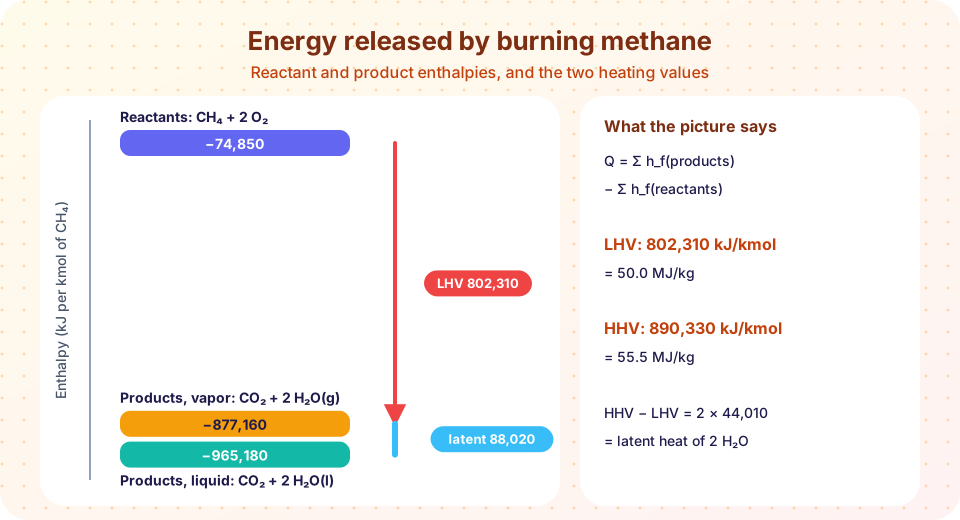
If reactants enter and products leave at 25 °C, then W = 0 and Q = Σ_P n_p h_f,p° − Σ_R n_r h_f,r°. For methane burning to gaseous water:
CH₄ + 2 O₂ → CO₂ + 2 H₂O(g)
with h_f° values in kJ/kmol: CH₄ −74,850; CO₂ −393,520; H₂O(g) −241,820; H₂O(l) −285,830.
Q = (−393,520 + 2 × (−241,820)) − (−74,850) = −802,310 kJ/kmol
So 802,310 kJ is released per kmol of methane. Divide by the molar mass: 802,310 / 16.043 = 50,010 kJ/kg. The nitrogen in air drops out of this accounting because it enters and leaves at the same temperature and has h_f° = 0.
Higher and lower heating values
If the water in the products is liquid the energy of condensation is recovered; if it is vapor it is not. So there are two heating values:
- LHV (lower heating value): products contain water vapor.
- HHV (higher heating value): products contain liquid water.
HHV = LHV + (mass of water per kg fuel) × h_fg.
For methane with liquid water: Q = (−393,520 + 2 × (−285,830)) − (−74,850) = −890,330 kJ/kmol, so HHV = 55,490 kJ/kg. The difference per kmol is 2 × 44,010 = 88,020 kJ, the latent heat of 2 kmol of water.
| Fuel | HHV (MJ/kg) | LHV (MJ/kg) |
|---|---|---|
| Hydrogen | 141.8 | 120.0 |
| Methane | 55.5 | 50.0 |
| Propane | 50.3 | 46.4 |
| Octane (liquid) | 47.9 | 44.4 |
| Ethanol (liquid) | 29.7 | 26.8 |
Engine and turbine performance is usually quoted on the LHV because the exhaust leaves hot. Utilities quoting boiler efficiency on the HHV and the LHV differ by several percent for natural gas, a classic source of confusion.
A burner with hot products
Methane at 25 °C burns with theoretical air at 25 °C in a steady-flow chamber, and the products leave at 400 K. How much heat is lost? The sensible enthalpies above 298 K at 400 K are (kJ/kmol, rounded): CO₂ 4,008; H₂O(g) 3,452; N₂ 2,971.
Products: 1 CO₂ + 2 H₂O + 7.52 N₂. Their sensible enthalpy is 4,008 + 2 × 3,452 + 7.52 × 2,971 = 33,254 kJ/kmol of fuel. Then
Q = −802,310 + 33,254 = −769,056 kJ/kmol, or −47,940 kJ/kg.
Heat removed is 96 % of the lower heating value, because 4 % of the energy leaves as hot sensible enthalpy of the exhaust. That is the logic of heat recovery: the lower the exhaust temperature, the more of the fuel's energy ends up as useful heat.
Common misconceptions
"Enthalpy of formation is the heat of the reaction." Heat of reaction combines the h_f° of products and reactants; h_f° is a property of one substance. "Nitrogen takes no part in the energy balance." It carries sensible enthalpy when the temperature changes, which matters a lot at flame temperature. "HHV is always the right number." It applies only when the water condenses and the latent heat is used.
Try it
Press Run (or Ctrl + Enter) to see the result here.
Program input · what you'd type while the program runs
Type the answers before you press Run, one per line. Each time the program reads a line (with input()), it gets the next line from this box.
Press Run (or Ctrl + Enter) to see the result here.
Program input · what you'd type while the program runs
Type the answers before you press Run, one per line. Each time the program reads a line (with input()), it gets the next line from this box.
Check your understanding
Quick check · 6 questions
of 6 answered You scored / 6 · perfect!
-
1. What is the enthalpy of formation of O2 at 25 °C and 1 atm?
By convention, stable elements have zero enthalpy of formation. -
2. Why is the HHV of a hydrocarbon larger than its LHV?
HHV assumes the water leaves as liquid, so the latent heat is also released. -
3. Methane releases 802,310 kJ per kmol (LHV). What is the LHV per kilogram?
802,310 / 16.043 = 50,010 kJ/kg. -
4. In a steady-flow combustion chamber with W = 0 and products hot, Q is...
Q = H_products − H_reactants, and the more energy the hot products carry out, the less heat leaves through the walls. -
5. Which fuel has the highest LHV per kilogram?
Hydrogen has about 120 MJ/kg, more than twice methane. -
6. A condensing boiler recovers extra energy by...
It uses the latent heat that the LHV leaves out.
Summary
- Absolute enthalpy:
h̄ = h̄_f° + Δh̄, withh_f° = 0for stable elements. - Heat of combustion from enthalpies of formation: methane LHV 802,310 kJ/kmol (50.0 MJ/kg), HHV 890,330 kJ/kmol (55.5 MJ/kg).
- HHV counts condensing the water; LHV does not.
- Hot products carry away sensible enthalpy: 400 K exhaust costs about 4 % of the methane LHV.
Track your progress
Create a free account to tick off lessons and pick up where you left off on any device.
of Engineering Thermodynamics lessons completed